
Work slang meaning can be confusing because the word “work” has different meanings depending on the conversation, workplace, social media platform, or online community. While work normally means doing a job or completing a task, slang can give the word a more casual, humorous, or completely different meaning. People may use “work” to talk about effort, success, a job, money, personal projects, or even something impressive they have accomplished.
You may see phrases such as “work it,” “put in work,” “that works,” “work on yourself,” or “work bestie” in texts, TikTok comments, Instagram captions, and everyday conversations. Understanding these expressions can help you communicate more naturally and avoid misunderstandings.
In this guide, we will explain the work slang meaning, where these expressions come from, how people use them, examples in conversations, related slang terms, and common misconceptions. Whether you encountered “work” in a text message, social media post, or workplace conversation, this article will help you understand what it means.
What Is the Work Slang Meaning?
The basic work slang meaning is usually connected to effort, achievement, hustle, or getting something done, but the exact meaning depends heavily on context.
In casual English, “work” can be used as a shortened or informal way of expressing several ideas.
For example:
- “Put in work” = Make a serious effort.
- “Work it” = Show confidence or perform impressively.
- “That works” = That idea or arrangement is acceptable.
- “It’s working” = Something is successful or producing the desired result.
- “Work bestie” = A close friend or favorite coworker.
- “Work on yourself” = Improve your habits, personality, skills, or lifestyle.
- “Work smarter, not harder” = Find a more efficient way to accomplish something.
Therefore, work slang does not have one fixed definition. The phrase or sentence surrounding the word usually tells you what the speaker means.
Work Meaning in Standard English vs. Slang
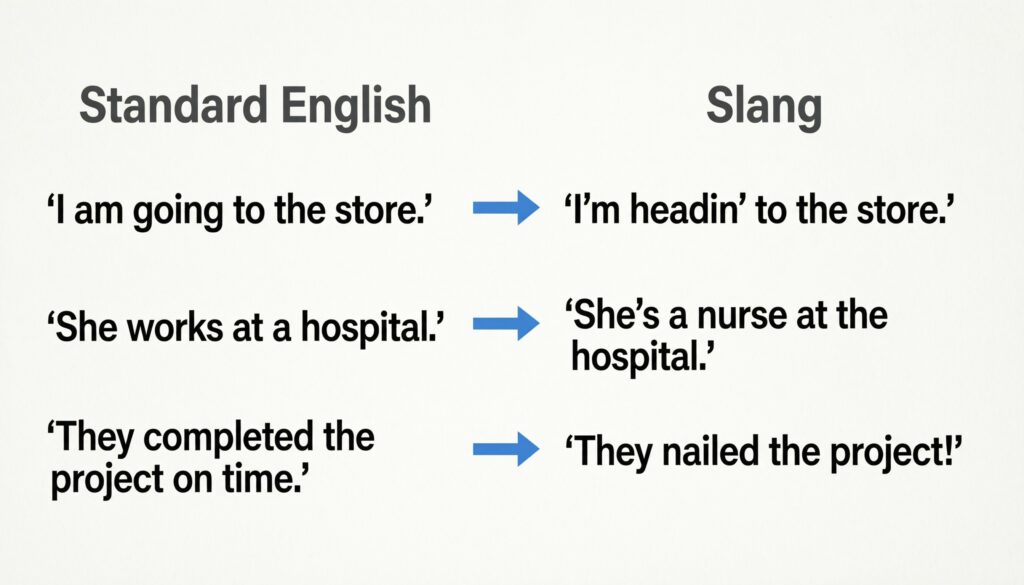
The word “work” has a traditional meaning that is different from many of its slang uses.
| Usage | Meaning | Example |
|---|---|---|
| Standard English | A job or employment | “I have work tomorrow.” |
| Standard English | An activity requiring effort | “This project needs more work.” |
| Slang | Serious effort | “You need to put in work.” |
| Slang | Perform confidently | “Work it!” |
| Casual expression | Something is successful | “This plan works.” |
| Internet slang | Improvement or progress | “I’m working on myself.” |
| Workplace slang | Close coworker | “She’s my work bestie.” |
This distinction is important because someone saying “work” in a casual conversation may not be talking about their actual job.
Why Do People Use “Work” as Slang?
Language constantly changes. Words that originally had one meaning can develop additional meanings through music, movies, social media, sports, and everyday conversations.
The word work became especially flexible because effort and achievement are common subjects in modern conversations.
People frequently talk about:
- Career goals
- Making money
- Fitness
- Studying
- Relationships
- Personal development
- Side hustles
- Entrepreneurship
- Social media success
- Creative projects
As a result, “work” can describe much more than traditional employment.
For example, someone might say:
“I’ve been putting in work at the gym.”
They are not talking about their workplace. They mean they have been training hard and making an effort.
Similarly:
“She really put in the work for that exam.”
Here, “work” refers to studying and preparation.
“Put in Work” Slang Meaning
One of the most common expressions is “put in work.”
It means to make a serious effort, work hard, practice consistently, or do what is necessary to achieve a goal.
Examples
Fitness:
“He’s been putting in work at the gym.”
Meaning: He has been training hard.
School:
“If you want good grades, you have to put in work.”
Meaning: You need to study and make an effort.
Career:
“She put in the work and finally got promoted.”
Meaning: She worked hard and earned the promotion.
Relationships:
“A healthy relationship takes work.”
Meaning: Maintaining a strong relationship requires effort.
This expression is often motivational and positive.
“Work It” Slang Meaning
“Work it” can mean to perform confidently, show off a particular skill, or make the most of a situation.
It is often associated with confidence, fashion, dancing, modeling, or performance.
For example:
“That outfit looks amazing. Work it!”
The speaker is encouraging someone to confidently show off their outfit.
It can also be used jokingly:
“You got a promotion? Work it!”
Here, the phrase celebrates someone’s success.
Depending on context, “work it” can sound encouraging, playful, fashionable, or humorous.
“That Works” Slang Meaning
You may frequently see people respond with:
“That works.”
In casual conversation, this usually means:
“That is acceptable,” “That is a good idea,” or “That arrangement is fine with me.”
For example:
Person A: “Can we meet at 6 instead of 5?”
Person B: “Yeah, that works.”
Here, “works” does not mean employment. It means the suggested plan is suitable.
Other examples include:
- “Tomorrow works for me.”
- “That excuse works.”
- “This solution works.”
- “Friday works better.”
This is extremely common in texting and everyday spoken English.
“Work on Yourself” Slang Meaning
Another popular expression is “work on yourself.”
It means to spend time improving yourself physically, mentally, emotionally, socially, professionally, or personally.
For example:
“I’m taking some time to work on myself.”
The person may mean they are:
- Learning new skills
- Improving their health
- Developing better habits
- Becoming more confident
- Managing their time
- Focusing on education
- Building their career
- Becoming more independent
On social media, this expression is often connected with self-improvement, personal growth, and glow-up culture.
“Work Bestie” Meaning
Work bestie is a casual workplace expression for a coworker who has become a close friend.
A work bestie might be someone you:
- Eat lunch with
- Talk to during breaks
- Share jokes with
- Ask for advice
- Complain about work with
- Collaborate with regularly
For example:
“My work bestie makes Mondays bearable.”
This does not necessarily mean the person is your best friend outside work. It simply describes a close friendship developed at the workplace.
The phrase is especially common in social media posts about office life.
“Work Wife” and “Work Husband” Meaning
You may also encounter expressions such as work wife or work husband.
These are usually informal terms for coworkers who have a very close professional friendship or work partnership.
For example:
“He’s basically my work husband—we work on everything together.”
Usually, the phrase is not meant literally. It often describes a coworker who:
- Works closely with you
- Understands your routine
- Helps you solve problems
- Shares workplace jokes
- Is your regular partner on projects
However, these terms can be sensitive in some workplaces because they may create confusion about personal relationships. Professional terms such as work partner, close colleague, or team partner may be more appropriate in formal settings.
“Work Hard” Slang Meaning
“Work hard” is not technically slang, but it is commonly used in casual expressions connected to hustle culture.
When someone says:
“You have to work hard for success.”
They mean that achieving a goal requires effort, persistence, and consistency.
Online, people sometimes use phrases such as:
- “Work hard.”
- “Keep grinding.”
- “Put in the work.”
- “Stay consistent.”
- “Trust the process.”
- “Keep hustling.”
These expressions are particularly common in fitness, business, education, and motivational content.
“Work Smarter, Not Harder”
“Work smarter, not harder” is a popular phrase meaning that people should focus on efficiency rather than simply increasing the amount of effort they spend.
For example, imagine a student studying for ten hours but remembering very little. Another student studies for five focused hours using effective techniques and performs better.
The second approach illustrates:
“Work smarter, not harder.”
The phrase encourages people to:
- Use better tools
- Plan ahead
- Automate repetitive tasks
- Prioritize important activities
- Avoid unnecessary effort
- Improve productivity
It does not necessarily mean working less. Instead, it emphasizes working efficiently.
Work Slang in Text Messages
Texting has made casual work-related language even more common.
Here are some examples:
| Text | Meaning |
|---|---|
| “I’m at work rn.” | I am at work right now. |
| “That works.” | That is fine/acceptable. |
| “Put in work.” | Make an effort. |
| “Work on it.” | Improve or fix it. |
| “Work bestie ” | A close friend at work. |
| “Back to work.” | Returning to tasks. |
| “It’s working!” | It is successful. |
| “Work mode.” | Focusing seriously on tasks. |
Example conversation
Friend 1: “Are you free tonight?”
Friend 2: “Nah, I have work.”
Here, “work” simply means the person’s job.
But:
Friend 1: “How did you get so good at basketball?”
Friend 2: “Just put in work.”
Here, “work” means effort and practice.
The context changes the meaning.
Work Slang on TikTok and Social Media
Social media has expanded the number of expressions involving “work.”
You might see:
“Put in the work”
Usually means making consistent effort toward a goal.
“Work mode”
Means someone is focused on completing tasks.
“Work ethic”
Describes someone’s attitude toward effort, discipline, and responsibility.
“Doing the work”
Often means actively addressing a problem or improving yourself.
For example:
“I’m doing the work to become a better version of myself.”
This can refer to personal development.
“It works”
Can be used humorously when an unusual idea unexpectedly succeeds.
For example:
“I know this looks weird, but it works.”
Work Slang in Different Contexts
The meaning of “work” can change significantly depending on the situation.
1. Workplace
At work, “work” generally refers to your job or professional responsibilities.
Example:
“I have too much work today.”
Meaning: I have many tasks to complete.
2. Fitness
In fitness conversations, “work” often refers to training or effort.
Example:
“She puts in serious work at the gym.”
Meaning: She trains hard.
3. Education
Among students, “work” can mean studying or completing assignments.
Example:
“I need to get my work done before I go out.”
Meaning: I need to finish my school or college tasks.
4. Relationships
“Work” can describe effort required to maintain a relationship.
Example:
“Relationships take work.”
Meaning: Healthy relationships require communication, patience, and effort.
5. Business
In business and entrepreneurship, “work” often refers to effort, productivity, or building something.
Example:
“We’ve got a lot of work ahead of us.”
Meaning: There are many tasks or challenges to handle.
6. Social Media
On social media, “work” is often connected with hustle, progress, confidence, and self-improvement.
Example:
“Put in the work and trust the process.”
Common Examples of Work Slang
Here are some everyday examples:
Example 1
“You really put in work for this project.”
Meaning: You made a lot of effort.
Example 2
“That works for me.”
Meaning: I agree with that plan.
Example 3
“She’s in work mode.”
Meaning: She is focused on getting things done.
Example 4
“I need to work on myself.”
Meaning: I want to improve myself.
Example 5
“He’s my work bestie.”
Meaning: He is a close friend at my workplace.
Example 6
“Work smarter, not harder.”
Meaning: Find an efficient way to accomplish your goal.
Example 7
“Put in the work and you’ll improve.”
Meaning: Consistent effort will help you get better.
Work Slang vs. Related Slang Terms
Several slang expressions have meanings similar to “put in work.”
| Slang Term | Meaning |
|---|---|
| Grind | Work consistently toward a goal |
| Hustle | Work hard, often to earn money or succeed |
| Grindset | A mindset focused heavily on achievement |
| Lock in | Focus intensely on something |
| Put in work | Make serious effort |
| Get it done | Finish a task |
| Level up | Improve or advance |
| Go hard | Put in maximum effort |
| Keep grinding | Continue working toward a goal |
| Do the work | Take action instead of only talking |
These expressions are popular in online communities, especially among younger users.
Is “Work” Always Slang?
No.
This is one of the most important things to understand.
The word work is a normal English word first. It is only considered slang or informal language when it is used in a particular casual expression or unconventional context.
For example:
“I go to work at 9 a.m.”
This is standard English.
But:
“You need to put in work.”
This is a more informal expression.
Similarly:
“This machine works.”
is standard English, while:
“Work it!”
is an informal expression.
Therefore, you should always consider the sentence and context before deciding whether “work” is being used as slang.
Common Misunderstandings About Work Slang
Misunderstanding 1: “Work” Always Means a Job
Not necessarily.
In slang, “work” can mean effort, practice, progress, or improvement.
Misunderstanding 2: “Put in Work” Means Physical Labor
Not always.
Someone can put in work studying, practicing music, exercising, building a business, or improving a relationship.
Misunderstanding 3: “Work Bestie” Means a Romantic Partner
Usually, no.
It normally refers to a close friend at work.
Misunderstanding 4: “That Works” Means Someone Is Working
No.
In casual conversation, “that works” usually means “that is acceptable” or “that plan is suitable.”
Misunderstanding 5: Every Use of “Work” Is Gen Z Slang
No.
“Work” has been part of English for centuries. Modern slang has simply created additional informal expressions around it.
How to Use Work Slang Naturally
If you want to use these expressions naturally, pay attention to the situation.
Use “put in work” when:
You want to describe serious effort.
“I’ve been putting in work to improve my writing.”
Use “that works” when:
You agree with a suggestion.
“Meeting at 4 works for me.”
Use “work bestie” when:
You are describing a close coworker casually.
“My work bestie always makes me laugh.”
Use “work on yourself” when:
You are talking about self-improvement.
“Sometimes you need to take a break and work on yourself.”
Use “work mode” when:
You are focused on getting things done.
“No distractions today—I’m in work mode.”
Is Work Slang Appropriate in Professional Communication?
It depends on the workplace.
Casual expressions can be perfectly fine when talking with coworkers you know well. However, formal emails, business reports, interviews, and professional presentations usually require standard language.
Casual:
“I’m in work mode today.”
More professional:
“I’m focusing on completing the project today.”
Casual:
“We need to put in some work.”
More professional:
“We need to make additional progress on the project.”
Knowing when to switch between casual and professional English is an important communication skill.
Tips for Understanding Work Slang Online
When you encounter “work” in a social media post or message, use these clues:
- Read the entire sentence.
- Look at the words before and after “work.”
- Consider the topic of the conversation.
- Check whether the person is talking about a job.
- Look for words such as “put in,” “work it,” or “bestie.”
- Consider whether the post is motivational or humorous.
- Do not assume every use is Gen Z slang.
Context is usually the fastest way to understand slang.
Frequently Asked Questions About Work Slang Meaning
1. What does “work” mean in slang?
In slang, “work” can refer to effort, achievement, practice, productivity, or getting something done. Its meaning depends on the expression and context.
2. What does “put in work” mean?
“Put in work” means to make serious effort toward a goal. It can refer to studying, exercising, practicing, working, or improving something.
3. What does “that works” mean in texting?
“That works” usually means “that is fine,” “I agree,” or “that plan is suitable.” For example, “Meeting at 7?” — “Yeah, that works.”
4. What does “work bestie” mean?
A “work bestie” is a coworker who has become a close friend. The term is informal and does not necessarily indicate a romantic relationship.
5. What does “work on yourself” mean?
“Work on yourself” means making an effort to improve yourself, such as developing better habits, learning skills, becoming healthier, or improving personal behavior.
6. Is “work” a Gen Z slang word?
“Work” itself is not specifically Gen Z slang. It is a standard English word. However, Gen Z and other online communities commonly use informal expressions containing “work,” such as “work mode,” “put in work,” and “work bestie.”
7. What is another word for “put in work”?
Depending on the context, alternatives include work hard, grind, hustle, make an effort, put in effort, stay consistent, lock in, and get it done.
Conclusion
Understanding the work slang meaning becomes much easier when you focus on context. Although “work” traditionally refers to a job, task, or activity requiring effort, informal expressions can give it several additional meanings.
Phrases such as “put in work,” “work it,” “that works,” “work mode,” “work bestie,” and “work on yourself” are common in everyday conversations, texting, social media, fitness discussions, education, and professional environments.
The most important thing is not to assume that every use of “work” has the same meaning. Look at the surrounding words and consider the situation.
If you are learning modern English or trying to understand social media conversations, learning common work slang and related expressions can make your communication more natural and easier to understand.
Quick takeaway: “Work” can mean a job, effort, progress, practice, or success depending on context. When you see it used as slang, read the whole sentence before deciding what the speaker means.
Discover More Articles:
- What Does FF Mean in Slang? 10+ Meanings You Should Know
- Melt Slang Meaning in Modern Internet Conversations
- Whale Slang Meaning: What Does “Whale” Mean in Slang?

Hi, I’m Ethan Walker, founder of GrammarNestz. Passionate about language, writing, and clear communication, I help learners and writers improve their grammar skills through practical tips, easy-to-understand guides, and engaging content.