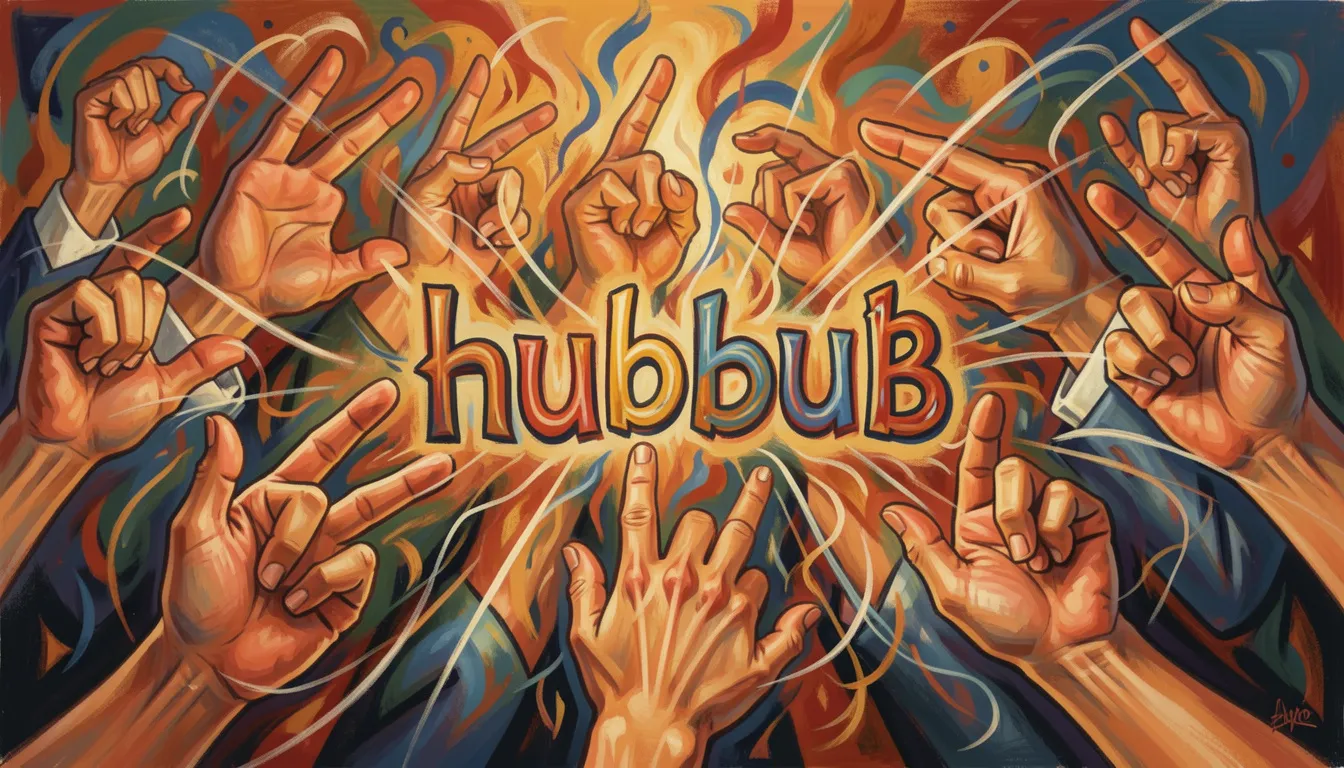
Have you ever walked into a crowded room where everyone was talking, laughing, and making noise at the same time? That lively mix of sounds and confusion is a perfect example of hubbub meaning. The word hubbub describes a noisy situation filled with excitement, confusion, or the voices of many people. You might hear it used to describe a busy school hallway, a crowded market, or a group of people reacting to surprising news.
Understanding the meaning of hubbub can help you improve your English vocabulary and express everyday situations more naturally. Although it is not a word people use in every conversation, it appears in books, news articles, stories, and ordinary descriptions of busy places.
In this guide, you will learn what hubbub means, where the word comes from, how to use it in sentences, its synonyms and antonyms, and the common mistakes to avoid.
What Is the Meaning of Hubbub?
Hubbub means a loud mixture of voices, noise, activity, or confusion, usually caused by several people talking or reacting at once.
It is a noun that describes the sound or atmosphere of a busy, noisy situation. Depending on the context, it can suggest excitement, disorder, or a general sense of commotion.
Simple definition: Hubbub is the noise and confusion created when many people are talking, moving, or reacting at the same time.
Examples of Hubbub in Everyday Life
Here are some situations that illustrate the meaning of hubbub:
- At school: The hubbub in the classroom stopped when the teacher entered.
- At a market: The hubbub of shoppers and sellers filled the busy street.
- At a party: We could barely hear the music over the hubbub of conversation.
- During breaking news: The announcement created a hubbub among the reporters.
- At a sporting event: The hubbub from excited fans echoed throughout the stadium.
In each example, the word describes a mixture of noise, voices, or activity rather than one specific sound.
Hubbub Meaning in Simple English
In simple English, hubbub means a lot of noise and activity happening together.
Imagine that you are sitting in a quiet library. Suddenly, a large group enters and starts talking loudly, moving chairs, and laughing. The peaceful atmosphere disappears, and the room becomes noisy.
You could describe the situation by saying:
“The hubbub made it difficult to concentrate.”
This sentence means that the combined noise and activity made it hard to focus.
Hubbub can also describe a public reaction to an event. For example, when a celebrity announces unexpected news, people may start talking about it excitedly. The resulting discussion and excitement can be called a hubbub.
Hubbub Pronunciation and Word Forms
Learning the pronunciation and grammatical use of a word makes it easier to use correctly.
- Word: Hubbub
- Part of speech: Noun
- Pronunciation: HUH-bub
- Phonetic spelling: /ˈhʌbʌb/
- Plural form: Hubbubs
- Common use: A hubbub, the hubbub, a noisy hubbub
The stress falls on the first syllable: HUB-bub.
Although the plural hubbubs is grammatically possible, the word is often used as an uncountable or general noun when referring to noise and confusion.
Examples:
- The hubbub outside the office was distracting.
- A sudden hubbub broke out in the hallway.
- Several small hubbubs arose during the meeting.
The first two examples show common ways to use the word in natural English.
What Is the Origin of the Word Hubbub?
The word hubbub has been used in English for several centuries. It appeared in English writing during the 16th century and was commonly associated with noisy confusion, uproar, and the sounds of a crowd.
Its precise origin is uncertain. Dictionaries have discussed possible connections to expressions used to imitate or represent noisy shouting, including the cries of crowds. However, there is no universally accepted explanation of its earliest source.
Over time, hubbub developed into a familiar English noun for describing a mixture of voices and activity.
Today, it can appear in several contexts:
- Literature: To create a picture of a busy or disorderly scene.
- Journalism: To describe public excitement or controversy.
- Daily conversation: To explain why a place is noisy.
- Descriptive writing: To bring a crowded scene to life.
The word remains useful because it communicates more than simple loudness. It can also suggest the feeling of a crowded, active, or confusing environment.
How to Use Hubbub in a Sentence
The easiest way to understand a word is to see how it works in real sentences. Hubbub generally appears as the subject or object of a sentence, often alongside words such as crowd, noise, room, street, conversation, and excitement.
1. Hubbub as a Description of Noise
Use hubbub when several sounds blend together and create a noisy atmosphere.
Examples:
- The hubbub in the cafeteria made it difficult to hear my friend.
- I woke up to the hubbub of people outside my window.
- The teacher waited patiently for the classroom hubbub to settle down.
- We enjoyed the hubbub of the busy shopping district.
These sentences focus on the combined sounds of people and activities.
2. Hubbub as a Description of Confusion
Hubbub can also refer to a situation in which people react noisily to something unexpected.
Examples:
- The unexpected announcement caused a hubbub among employees.
- There was a hubbub when the final results were announced.
- The new school rule created a hubbub among students and parents.
- A small mistake caused a surprising amount of hubbub at the office.
In these examples, the word suggests a noisy reaction or a state of commotion.
3. Hubbub in Descriptive Writing
Writers often use hubbub to help readers imagine a scene.
Examples:
- The morning hubbub of the city began before sunrise.
- Beyond the quiet garden, the hubbub of the marketplace continued.
- She stepped away from the hubbub of the party to enjoy a few moments of silence.
- The station was filled with the hubbub of travelers rushing to their trains.
This use makes writing more descriptive without requiring a long explanation of every sound.
Hubbub Meaning in Different Contexts
The meaning of hubbub stays relatively consistent, but its tone can change depending on the situation.
Hubbub at School
At school, hubbub usually refers to the combined voices and activities of students.
Example: “The usual hubbub of the playground filled the air during lunchtime.”
This sentence describes a lively environment rather than necessarily suggesting that students are doing anything wrong.
Hubbub at Work
In an office, hubbub may describe a noisy discussion, a sudden reaction to news, or several conversations happening at once.
Example: “There was a hubbub in the office after the manager announced the new schedule.”
The word suggests that employees were talking or reacting together.
Hubbub in the News
In news reporting, hubbub can describe a public reaction, controversy, or wave of discussion.
Example: “The proposal created a hubbub on social media.”
Here, the emphasis is on the attention and discussion surrounding the proposal. The word does not automatically mean that the proposal was good or bad.
Hubbub at a Party
At a social gathering, hubbub often describes lively conversations, laughter, and general activity.
Example: “The hubbub of the party continued until midnight.”
This usage can be positive because the noise may come from people enjoying themselves.
Hubbub in a Public Place
At an airport, railway station, restaurant, or shopping center, hubbub describes the mixture of voices and movement.
Example: “Amid the hubbub of the railway station, I finally heard my platform number.”
The word helps readers imagine a crowded, active environment.
Synonyms of Hubbub
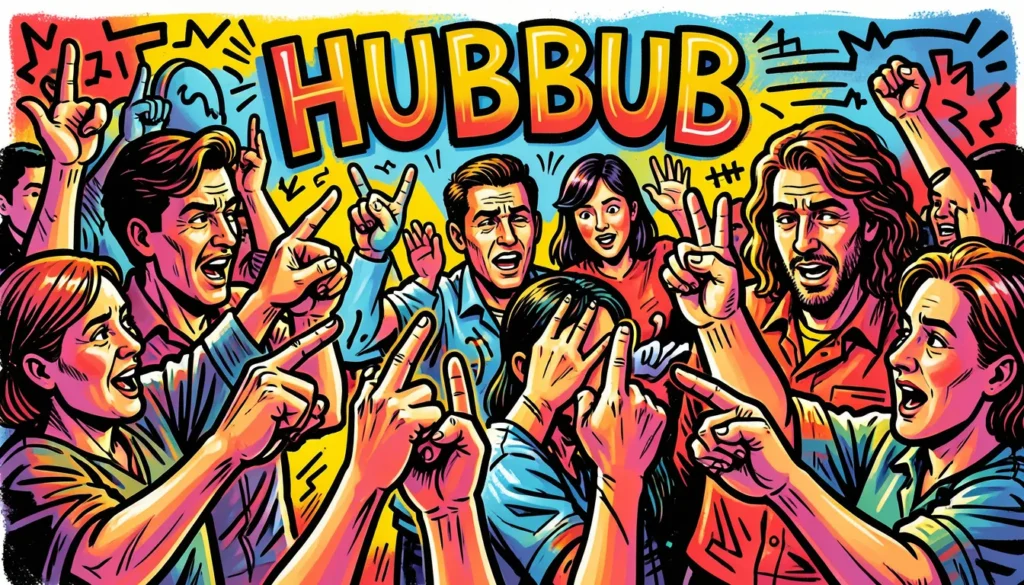
Synonyms are words with similar meanings. Learning synonyms for hubbub helps you express the same idea in different ways.
| Synonym | Meaning | Example |
|---|---|---|
| Commotion | Noisy activity or disturbance | The announcement caused a commotion. |
| Uproar | A loud reaction, often involving anger or excitement | The decision caused an uproar. |
| Clamor | Loud, persistent noise or demands | The clamor of the crowd grew louder. |
| Ruckus | A noisy disturbance | The children made a ruckus outside. |
| Tumult | Confused, disorderly activity | A tumult arose in the hall. |
| Din | A loud, continuous noise | The din of traffic filled the street. |
| Bustle | Energetic activity, often in a busy place | The bustle of the market began early. |
| Pandemonium | Wild confusion and disorder | Pandemonium followed the sudden announcement. |
| Noise | Unwanted or general sound | The noise interrupted our conversation. |
| Fuss | Unnecessary excitement or concern | There was a fuss over the minor mistake. |
Which Synonym Should You Choose?
Although these words overlap, they are not always interchangeable.
- Use commotion for noisy activity or disturbance.
- Use uproar for a strong public reaction, often involving disagreement.
- Use din when the main focus is loud, continuous sound.
- Use bustle when a place is active and busy, often in a positive way.
- Use ruckus for an informal description of a noisy disturbance.
- Use pandemonium for an especially chaotic situation.
For example, “the bustle of the market” sounds natural because a market is normally active. “The pandemonium of the market” suggests a much more chaotic scene.
Antonyms of Hubbub
An antonym is a word with the opposite or contrasting meaning.
Common antonyms of hubbub include:
- Silence: Complete absence of sound.
- Quiet: Little or no noise.
- Peace: A calm state without disturbance.
- Stillness: A condition with little movement or activity.
- Tranquility: A peaceful, relaxed atmosphere.
- Serenity: A feeling or state of calmness.
Examples:
- The hubbub of the cafeteria disappeared when everyone left.
- After the noisy celebration, the house returned to silence.
- She escaped the hubbub of the city to enjoy the tranquility of the countryside.
Remember that quiet and silence focus more directly on sound, while peace, tranquility, and serenity can also describe a person’s feelings or the general atmosphere.
Hubbub vs. Commotion vs. Uproar
Hubbub, commotion, and uproar have similar meanings, but each word emphasizes something slightly different.
| Word | Main emphasis | Example |
|---|---|---|
| Hubbub | A mixture of voices, noise, and activity | The hubbub of the restaurant continued. |
| Commotion | Noisy activity or a disturbance | A commotion broke out near the entrance. |
| Uproar | A strong, often public reaction | The announcement caused an uproar. |
Commotion
Paints a picture of several people talking or making noise together. Commotion usually emphasizes that something is happening in a disorderly or noticeable way.
Example:
- Hubbub: The hubbub of the crowd filled the square.
- Commotion: The sudden commotion attracted everyone’s attention.
Hubbub vs. Uproar
Uproar often suggests a stronger reaction, particularly when people are angry, excited, or protesting. Hubbub can be much more ordinary and does not necessarily involve conflict.
Example:
- Hubbub: A hubbub of conversation filled the conference room.
- Uproar: The controversial decision caused an uproar among residents.
Choosing the right word depends on whether you want to emphasize general noise, disturbance, or a strong reaction.
Is Hubbub a Positive or Negative Word?
Hubbub is generally a neutral word. It can describe a pleasant, lively atmosphere or an unpleasant, distracting situation.
Positive Use
Hubbub can suggest excitement, social activity, and the energy of a crowd.
Examples:
- I loved the cheerful hubbub of the wedding reception.
- The hubbub of the festival made the entire town feel alive.
- She enjoyed the friendly hubbub of the family gathering.
In these sentences, the noise is part of an enjoyable experience.
Negative Use
Hubbub can also describe noise that makes it difficult to concentrate or creates confusion.
Examples:
- The hubbub outside my office prevented me from working.
- He left the crowded room to escape the hubbub.
- The sudden hubbub made it difficult to understand the instructions.
The surrounding sentence tells the reader whether the noise is welcome or irritating.
Common Mistakes When Using Hubbub
Even if you understand the definition, a few mistakes can make your sentences sound unnatural.
Mistake 1: Treating Hubbub as a Verb
Hubbub is a noun, not a standard verb.
Incorrect: “The children hubbubbed in the hallway.”
Better: “The children created a hubbub in the hallway.”
You can use verbs such as create, cause, hear, escape, or quiet to build natural sentences around the word.
Mistake 2: Assuming Hubbub Always Means Anger
Hubbub does not automatically mean people are angry.
Incorrect interpretation: “There was a hubbub at the wedding, so everyone must have been upset.”
Better interpretation: The hubbub could have come from happy conversations, laughter, and excited guests.
The context determines the mood.
Mistake 3: Using Hubbub for Every Kind of Noise
Hubbub is particularly suitable for a mixture of voices, activities, and reactions. It is not always the best choice for a single sound.
For example:
- Natural: “The hubbub of the crowd filled the hall.”
- More precise: “The alarm clock rang loudly.”
The second sentence describes one specific sound, so hubbub would be less suitable.
Mistake 4: Confusing Hubbub with a Hubbub of One Person
The word can refer to a noisy situation involving many people or a general commotion. If only one person is speaking quietly, another word may be more accurate.
For example, “a whispered conversation” is more precise than “a hubbub” when describing two people speaking softly.
Related Words and Expressions

Learning related vocabulary helps you understand how hubbub fits into everyday English.
1. Hubbub of Activity
This expression describes a busy scene in which many things are happening.
Example: “The hubbub of activity backstage continued before the show.”
2. Hubbub of Voices
This phrase emphasizes the sound of several people talking at once.
Example: “A hubbub of voices rose from the crowded waiting room.”
3. Make a Fuss
To make a fuss means to show a lot of concern, excitement, or annoyance about something.
Example: “There is no need to make a fuss over a small mistake.”
Unlike hubbub, this expression can focus on someone’s reaction rather than the sound of a crowd.
4. Raise a Ruckus
This informal expression means to make a lot of noise or cause a disturbance.
Example: “The children raised a ruckus when the game ended.”
5. All the Buzz
This expression refers to something receiving a lot of attention or discussion.
Example: “The new restaurant is all the buzz in town.”
This phrase often relates to popularity or public interest, while hubbub focuses more on noisy activity or commotion.
How to Improve Your Vocabulary With Hubbub
You do not need to memorize complicated definitions to use hubbub correctly. A few practical techniques can help you remember it.
1. Connect the word with a scene. Imagine a crowded marketplace where sellers call out prices and shoppers talk over one another. This is an easy mental picture of hubbub.
2. Practice with short sentences. Write three sentences about school, work, and a public event. For example, “The hubbub of the cafeteria made lunchtime lively.”
3. Learn related words. Study words such as commotion, uproar, bustle, and din. Compare their meanings to understand subtle differences.
4. Read English stories and news articles. Pay attention to how writers use hubbub to describe busy places, public reactions, and noisy environments.
5. Use context to understand tone. Ask yourself whether the situation sounds cheerful, confusing, irritating, or controversial. This will help you understand the word’s intended meaning.
Frequently Asked Questions About Hubbub Meaning
1. What does hubbub mean in simple words?
Hubbub means a mixture of noise, voices, and activity, often caused by many people talking or reacting together. For example, a busy classroom filled with students talking can be described as a hubbub.
2. Is hubbub a noun or a verb?
Hubbub is a noun. It names a noisy or confusing situation rather than describing an action. You can say, “The hubbub continued for several minutes,” or “The announcement caused a hubbub.”
3. What is another word for hubbub?
Common synonyms include commotion, uproar, ruckus, clamor, din, and tumult. The best choice depends on the context. Din emphasizes loud noise, while uproar often describes a strong public reaction.
4. Is hubbub a positive or negative word?
Hubbub is generally neutral. It can describe happy conversations at a party or distracting noise in an office. The surrounding words and situation determine whether the hubbub sounds pleasant or unpleasant.
5. What is the opposite of hubbub?
Words such as silence, quiet, tranquility, serenity, and stillness can express the opposite of hubbub. The best antonym depends on whether you mean the absence of sound or a peaceful atmosphere.
6. How do you pronounce hubbub?
Hubbub is pronounced HUH-bub, with the stress on the first syllable. Its phonetic transcription is /ˈhʌbʌb/.
7. Can you use hubbub in a sentence?
Yes. Here is a natural example: “The hubbub of the crowded market made it difficult to hear the shopkeeper.” The sentence describes the combined noise of people talking and moving around.
Conclusion
Understanding hubbub meaning is a simple way to strengthen your English vocabulary. The word describes a noisy mixture of voices, activity, excitement, or confusion. It is especially useful when talking about crowded places, busy gatherings, public reactions, and situations in which several people are making noise at once.
Remember these key points:
- Hubbub is a noun.
- It usually describes combined noise, voices, or activity.
- It can have either a positive or negative tone.
- Common synonyms include commotion, uproar, ruckus, and din.
- Words such as silence, quiet, and tranquility express contrasting ideas.
To use hubbub confidently, start by practicing it in familiar situations. Describe a busy classroom, a crowded street, or a lively celebration. With regular practice, you will learn when this expressive word fits naturally into your English conversations and writing.
Discover More Articles:
- Auld Lang Syne Meaning: What the Famous Phrase Really Means
- Ablation Meaning Explained Clearly: Definition, Examples & More
- Voilà Meaning: Definition, Origin, Examples, and How to Use It

Hi, I’m Ethan Walker, founder of GrammarNestz. Passionate about language, writing, and clear communication, I help learners and writers improve their grammar skills through practical tips, easy-to-understand guides, and engaging content.