
If you have come across the term ablation meaning while reading a medical report, science article, or health-related information, you may wonder what it actually means. In simple terms, ablation refers to the process of removing, destroying, or reducing something, often through heat, cold, energy, or another controlled method. The exact meaning depends on the context in which the word is used.
In medicine, ablation is commonly used to treat certain heart rhythm problems, abnormal tissues, tumors, and other conditions. The word can also describe processes in science and engineering, such as material being gradually removed from a surface.
This guide explains what ablation means, where the term comes from, how it is used, and the different types you may encounter. Whether you saw the word in a medical document or simply want to understand its meaning in English, this article will make it easy to understand.
What Does Ablation Mean?
Ablation means the removal, destruction, or gradual loss of material, tissue, or another substance.
The meaning changes slightly depending on the field:
- Medical ablation: Destroying or removing unwanted or abnormal tissue.
- Cardiac ablation: Destroying small areas of heart tissue that cause abnormal electrical signals.
- Endometrial ablation: Treating the lining of the uterus to reduce heavy menstrual bleeding.
- Tumor ablation: Destroying abnormal or cancerous tissue.
- Scientific ablation: Removing material from a surface through processes such as melting, vaporization, or erosion.
- Environmental ablation: The gradual loss of material, such as ice or snow melting from a glacier.
Simple Definition of Ablation
A simple definition is:
Ablation is the process of removing, destroying, or wearing away something in a controlled or natural way.
For example, if a doctor uses heat to destroy a small area of abnormal heart tissue, that procedure is called an ablation.
Ablation Meaning in Simple English
In everyday English, you can think of ablation as controlled removal or destruction.
For example:
Medical example:
“The patient underwent cardiac ablation to treat an abnormal heart rhythm.”
This means doctors used a medical procedure to destroy a small area of heart tissue responsible for the abnormal rhythm.
Science example:
“Heat caused ablation of the material.”
This means the material was gradually removed or destroyed because of intense heat.
So, although the word may sound complicated, its basic idea is quite simple: something unwanted is removed, destroyed, or worn away.
Ablation Definition
The word ablation can be defined as:
Ablation: The removal, destruction, or erosion of material or tissue, usually through a specific physical, chemical, medical, or natural process.
The term is often used when the removal happens gradually or through a controlled procedure.
Depending on the context, related words may include:
- Removal
- Destruction
- Elimination
- Erosion
- Reduction
- Treatment
- Excision
- Burning
- Freezing
However, these words are not always exact synonyms. The appropriate word depends on the situation.
Where Does the Word Ablation Come From?
The word ablation comes from the Latin word ablātio, which is associated with taking away or removing something.
Over time, the word became useful in several technical fields. Medicine adopted it to describe procedures that remove or destroy unwanted tissue, while science and engineering use it to describe the loss or removal of material.
Today, ablation is especially common in medical terminology, but it is not limited to healthcare.
Ablation Meaning in Medical Terms

In medicine, ablation generally refers to deliberately destroying or removing abnormal tissue.
Doctors may use different forms of energy to perform an ablation, depending on the condition being treated.
Common approaches include:
- Heat
- Cold
- Radiofrequency energy
- Laser energy
- Electrical energy
- Chemical methods
- Other specialized energy sources
The goal is usually to target a specific area while limiting damage to surrounding healthy tissue.
Why Is Ablation Used?
Ablation may be used when doctors need to eliminate tissue that is causing a medical problem.
For example, abnormal tissue may:
- Produce irregular electrical signals.
- Cause excessive bleeding.
- Form a tumor.
- Trigger unwanted symptoms.
- Interfere with normal organ function.
The specific technique depends on the patient’s condition and the doctor’s treatment plan.
What Is Cardiac Ablation?
One of the most common uses of the term is cardiac ablation, also called heart ablation.
Cardiac ablation is a procedure used to treat certain abnormal heart rhythms, known as arrhythmias.
The heart normally beats according to organized electrical signals. Sometimes abnormal electrical signals cause the heart to beat too quickly, irregularly, or unpredictably.
During certain types of cardiac ablation, a doctor guides a thin tube called a catheter through a blood vessel toward the heart. Specialized equipment can then identify and treat the area producing abnormal signals.
What Conditions Can Cardiac Ablation Treat?
Depending on the specific situation, cardiac ablation may be used for conditions such as:
- Atrial fibrillation
- Atrial flutter
- Certain types of supraventricular tachycardia
- Some other abnormal heart rhythms
The suitability of ablation depends on the individual patient’s diagnosis and medical history.
Example of Cardiac Ablation
Imagine that a small area of heart tissue is repeatedly sending incorrect electrical signals.
Those signals can cause the heart to beat abnormally.
During an ablation procedure, the doctor identifies the problematic area and applies controlled energy to create a small scar. That scar can prevent the abnormal electrical signals from continuing through the heart.
This is why cardiac ablation is sometimes described as destroying abnormal heart tissue to restore a normal rhythm.
What Is Endometrial Ablation?
Another important medical use is endometrial ablation.
The endometrium is the lining inside the uterus. Endometrial ablation is a procedure designed to destroy or reduce this lining to help treat certain cases of heavy menstrual bleeding.
Different techniques can be used, depending on the patient’s circumstances and the medical system or device involved.
Why Is Endometrial Ablation Performed?
It may be considered for people experiencing unusually heavy menstrual bleeding when other treatments have not provided sufficient relief.
The procedure aims to reduce the amount of uterine lining that can contribute to menstrual bleeding.
It is important to understand that endometrial ablation is not simply another word for a hysterectomy. They are different procedures.
Anyone considering endometrial ablation should discuss fertility, pregnancy risks, alternatives, and suitability with a qualified healthcare professional.
What Is Tumor Ablation?
Tumor ablation refers to techniques that destroy tumor tissue using a targeted treatment.
Depending on the procedure, doctors may use:
- Heat
- Cold
- Microwaves
- Radiofrequency energy
- Other specialized methods
Tumor ablation can sometimes be used when surgery is not suitable or when a targeted treatment is appropriate. Whether it is an option depends on factors such as the type, size, location, and stage of a tumor.
It should not be assumed that every tumor can be treated with ablation.
Types of Ablation
The word ablation covers several different procedures and processes.
Here is a simple comparison:
| Type of Ablation | Common Meaning |
|---|---|
| Cardiac ablation | Treats certain abnormal heart rhythms |
| Endometrial ablation | Reduces the uterine lining to help manage heavy bleeding |
| Tumor ablation | Destroys targeted tumor tissue |
| Radiofrequency ablation | Uses radiofrequency energy to heat and treat targeted tissue |
| Laser ablation | Uses concentrated laser energy |
| Cryoablation | Uses extreme cold to destroy targeted tissue |
| Surgical ablation | Removes or destroys tissue through a surgical technique |
| Surface/material ablation | Removes material through heat, erosion, or other physical processes |
The same word is therefore used for very different procedures.
What Is Radiofrequency Ablation?
Radiofrequency ablation, often shortened to RFA, uses radiofrequency energy to produce heat in a targeted area.
It can be used in several medical settings.
For example, radiofrequency ablation can be used in certain procedures involving:
- Abnormal heart rhythms
- Some pain conditions
- Certain tumors
- Other targeted tissue treatments
The exact technique varies according to the condition being treated.
The important idea is that radiofrequency energy generates controlled heat that affects the targeted tissue.
What Is Cryoablation?
Cryoablation uses extremely cold temperatures to destroy targeted tissue.
Instead of heating tissue, the procedure freezes it.
This technique can be used in selected medical procedures, including some treatments involving abnormal heart tissue or tumors.
A simple way to remember the difference is:
Radiofrequency ablation = heat
Cryoablation = extreme cold
Both are forms of targeted tissue destruction, but they use different physical mechanisms.
Ablation vs. Surgery
Ablation and surgery are not always the same thing.
Traditional surgery may involve physically cutting out tissue or an organ.
Ablation often focuses on destroying or disabling a targeted area without necessarily removing it as a physical piece.
Some ablation procedures are minimally invasive and may use a catheter, needle, probe, or specialized device.
However, the term ablation does not automatically mean that a procedure is minor or risk-free.
The risks, recovery time, and effectiveness depend on the specific procedure.
Ablation vs. Excision
These terms can sometimes be confused.
Excision generally means cutting out and removing tissue.
Ablation generally means destroying, removing, or reducing tissue through a particular method.
For example:
- A surgeon may excise a mass by cutting it out.
- A doctor may ablate tissue using heat or cold.
The distinction can vary depending on the medical context.
Ablation in Science and Engineering
Ablation is not only a medical term.
In science and engineering, ablation can describe the removal of material from a surface.
This may happen because of:
- Extreme heat
- Friction
- Radiation
- Chemical reactions
- Melting
- Vaporization
- Erosion
Example: Spacecraft
Ablative materials can be used in spacecraft heat shields.
When a spacecraft enters an atmosphere at extremely high speed, its surface can experience intense heat. Certain heat-shield materials are designed to gradually break down or vaporize, carrying heat away from the spacecraft.
This process is known as ablative heat protection.
In this context, ablation is not a medical treatment. It is a physical process that helps protect the spacecraft.
Ablation in Glaciers
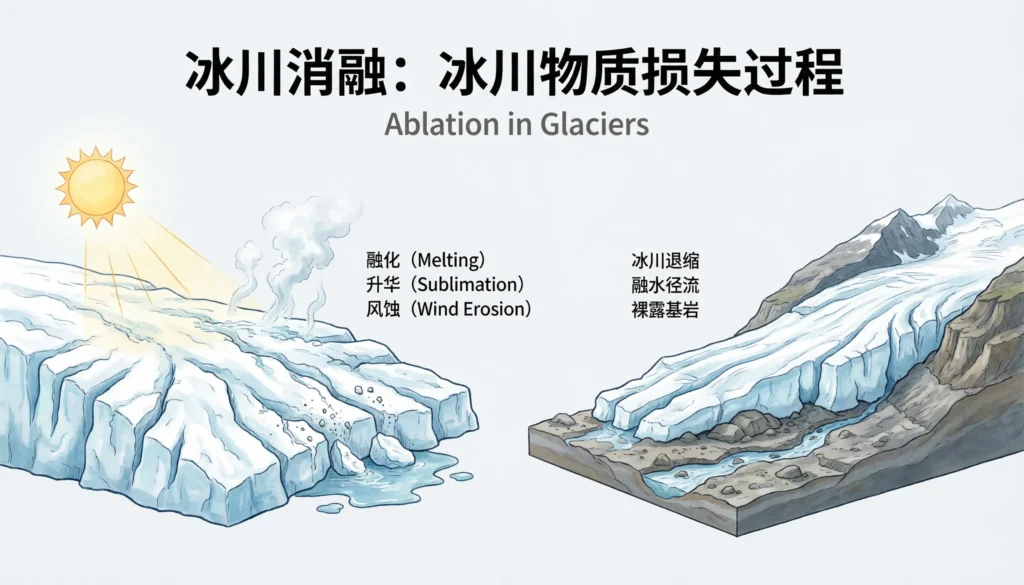
The term also appears in environmental science.
Glacial ablation refers to the loss of ice or snow from a glacier.
This can happen through processes such as:
- Melting
- Evaporation
- Sublimation
- Ice breaking away
For example, if a glacier loses more ice through melting than it gains through snowfall, its overall mass may decrease.
Here, ablation simply refers to the loss of glacier material.
Common Misunderstandings About Ablation
Because ablation is used in many fields, misunderstandings are common.
Misunderstanding 1: Ablation Always Means Surgery
Not necessarily.
Some ablation procedures are minimally invasive and use catheters, needles, probes, or other devices rather than traditional open surgery.
Misunderstanding 2: Ablation Always Uses Heat
No.
Some techniques use heat, while others use extreme cold or different forms of energy.
Misunderstanding 3: Ablation Is Only a Medical Term
Ablation is widely used in science and engineering as well.
It can describe the removal of material caused by heat, erosion, melting, or other processes.
Misunderstanding 4: Ablation Means the Entire Organ Is Removed
Usually, no.
Many ablation procedures target a relatively small or specific area of tissue.
The exact amount and location of tissue affected depend on the procedure.
Misunderstanding 5: Every Ablation Procedure Has the Same Purpose
Definitely not.
Cardiac ablation, endometrial ablation, tumor ablation, and spacecraft material ablation have very different purposes.
The surrounding context is essential for understanding the meaning.
Ablation Examples in Sentences
Here are several examples to make the meaning easier to understand.
- The doctor recommended cardiac ablation to treat the patient’s abnormal heart rhythm.
- Radiofrequency ablation uses controlled heat to target specific tissue.
- The patient discussed endometrial ablation with her doctor.
- Cryoablation destroys targeted tissue using extreme cold.
- The spacecraft’s heat shield relies on an ablative material.
- Glacial ablation increased during the warmer season.
These examples show how the same word can have different meanings depending on the context.
Synonyms and Related Words for Ablation
There is no single perfect synonym for ablation because its meaning changes by context.
Possible related words include:
- Removal
- Destruction
- Reduction
- Elimination
- Erosion
- Excision
- Treatment
- Burning
- Freezing
- Disintegration
- Material loss
For medical writing, however, it is usually better to use ablation when referring to a specific procedure rather than replacing it with a general synonym.
How to Understand Ablation in a Medical Report
If you see the word ablation in a medical report, do not assume you know what procedure it refers to.
Look for the words around it.
For example:
- Cardiac ablation → likely related to heart rhythm.
- Endometrial ablation → related to the uterine lining.
- Tumor ablation → related to destroying tumor tissue.
- Radiofrequency ablation → identifies the energy source.
- Cryoablation → indicates freezing is involved.
If a medical report uses terminology you do not understand, ask the healthcare professional who provided the report for an explanation specific to your situation.
Questions to Ask About an Ablation Procedure
If a doctor recommends an ablation, useful questions may include:
- What condition is the procedure treating?
- What type of ablation will be used?
- Why is this procedure being recommended?
- What are the potential benefits?
- What are the possible risks?
- What alternatives are available?
- How long does recovery usually take?
- Will I need medication afterward?
- What symptoms should prompt medical attention?
These questions can help you understand what the procedure means in your particular situation.
Frequently Asked Questions About Ablation
1. What does ablation mean in simple words?
Ablation means removing, destroying, or reducing something. In medicine, it usually refers to deliberately destroying or removing unwanted or abnormal tissue using a controlled technique.
2. What does ablation mean in medical terms?
In medical terminology, ablation generally means destroying or removing targeted tissue to treat a particular condition. Different types may use heat, cold, radiofrequency energy, lasers, or other techniques.
3. Is ablation the same as surgery?
No. Ablation and surgery are different concepts, although some ablation procedures can be performed as part of a surgical treatment. Many ablation procedures use specialized probes or catheters rather than traditional surgery.
4. What is cardiac ablation?
Cardiac ablation is a procedure used to treat certain abnormal heart rhythms. It targets areas of heart tissue responsible for abnormal electrical signals.
5. What is cryoablation?
Cryoablation is a type of ablation that uses extremely cold temperatures to destroy targeted tissue. It is sometimes used in selected heart and tumor treatments.
6. What is radiofrequency ablation?
Radiofrequency ablation uses radiofrequency energy to create controlled heat in a targeted area. It has applications in several medical procedures, depending on the condition being treated.
7. Can ablation have different meanings?
Yes. Ablation is a broad term. In medicine, it often refers to targeted tissue destruction. In science, engineering, or environmental studies, it can describe material being removed through heat, erosion, melting, evaporation, or other processes.
Conclusion
The simplest way to understand ablation meaning is to remember that it refers to removing, destroying, reducing, or wearing away material or tissue.
In healthcare, ablation is often a targeted procedure used to treat abnormal tissue. Cardiac ablation can address certain abnormal heart rhythms, while endometrial ablation can help manage certain cases of heavy menstrual bleeding. Other forms, such as tumor ablation, radiofrequency ablation, and cryoablation, have their own specific applications.
Outside medicine, ablation can describe physical material loss, such as the breakdown of a spacecraft heat shield or the melting of glacier ice.
The most important point is that ablation does not have one single meaning in every situation. Always consider the context and the type of ablation being discussed.
If you encounter the term in a medical report, learning the specific type of ablation is the best way to understand what it means. And when the information relates to your own health, a qualified healthcare professional can explain what the term means for your particular circumstances.
Discover More Articles:
- COB Meaning in Texting: A Complete Beginner’s Guide
- Shibari Meaning: Japanese Origins and Modern Interpretation
- Rain Check Meaning: Definition, Examples, and How to Use It

Hi, I’m James Richardson, the creator of GrammarNestz.com. My mission is to help students, writers, and language enthusiasts improve their English grammar skills through practical guides, easy lessons, and useful learning resources.