Blues slang meaning can be confusing because the word “blues” has several meanings depending on the context. In everyday conversation, saying someone has “the blues” usually means they feel sad, down, lonely, disappointed, or emotionally low. However, “blues” can also refer to a famous music genre, a difficult emotional period, or certain expressions used in online conversations and popular culture.
You may see phrases such as “I’ve got the blues,” “feeling blue,” or “she’s got the blues” in text messages, social media posts, songs, movies, and casual conversations. Understanding the context is important because the same word can communicate anything from temporary sadness to a reference to blues music.
In this guide, we’ll explain the blues slang meaning, its history, common expressions, examples, related terms, and how people use it in modern communication. Whether you encountered “blues” on TikTok, Instagram, WhatsApp, or in a song, this article will help you understand what it means.
What Does “Blues” Mean in Slang?
In slang and informal English, “blues” commonly means feelings of sadness, disappointment, loneliness, or low spirits.
For example:
“I’ve got the blues today.”
This means:
“I’m feeling sad or down today.”
The word usually describes an emotional state rather than a specific medical condition. Someone might have “the blues” after a breakup, a stressful day, bad news, homesickness, or simply when they are feeling emotionally low.
Simple Definition of Blues Slang
Blues: An informal expression describing sadness, low mood, disappointment, loneliness, or feeling emotionally down.
The meaning can change when “blues” appears in a particular phrase or context.
Examples
- “I’ve got the blues after the weekend ended.”
- “She’s been feeling the blues since her friend moved away.”
- “This rainy weather is giving me the blues.”
- “I’m a little blue today.”
In these examples, “blues” does not necessarily mean severe or long-term sadness. It can simply describe a temporary feeling of being unhappy or discouraged.
Why Does “Blues” Mean Sadness?
The connection between blue and sadness has existed in English for a long time. Eventually, “blue” became associated with melancholy and emotional sadness, while “the blues” developed into an expression for feeling low.
The exact historical development is complicated, but the expression became strongly associated with American English and African American cultural traditions, particularly through blues music.
The blues as a musical tradition often expressed themes such as:
- Heartbreak
- Poverty
- Loneliness
- Hard work
- Relationships
- Loss
- Struggle
- Hope
- Everyday life
Because the music frequently explored difficult emotions, the word “blues” became strongly connected with sadness and emotional experiences.
This is why phrases such as “I’ve got the blues” can refer to feeling emotionally down.
“Blues” vs. “Blue” — What’s the Difference?
Although blue and blues are closely related, they are not always interchangeable.
| Expression | Meaning |
|---|---|
| Feeling blue | Feeling sad or unhappy |
| The blues | A feeling of sadness or low spirits |
| I’ve got the blues | I’m feeling sad/down |
| Blues music | A musical genre |
| Blue mood | A sad or melancholy mood |
| Beat the blues | Overcome feelings of sadness |
For example:
“I’m feeling blue.”
This means you are feeling sad.
“I’ve got the blues.”
This also means you are feeling sad or emotionally down.
But:
“I listen to the blues.”
Here, “blues” refers to the music genre, not sadness itself.
What Does “Got the Blues” Mean?
“Got the blues” is one of the most common expressions containing the word.
When someone says:
“I’ve got the blues.”
They usually mean:
“I’m feeling sad, lonely, disappointed, or down.”
Example Conversation
Alex: “What’s wrong?”
Sam: “Nothing major. I’ve just got the blues today.”
In this conversation, Sam is saying that they feel emotionally low but may not be experiencing a serious problem.
Another example:
“She got the blues after her vacation ended.”
This means she became sad when her vacation was over.
What Does “Feeling Blue” Mean?
“Feeling blue” is another common expression that means feeling sad or unhappy.
For example:
“I’m feeling blue because my best friend moved away.”
The person is saying that they feel sad because their friend left.
Common Reasons Someone Might Say “Feeling Blue”
People may use the phrase when they are:
- Missing someone
- Experiencing a breakup
- Having a difficult day
- Feeling lonely
- Disappointed about something
- Missing home
- Dealing with stress
- Thinking about an unpleasant memory
“Feeling blue” is generally casual and conversational.
Blues Slang Meaning on Social Media
On social media, blues can still mean sadness, but the exact meaning depends on how the word is used.
Someone might post:
“The Sunday blues are real.”
This means they feel sad or anxious because the weekend is ending and work or school is approaching.
Another person might write:
“Got the blues tonight.”
This usually means they are feeling lonely or emotionally down.
Common Social Media Examples
“Monday blues”
Feeling unmotivated or unhappy because the weekend has ended.
“Sunday blues”
Feeling sad or anxious about the upcoming week.
“Post-vacation blues”
Feeling down after returning from a vacation.
“Winter blues”
Feeling emotionally low during winter, often because of darker or colder days.
“Breakup blues”
Feeling sad after a relationship ends.
These expressions are common in casual online communication.
Blues Slang Meaning in Texting
In texting, “blues” is usually used informally to describe sadness or a low mood.
For example:
Person 1: “You okay?”
Person 2: “Yeah, just got the blues rn.”
Here, “rn” means “right now,” so the person means:
“I’m just feeling sad right now.”
Another example:
“These rainy days are giving me the blues.”
This means the rainy weather is making the person feel sad or gloomy.
Texting Examples
- “I’ve got the blues ”
- “Feeling blue today.”
- “Trying to beat the blues.”
- “The Sunday blues hit hard.”
- “I’m in my blues era.”
The last expression can be more playful or social-media-oriented and may not indicate serious sadness.
Blues Slang Meaning on TikTok
On TikTok, “blues” can appear in captions, comments, memes, music-related posts, and discussions about emotions.
For example:
“POV: the Sunday blues hit again.”
The creator is joking about feeling down because Monday is approaching.
Another example:
“Trying to get out of the blues.”
This suggests the person is trying to improve their mood.
However, context matters. On social media, slang can change quickly, and “blues” may have meanings unrelated to sadness in certain communities.
For that reason, you should look at the entire sentence, video, caption, and surrounding conversation before deciding what the word means.
“Blues” as a Music Term
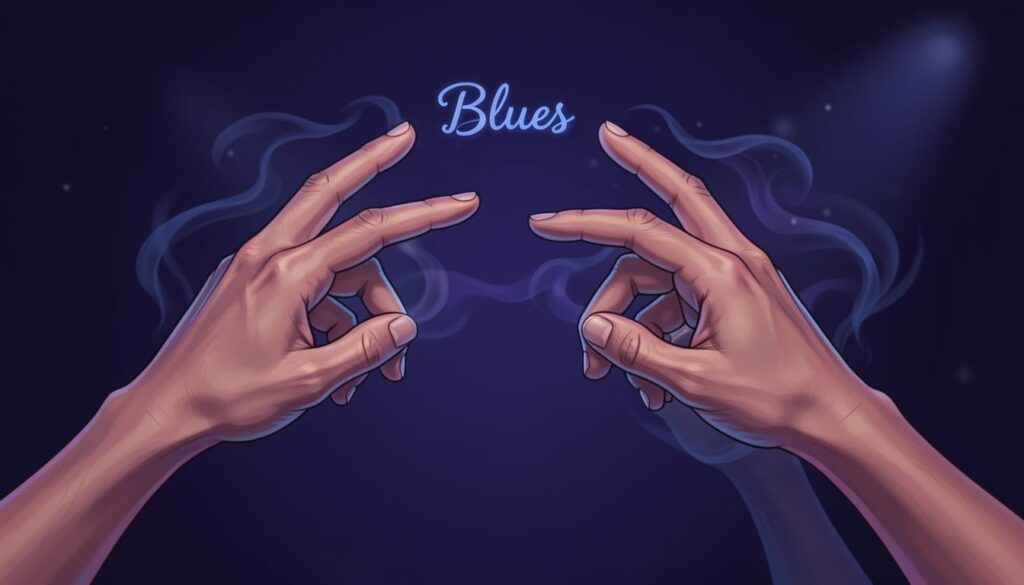
One of the most important meanings of blues is the musical genre.
The blues is a major American musical tradition that developed from African American musical and cultural traditions, particularly in the late 19th and early 20th centuries.
Blues music has had a huge influence on:
- Rock
- Jazz
- Rhythm and blues
- Soul
- Country
- Popular music
The genre often focuses on emotional storytelling and experiences involving love, hardship, loss, work, and everyday life.
Example
“My dad loves listening to the blues.”
Here, “blues” does not mean sadness. It refers to the music genre.
This is one reason context is so important when understanding blues slang meaning.
The Relationship Between Blues Music and Sadness
The emotional meaning of “blues” and the musical meaning of “blues” are closely connected.
Blues music has historically provided a way for artists to express difficult emotions and personal experiences. Songs could communicate pain while also showing resilience, humor, creativity, and hope.
This helped reinforce the association between the word blues and feelings of sadness or hardship.
However, blues music is not simply “sad music.” It can include:
- Humor
- Celebration
- Confidence
- Love
- Desire
- Storytelling
- Social commentary
- Resilience
Therefore, describing all blues music as depressing would be an oversimplification.
Common Phrases With “Blues”
Understanding common phrases can make the meaning easier to recognize.
1. “I’ve Got the Blues”
Meaning: I feel sad or emotionally down.
Example:
“I’ve got the blues after saying goodbye to my family.”
2. “Feeling Blue”
Meaning: Feeling sad or unhappy.
Example:
“I’m feeling blue today.”
3. “Beat the Blues”
Meaning: Try to overcome sadness or improve your mood.
Example:
“I went for a walk to beat the blues.”
4. “Sunday Blues”
Meaning: Feeling down because the weekend is ending.
Example:
“Sunday blues are already here.”
5. “Monday Blues”
Meaning: Feeling tired, unhappy, or unmotivated at the beginning of the work or school week.
Example:
“I’ve got the Monday blues.”
6. “Winter Blues”
Meaning: Feeling down during the winter season.
Example:
“The short days are giving me the winter blues.”
7. “Post-Vacation Blues”
Meaning: Feeling sad after returning from vacation.
Example:
“I’m dealing with serious post-vacation blues.”
Is “Blues” Always a Serious Expression?
No. “Blues” can be completely casual or playful.
For example:
“I have the Monday blues because I don’t want to get out of bed.”
The person may simply be complaining about going to work or school.
Similarly:
“I’ve got the ice-cream blues because my favorite flavor is sold out.”
This could be humorous rather than a serious emotional statement.
Therefore, the phrase “the blues” does not automatically mean someone has a serious mental health problem.
It is usually an informal expression for sadness or low spirits. The surrounding context determines how seriously it should be understood.
Blues vs. Depression: Are They the Same?
No. This is an important distinction.
The blues generally refers to temporary sadness, disappointment, or low spirits.
Depression is a mental health condition that can involve persistent changes in mood and functioning and may require professional support.
For example:
“I have the blues because my team lost.”
This usually describes temporary disappointment.
It would be inappropriate to automatically interpret this statement as meaning the person has depression.
Quick Comparison
| Blues | Depression |
|---|---|
| Usually informal | Medical/mental health term |
| Often temporary | Can be persistent |
| May result from everyday disappointments | Can have many contributing factors |
| Usually describes feeling down | Can affect mood, sleep, energy, concentration, and daily functioning |
| Does not automatically indicate a disorder | May require professional evaluation and treatment |
Using these terms correctly helps avoid misunderstandings.
Common Misunderstandings About “Blues”
Misunderstanding 1: “Blues” Always Means Depression
Not necessarily.
In casual English, “the blues” usually means feeling sad or down. It does not automatically mean clinical depression.
Misunderstanding 2: Blues Only Refers to Music
Not true.
“Blues” can refer to sadness, music, or various expressions such as “Monday blues.”
Misunderstanding 3: “Feeling Blue” Means Being Calm
Usually, no.
Although blue is a color associated with calmness in some contexts, “feeling blue” in English commonly means feeling sad.
Misunderstanding 4: Every Use of “Blues” Is Slang
Not necessarily.
“Blues” is also a standard English word and the name of a major musical tradition. Whether it is slang depends on the context.
Blues Meaning in Different Contexts
The following table makes the differences easier to understand:
| Context | Meaning of “Blues” |
|---|---|
| Everyday conversation | Sadness or low spirits |
| Texting | Feeling down or unhappy |
| Social media | Often sadness, disappointment, or a humorous low mood |
| Music | A musical genre |
| “Got the blues” | Feeling sad |
| “Monday blues” | Low motivation at the beginning of the week |
| “Feeling blue” | Feeling sad |
| “Beat the blues” | Overcome sadness |
| Sports | Could refer to a team or club nickname, depending on context |
| Fashion/colors | Could literally refer to the color blue |
How to Respond When Someone Says “I’ve Got the Blues”
If a friend says:
“I’ve got the blues today.”
You can respond naturally and supportively.
Casual Responses
- “Aw, what happened?”
- “I hope you feel better soon.”
- “Want to talk about it?”
- “I’m here if you need me.”
- “Let’s do something fun.”
- “Bad day?”
- “Hopefully tomorrow is better.”
Example Conversation
Friend: “I’ve got the blues today.”
You: “I’m sorry. Want to tell me what’s going on?”
Friend: “Nothing huge. I’m just missing my family.”
You: “I understand. Maybe give them a call tonight.”
This sounds natural and caring without assuming something more serious.
Related Slang and Expressions
If you’re researching blues slang meaning, you may also come across several related expressions.
“Blue”
Often means sad.
Example:
“I’m feeling blue.”
“Down”
Means feeling unhappy or discouraged.
Example:
“I’ve been feeling down lately.”
“Bummed Out”
Means disappointed or unhappy.
Example:
“I was really bummed out when the event was canceled.”
“Gloomy”
Means sad, dark, or lacking optimism.
Example:
“The weather is gloomy today.”
“Low”
Can describe an emotionally difficult mood.
Example:
“I’ve been feeling a little low.”
“Melancholy”
A more literary or formal word for a thoughtful or gentle sadness.
Example:
“The song has a melancholy feeling.”
Blues vs. Similar Expressions
Here is a simple comparison:
| Term | Basic Meaning | Tone |
|---|---|---|
| Blues | Sadness/low spirits | Casual |
| Blue | Sad | Casual |
| Down | Unhappy or discouraged | Casual |
| Bummed out | Disappointed | Very casual |
| Gloomy | Sad or pessimistic | Neutral |
| Melancholy | Deep or reflective sadness | Literary |
| Heartbroken | Extreme emotional pain after loss/breakup | Strong |
| Miserable | Very unhappy | Strong |
The best word depends on the situation and emotional intensity.
Examples of “Blues” in Everyday Sentences
Here are more examples to help you understand the word naturally:
- “I’ve got the blues after my vacation ended.”
- “She was feeling the blues after her friend moved away.”
- “Rainy weather always gives me the blues.”
- “He’s listening to blues music tonight.”
- “The Monday blues are hitting hard.”
- “I’m trying to beat the blues by going outside.”
- “She’s feeling blue after the breakup.”
- “The Sunday blues are real.”
- “That song gives me the blues.”
- “I’ve been a little down lately.”
Notice how the meaning changes according to context.
Is “Blues” Still Used in Modern Slang?

Yes. Although “the blues” is not necessarily new Gen Z slang, the expression remains common in modern English.
Social media has also created newer combinations such as:
- Sunday blues
- Monday blues
- Post-vacation blues
- Breakup blues
- Holiday blues
- Winter blues
- Back-to-school blues
These phrases often appear in captions, memes, videos, and casual conversations.
The underlying idea remains the same: feeling sad, unmotivated, disappointed, or emotionally low.
Why Context Matters When Understanding Slang
Words rarely have only one meaning.
Consider this sentence:
“I love the blues.”
This probably means the person enjoys blues music.
Now consider:
“I’ve got the blues.”
This probably means the person is feeling sad.
And:
“The Monday blues are killing me.”
This means the person is feeling unhappy or unmotivated about Monday.
The word itself has not changed dramatically. The surrounding words provide the clue.
A Simple Rule
When you see “blues,” ask:
- Is the person talking about emotions?
- Is music being discussed?
- Is it part of a phrase like “Monday blues”?
- Is it being used literally?
- Is the conversation about a specific group, team, or cultural reference?
Answering these questions usually makes the intended meaning clear.
How to Use “Blues” Correctly
If you want to use “blues” naturally in conversation, remember these simple patterns:
sadness
“I’ve got the blues.”
temporary sadness
“I’m feeling blue today.”
work or school
“I’ve got the Monday blues.”
weekends
“The Sunday blues are back.”
music
“I really enjoy blues music.”
Avoid assuming that every use of “blues” refers to sadness.
Frequently Asked Questions About Blues Slang Meaning
1. What does “blues” mean in slang?
In informal English, “blues” usually means feelings of sadness, disappointment, loneliness, or low spirits. The phrase “I’ve got the blues” means “I’m feeling sad.”
2. What does “I’ve got the blues” mean?
“I’ve got the blues” means I’m feeling sad, down, lonely, or emotionally low. It is generally a casual expression.
3. What does “feeling blue” mean?
“Feeling blue” means feeling sad or unhappy. For example, “I’m feeling blue today” means “I’m feeling sad today.”
4. Is “blues” the same as depression?
No. “The blues” is usually an informal description of temporary sadness or low spirits, while depression is a mental health condition. The two should not automatically be treated as the same thing.
5. What does “Monday blues” mean?
“Monday blues” describes feeling tired, unhappy, unmotivated, or disappointed because the weekend has ended and a new work or school week has started.
6. What does “blues” mean in music?
In music, the blues refers to an influential American musical tradition with deep roots in African American culture. It has influenced genres including rock, jazz, soul, and rhythm and blues.
7. Is “blues” Gen Z slang?
Not exactly. “The blues” and “feeling blue” are older English expressions rather than newly created Gen Z slang. However, younger people still use them in texting, memes, captions, and social media, often in newer phrases such as “Sunday blues” or “post-vacation blues.”
Conclusion
Understanding the blues slang meaning is easier once you consider the context. In everyday conversation, “the blues” usually refers to sadness, disappointment, loneliness, or feeling emotionally down. Expressions such as “I’ve got the blues,” “feeling blue,” and “Monday blues” are common examples.
At the same time, “blues” can refer to the important musical tradition known as the blues, so it is essential not to assume that every use of the word describes sadness. Context, surrounding words, and the topic of conversation usually reveal the intended meaning.
If you see “blues” in a text, TikTok caption, Instagram post, song, or everyday conversation, look at the full sentence before interpreting it. In most casual emotional contexts, you can understand it as feeling sad or down.
The simplest takeaway is:
“Blues” usually means sadness or low spirits when used as an informal expression, but it can also refer to blues music or other context-specific meanings.
Once you know these differences, you can confidently understand and use blues in modern English conversations, texting, and social media.
Discover More Articles:
- Cracker Slang Meaning: What Does “Cracker” Mean in Slang?
- IGHT Slang Meaning Explained: A Simple Guide for Beginners
- Sub Slang Meaning in Chat: What Does It Really Mean?

Hi, I’m James Richardson, the creator of GrammarNestz.com. My mission is to help students, writers, and language enthusiasts improve their English grammar skills through practical guides, easy lessons, and useful learning resources.