Softball slang meaning can be confusing if you are new to the sport or hear players using casual words during a game. Softball has its own language, filled with short phrases, nicknames, expressions, and terms that describe plays, players, situations, and emotions. From “rake” and “dinger” to “K,” “duck,” and “can of corn,” these expressions can make conversations around the field much more interesting.
Understanding softball slang helps players, coaches, parents, and fans follow the game more easily. It can also help beginners communicate naturally with teammates and understand what coaches mean during practices and games.
In this guide, we will explain the softball slang meaning, where these terms come from, how players use them, and what they mean in different situations. Whether you are watching your first softball game or trying to understand your teammates, this article will give you a useful introduction to softball terminology.
What Does Softball Slang Mean?
Softball slang refers to informal words, phrases, nicknames, and expressions commonly used by softball players, coaches, fans, and commentators.
Unlike official softball terminology, slang is usually casual and conversational. Some slang words describe specific plays, while others describe a player’s performance, personality, or situation.
For example:
- Rake – To hit the ball extremely well.
- Dinger – A home run.
- K – A strikeout.
- Duck – A batter’s head, often used when telling someone to avoid a high or inside pitch.
- Can of corn – An easy fly ball.
- Clutch – Performing well during an important moment.
- Ribbie/RBI – A run batted in.
- Bomb – A very powerful hit, usually a home run or long-distance hit.
- Web gem – An excellent defensive play.
These terms can vary between teams, regions, age groups, and levels of competition.
Why Is Softball Slang Important?
Learning softball slang isn’t necessary to understand the basic rules, but it can make the sport much easier to follow.
1. It improves communication
Players need to communicate quickly. Short expressions can be easier than explaining an entire situation.
2. It helps beginners understand conversations
A new player might hear teammates say, “She just raked that pitcher,” and wonder what they mean. Knowing softball slang makes the conversation immediately understandable.
3. It creates team culture
Teams often develop their own expressions, jokes, nicknames, and phrases. Slang can help players feel connected.
4. It makes watching games more enjoyable
Fans who understand common softball terminology can better follow commentary and conversations during games.
5. It adds personality to the sport
Softball isn’t only about statistics and rules. Informal expressions make the game more social, energetic, and fun.
Common Softball Slang Terms and Their Meanings
Here are some of the most common expressions you may hear around a softball field.
Rake
Meaning: To hit extremely well.
If someone says, “She can rake,” they mean the player is an excellent hitter.
Example:
“She’s been raking all season.”
This usually suggests that the batter consistently makes strong contact and gets hits.
Dinger
Meaning: A home run.
A dinger is a casual term for a home run.
Example:
“She hit a dinger in the fifth inning.”
You may also hear words such as “bomb,” “shot,” or “jack” used for a powerful home run.
Bomb
Meaning: A very long or powerful hit, especially a home run.
Example:
“That was an absolute bomb!”
The word emphasizes the power and distance of the hit.
K
Meaning: Strikeout.
The letter K is commonly used to represent a strikeout in baseball and softball scorekeeping.
Example:
“The pitcher recorded three Ks.”
A pitcher with many strikeouts may be described as having “good stuff” or “dealing.”
Dealing
Meaning: Pitching extremely well.
When a pitcher is “dealing,” they are usually throwing effectively and making it difficult for batters to get hits.
Example:
“Our pitcher is dealing tonight.”
Filthy
Meaning: An exceptionally difficult or impressive pitch.
A pitcher may throw a pitch with unusual movement or speed that is extremely difficult to hit.
Example:
“That changeup was filthy.”
Here, “filthy” is positive slang describing how difficult the pitch was.
Web Gem
Meaning: An outstanding defensive play.
A web gem usually describes a spectacular catch or defensive action.
Example:
“That diving catch was a web gem!”
The expression is especially common when talking about impressive defensive plays.
Can of Corn
Meaning: An easy fly ball that a defensive player can catch without much difficulty.
Example:
“The center fielder caught it like a can of corn.”
The phrase sounds strange if you don’t know the slang, but it simply describes an easy catch.
Ribbie
Meaning: RBI, or run batted in.
A ribbie is a playful pronunciation of “RBI.”
Example:
“She drove in two ribbies with a double.”
It is informal and more commonly heard in casual baseball and softball conversations.
Clutch
Meaning: Performing successfully during an important or high-pressure moment.
A player who consistently delivers when the game is on the line may be called clutch.
Example:
“She came through with a clutch hit in the seventh inning.”
Softball Hitting Slang
Hitting has some of the most colorful slang in softball.
Mash
Meaning: To hit the ball very hard.
Example:
“She can really mash.”
Smoked
Meaning: Hit extremely hard.
Example:
“He smoked the ball into left field.”
Roped
Meaning: Hit sharply and hard, often on a line.
Example:
“She roped a double down the line.”
Gap
Meaning: The open space between outfielders.
A player may say:
“Hit it in the gap.”
This means to hit the ball into the space between defenders.
Opposite Field
Meaning: Hitting the ball toward the side of the field opposite the batter’s natural pull side.
For example, a right-handed batter hitting toward right field is using the opposite field.
Pull
Meaning: Hitting toward the side of the field corresponding to the batter’s natural hitting side.
A right-handed hitter generally pulls the ball toward left field, while a left-handed hitter generally pulls it toward right field.
Softball Pitching Slang
Pitchers and teammates use many informal expressions to describe pitches and performances.
Gas
Meaning: A fast pitch.
Example:
“She was throwing gas today.”
This means the pitcher was throwing very hard.
Heat
Meaning: A fastball or very fast pitch.
Example:
“She brought the heat in the final inning.”
Changeup
A changeup is an off-speed pitch designed to look similar to a faster pitch while arriving at a slower speed.
Players may casually refer to a particularly effective changeup as “nasty” or “filthy.”
Paint the Corner
Meaning: Throwing a pitch very close to the edge of the strike zone.
Example:
“She painted the outside corner.”
This suggests excellent pitch location.
Freeze
Meaning: Getting a batter to hesitate or fail to swing at a pitch, often because the pitch appears to be in the strike zone.
Example:
“That pitch froze her.”
Softball Defensive Slang
Defense has its own vocabulary.
Boot
Meaning: To make an error while fielding the ball.
Example:
“The shortstop booted the ground ball.”
Pick
Meaning: Making a difficult defensive catch, especially a low throw near the ground.
Example:
“Great pick at first!”
Dime
Meaning: An excellent or accurate throw.
Example:
“She threw a dime to home plate.”
Hose
Meaning: To throw the ball extremely hard and accurately, especially to make an important defensive play.
Example:
“She has a hose from right field.”
Flash the Leather
Meaning: Make an impressive defensive play.
Example:
“The shortstop really flashed the leather today.”
Softball Base-Running Slang
Base running also has several informal expressions.
Wheels
Meaning: Speed or running ability.
Example:
“She has wheels.”
This means the player is fast.
Steal
Meaning: Advance to another base while the pitcher delivers the ball, according to the applicable rules and situation.
Example:
“She stole second base.”
Take an Extra Base
Meaning: Advance farther than expected because of speed, positioning, or a defensive mistake.
Example:
“She took an extra base on the throw.”
Rundown
Meaning: A situation where a runner is caught between bases while defenders attempt to tag them.
Example:
“The runner got caught in a rundown.”
Softball Slang for Players
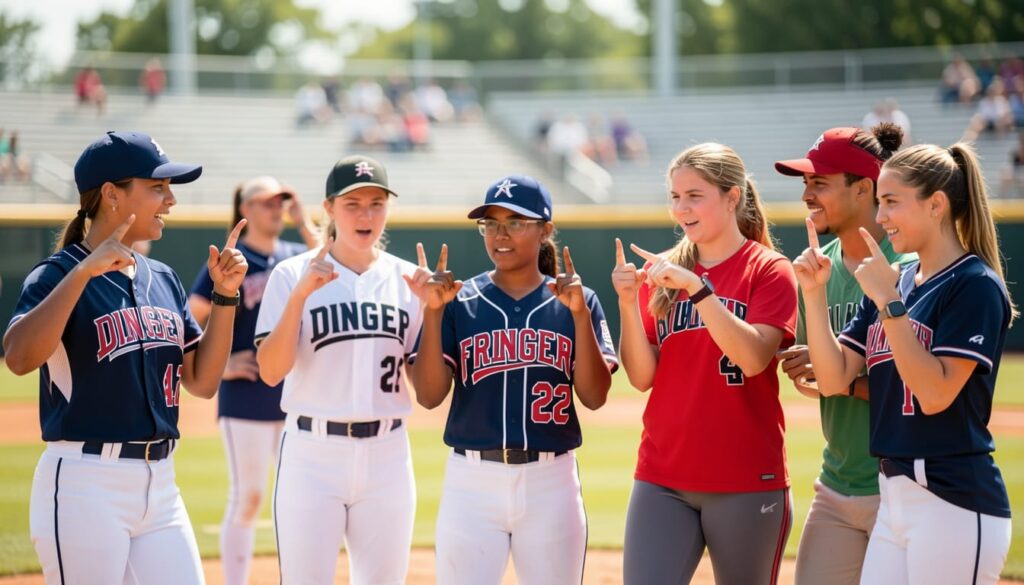
Players themselves may also be described using informal expressions.
| Slang | Meaning |
|---|---|
| Rake | Excellent hitter |
| Ace | Top pitcher |
| Stud | Outstanding player |
| Ballplayer | Skilled, experienced player |
| Speedster | Very fast runner |
| Utility player | Player capable of playing multiple positions |
| Clutch player | Performs well under pressure |
| Gold glove | Excellent defensive player |
| Workhorse | Player who handles a heavy workload |
| Spark plug | Player who brings energy to the team |
These expressions can be compliments, although the exact meaning depends on the context.
Softball Slang Used by Coaches
Coaches often use short phrases during games because there is little time for long explanations.
You might hear:
- “Stay hot!” – Keep hitting well.
- “See it deep.” – Stay patient and track the pitch.
- “Have a good at-bat.” – Focus on a quality plate appearance.
- “Move her over.” – Try to advance the runner.
- “Protect.” – Protect the plate with two strikes.
- “Take your base.” – Accept a walk or hit-by-pitch when appropriate.
- “Turn two.” – Attempt a double play.
- “Cut it!” – A fielder should make a cutoff play.
- “Back up!” – Move into a backup defensive position.
- “One more!” – Stay focused because another out or play is needed.
The exact language varies by coach and team.
Softball Slang in Texting and Social Media
Softball slang isn’t limited to the field. Players frequently use it in texts, group chats, captions, and social media posts.
For example:
- “Absolute dinger”
- “She was dealing today.”
- “Our defense was locked in.”
- “Clutch hit!”
- “We came to rake.”
- “That catch wasreckless.”
- “Game-day energy!”
- “Nothing but bombs today.”
Social media has helped spread sports slang beyond traditional team environments.
A player might post a photo after a home run and caption it:
“First dinger of the season!”
In this context, “dinger” simply means home run.
Softball Slang vs. Official Softball Terminology
One important thing to remember is that slang isn’t always an official softball term.
| Slang | More Formal Meaning |
|---|---|
| Dinger | Home run |
| K | Strikeout |
| Ribbie | RBI |
| Rake | Hit extremely well |
| Gas | Fast pitch |
| Wheels | Speed |
| Boot | Fielding error |
| Web gem | Spectacular defensive play |
| Clutch | Successful under pressure |
| Bomb | Powerful/long hit |
Official rules and scorekeeping terminology are more precise, while slang is usually conversational.
Common Misunderstandings About Softball Slang
Slang Doesn’t Always Have One Meaning
A word can have different meanings depending on the team or situation.
For example, “bomb” may mean a home run to one player but simply a very hard hit to another.
Slang Can Be Regional
Different parts of the country and different softball communities may use different expressions.
Some Terms Come From Baseball
Softball shares many expressions with baseball because the two sports have similar concepts and histories.
However, softball also has its own terminology and culture.
Slang Changes Over Time
Sports language evolves. New phrases can become popular through social media, younger players, broadcasts, and online communities.
This means a term that is popular today may become less common later.
How to Learn Softball Slang Quickly
If you’re new to softball, you don’t need to memorize every expression at once.
Start with the basics
Learn these first:
- Dinger
- Rake
- K
- Clutch
- Gas
- Wheels
- Boot
- Web gem
- Ribbie
- Can of corn
Listen to context
If someone says, “She has wheels,” look at what is happening. If they are talking about running, “wheels” probably refers to speed.
Ask teammates
There is nothing wrong with asking what an expression means.
Watch games
Listening to coaches, players, and commentators is one of the easiest ways to learn natural softball vocabulary.
Use slang naturally
Don’t force slang into every sentence. Once you understand how players use it, it will become easier to use naturally.
Softball Slang Examples in Real Conversations
Example 1: Talking about a hitter
Player A: “How was she today?”
Player B: “She was raking.”
Meaning: She was hitting extremely well.
Example 2: Talking about a pitcher
Player A: “How’s our pitcher doing?”
Player B: “She’s dealing.”
Meaning: The pitcher is performing very well.
Example 3: Talking about a home run
Player A: “Did you see that?”
Player B: “That was a bomb!”
Meaning: The player hit a very powerful or long home run.
Example 4: Talking about defense
Player A: “That catch was incredible.”
Player B: “Total web gem.”
Meaning: It was an outstanding defensive play.
Example 5: Talking about speed
Player A: “How fast is she?”
Player B: “She’s got wheels.”
Meaning: She is a very fast runner.
Softball Slang and Team Culture
Softball slang is more than a collection of funny words. It can become part of a team’s identity.
Teams often create their own:
- Nicknames
- Celebrations
- Inside jokes
- Catchphrases
- Dugout expressions
- Motivational phrases
- Social media captions
For young players especially, these expressions can make practices and games feel more social and memorable.
The language can also help teammates celebrate accomplishments. A great catch may earn a player praise for “flashing the leather,” while a big hit may be called a “bomb” or “dinger.”
Related Softball Terms You Should Know
If you’re learning softball slang, it’s also useful to understand basic softball terminology.
Inning
A section of the game in which both teams get an opportunity to bat and play defense.
At-Bat
A batter’s official plate appearance under the scoring rules.
Strike Zone
The area over home plate where a legally delivered pitch may be called a strike when the batter does not successfully put the ball in play.
Walk
A batter reaches first base after receiving the required number of balls.
Double Play
A defensive play that results in two outs during the same continuous play.
Grand Slam
A home run hit with the bases loaded, scoring four runs.
Double
A hit that allows the batter to reach second base safely.
Triple
A hit that allows the batter to reach third base safely.
Error
A defensive mistake that allows a batter or runner to advance in a way that would not normally occur without the mistake.
Understanding these basic terms makes softball slang much easier to follow.
Why Softball Slang Is So Popular
There are several reasons softball slang continues to be popular.
It’s quick. Players can communicate ideas with just one or two words.
It’s expressive. Saying “bomb” sounds more energetic than simply saying “home run.”
It’s social. Shared language creates a sense of belonging.
It’s memorable. Colorful phrases are easier to remember than technical descriptions.
It’s adaptable. Players can create new expressions and spread them through social media.
For these reasons, softball slang continues to evolve as the sport changes.
Frequently Asked Questions About Softball Slang
1. What does softball slang mean?
Softball slang refers to informal words and phrases used by softball players, coaches, fans, and commentators to describe plays, players, situations, and performances.
2. What does “rake” mean in softball?
“Rake” means to hit extremely well. If someone says a player can rake, they are complimenting that player’s hitting ability.
3. What does “dinger” mean in softball?
A “dinger” is informal slang for a home run. It is commonly used in casual conversations between players and fans.
4. What does “dealing” mean in softball?
When someone says a pitcher is “dealing,” they usually mean the pitcher is performing very well and making it difficult for opposing hitters.
5. What does “gas” mean in softball?
“Gas” usually refers to a very fast pitch. Saying that a pitcher is throwing gas means the pitcher is throwing with significant velocity.
6. What does “wheels” mean in softball?
“Wheels” refers to a player’s running speed. If someone says, “She has wheels,” they mean the player is fast.
7. Is softball slang the same as baseball slang?
There is significant overlap because softball and baseball share many concepts. However, individual teams, leagues, regions, and age groups may use different slang.
Conclusion
Understanding softball slang meaning makes it easier to follow conversations on the field, in the dugout, during practices, and online. Terms such as rake, dinger, bomb, K, gas, dealing, wheels, clutch, boot, and web gem may sound confusing at first, but their meanings become simple once you see them in context.
The best way to learn softball slang is to listen to players, watch games, and pay attention to how each expression is used. Remember that slang is informal, so meanings can vary between teams and regions.
If you’re new to softball, start with the most common terms and gradually build your vocabulary. Before long, phrases that once sounded confusing will become a natural part of understanding the game.
Whether you’re a player, parent, fan, or beginner, knowing softball slang can help you communicate better, enjoy games more, and feel more connected to softball culture.
Discover More Articles:
- Bees Knees Meaning in English: From 1920s Slang to Today
- Jody Slang Meaning: What Does “Jody” Mean in Slang?
- What Does LA Mean on Social Media? LA Slang Explained

Hi, I’m James Richardson, the creator of GrammarNestz.com. My mission is to help students, writers, and language enthusiasts improve their English grammar skills through practical guides, easy lessons, and useful learning resources.