
Scuba slang meaning can be confusing because the word “scuba” is most commonly associated with underwater diving. If you have seen “scuba” used in a text, social media post, gaming conversation, meme, or casual chat, you may wonder whether it has another meaning. In most situations, scuba is not traditional slang at all. It is a familiar abbreviation connected to underwater diving, although online communities sometimes use it humorously or creatively.
The word comes from the acronym SCUBA, which stands for Self-Contained Underwater Breathing Apparatus. It describes equipment that allows a diver to breathe underwater without being connected to a surface air supply.
However, language constantly changes. Divers, internet users, gamers, and social media communities can use “scuba” in different ways depending on context. Understanding the scuba slang meaning can therefore help you interpret conversations correctly.
In this guide, we will explain what scuba means, where the term came from, how people use it, related diving slang, examples, common misunderstandings, and frequently asked questions.
What Is the Scuba Slang Meaning?
The simplest scuba slang meaning is connected to scuba diving, rather than a separate slang definition.
SCUBA is an acronym for:
Self-Contained Underwater Breathing Apparatus
A scuba diver carries a tank containing compressed breathing gas and uses a regulator to breathe from it underwater.
In casual conversations, people may simply say “scuba” when talking about:
- Scuba diving
- Diving equipment
- Underwater exploration
- Recreational diving
- Dive training
- Divers
- Marine adventures
- Underwater photography
- Diving culture
For example:
“I’m going scuba this weekend.”
Here, “scuba” is an informal shortening of scuba diving.
Another example is:
“She’s really into scuba.”
This generally means she enjoys scuba diving.
So, while “scuba” may appear informal in a sentence, it is not necessarily slang in the same way as words such as “rizz,” “sus,” “lit,” or “cap.”
Scuba Meaning in Simple Words

If you want a very easy definition, you can think of it this way:
Scuba means using special breathing equipment to explore underwater.
The equipment normally includes:
- A scuba tank
- A regulator
- A buoyancy control device (BCD)
- A mask
- Fins
- Exposure protection such as a wetsuit
- A dive computer
- Other safety equipment
A scuba diver carries the breathing gas with them, which is why the term includes self-contained.
Simple Example
Imagine someone says:
“My brother went scuba diving in the ocean.”
This simply means the person went underwater using scuba equipment.
Where Did the Word SCUBA Come From?
The history of the term is particularly interesting.
The word SCUBA was originally an acronym rather than an ordinary word. It refers to a Self-Contained Underwater Breathing Apparatus.
The development of modern scuba technology involved several important inventors and engineers. One major development came during the twentieth century with the creation of effective diving regulators.
French inventor Émile Gagnan and explorer Jacques-Yves Cousteau played an important role in developing the Aqua-Lung, an early practical open-circuit scuba system.
As scuba equipment became more accessible, recreational diving grew around the world.
Eventually, “SCUBA” became so common that people began treating it like a normal word rather than an acronym.
Today, people commonly write:
- scuba
- scuba diving
- scuba diver
- scuba gear
The word has become part of everyday English.
Is Scuba Actually Slang?
This is one of the most important questions about the scuba slang meaning.
Technically, scuba is not traditional slang.
It is an established term used to describe underwater breathing equipment and the activity associated with it.
However, people may use it casually.
For example:
“We’re going scuba tomorrow.”
This sounds informal because the speaker has shortened “scuba diving” to “scuba.”
Similarly:
“He loves scuba.”
This can mean that he enjoys scuba diving.
Therefore, the meaning depends heavily on context.
Scuba: Slang vs. Informal Usage
| Usage | Meaning |
|---|---|
| Scuba equipment | Underwater breathing equipment |
| Scuba diving | Diving underwater using scuba equipment |
| Going scuba | Informal way of saying going scuba diving |
| Scuba diver | A person who dives using scuba equipment |
| Scuba gear | Diving equipment |
| Scuba community | People interested in scuba diving |
Scuba Meaning in Text Messages
If you see “scuba” in a text message, don’t automatically assume it has a hidden slang meaning.
Usually, the person is referring to diving.
For example:
Friend: “What are you doing Saturday?”
You: “Going scuba with my friends.”
This means:
“I’m going scuba diving with my friends.”
Another example:
“Have you ever tried scuba?”
This means:
“Have you ever tried scuba diving?”
Why Does It Sound Like Slang?
People often shorten words and phrases in casual communication.
Just as someone might say:
- “gym” instead of “gym workout”
- “vacay” instead of “vacation”
- “demo” instead of “demonstration”
someone may casually use “scuba” to refer to scuba diving.
Scuba Meaning on Social Media
On Instagram, TikTok, Facebook, Snapchat, and other social platforms, scuba usually relates to diving content.
You might see hashtags such as:
- #Scuba
- #ScubaDiving
- #ScubaDiver
- #ScubaLife
- #Diving
- #Underwater
- #OceanDiving
- #DiveLife
A caption might say:
“Scuba days are the best days.”
The meaning is straightforward: the person enjoys scuba diving.
Another example:
“POV: You finally go scuba diving.”
This is simply a social media-style caption about experiencing scuba diving.
Scuba Meaning in TikTok and Internet Culture
TikTok and other platforms often transform ordinary words into jokes, trends, or memes.
Because of this, “scuba” can sometimes appear in humorous contexts.
For example, someone might make a video showing:
- An underwater adventure
- A diver struggling with equipment
- A funny swimming situation
- An ocean-themed joke
- An underwater animal encounter
- A scuba diving fail
In these cases, the word still usually relates to diving.
However, online communities can create temporary meanings for almost any word. If you see “scuba” used strangely, the surrounding sentence, video, comment, or community is important.
Common Scuba Diving Slang and Terms
If you are researching scuba slang meaning, it is useful to know that actual scuba communities have plenty of specialized slang.
Here are some common terms.
1. Diver
A diver is someone who participates in underwater diving.
Example:
“She’s an experienced diver.”
2. Dive Buddy
A dive buddy is another diver who accompanies you underwater.
Buddy systems are important in recreational diving because divers can monitor and assist each other.
Example:
“Always check your equipment with your dive buddy.”
3. Dive Gear
“Dive gear” is an informal term for scuba equipment.
It can include:
- Mask
- Fins
- Regulator
- Tank
- BCD
- Dive computer
- Exposure suit
Example:
“I need to clean my dive gear.”
4. Air
Divers often casually refer to their breathing gas as air, even though the gas may not always be ordinary compressed air.
Example:
“How much air do you have left?”
5. Bottom Time
Bottom time refers broadly to the amount of time a diver spends underwater during a dive, with exact definitions depending on the diving context and training system.
Example:
“We planned our bottom time before entering the water.”
6. Safety Stop
A safety stop is a planned pause near the end of a dive, commonly performed at a shallow depth.
It is an important part of many recreational diving profiles.
Example:
“We completed our safety stop before surfacing.”
7. Surface Interval
A surface interval is the time a diver spends out of the water between dives.
Example:
“We had a one-hour surface interval before the next dive.”
8. BCD
BCD stands for Buoyancy Compensator Device.
It helps divers manage buoyancy underwater and at the surface.
Example:
“Check your BCD before entering the water.”
9. Reg
Divers sometimes shorten regulator to reg.
The regulator allows the diver to breathe gas from the tank at a usable pressure.
Example:
“My reg needs servicing.”
10. Tank
Divers commonly call their compressed-gas cylinder a tank, although “cylinder” is also used.
Example:
“Make sure your tank is properly secured.”
Scuba vs. Scuba Diving

People sometimes wonder whether “scuba” and “scuba diving” are exactly the same.
They are closely related, but they are not always grammatically identical.
Scuba can refer to the equipment or the general activity.
Scuba diving specifically describes the activity of diving underwater using scuba equipment.
Example
“I bought new scuba gear.”
Here, scuba describes the type of equipment.
“I went scuba diving yesterday.”
Here, scuba describes the type of diving.
“I love scuba.”
Here, scuba is being used informally to refer to the activity or hobby.
Scuba vs. Snorkeling
Another common misunderstanding is thinking scuba diving and snorkeling are the same.
They are different.
| Scuba Diving | Snorkeling |
|---|---|
| Uses scuba breathing equipment | Usually uses a snorkel |
| Allows extended underwater breathing | Primarily allows breathing while face-down at the surface |
| Divers generally descend underwater | Snorkelers usually remain near the surface |
| Requires specialized equipment and training | Usually simpler to learn |
| Often involves deeper underwater exploration | Commonly focuses on shallow-water observation |
Someone saying “I went scuba diving” means something different from saying “I went snorkeling.”
Scuba Meaning in Dating and Relationships
Sometimes people search for slang definitions because they have seen a word in dating profiles or conversations.
If you see “scuba” on a dating profile, it generally refers to an interest or hobby.
For example:
“Coffee, hiking, scuba, and traveling.”
Here, scuba almost certainly means scuba diving.
Someone might also write:
“Looking for a dive buddy.”
Depending on the context, this could literally mean they want someone to go diving with.
It should not automatically be interpreted as sexual or romantic slang.
Important Tip
Don’t assume that a normal hobby word has a hidden meaning simply because it appears on a dating app. Look at the surrounding profile information and conversation.
Scuba Meaning in Gaming
Gaming communities sometimes use ordinary words creatively.
A game involving:
- underwater exploration
- ocean survival
- diving
- submarines
- marine creatures
may use “scuba” as a gameplay term.
For example:
“Grab the scuba gear before entering the underwater zone.”
Here, the meaning is related to diving equipment.
A gaming community could also create an inside joke around the word, but that would be specific to that community rather than a universal slang definition.
Examples of Scuba Used in Conversations
Understanding examples is one of the easiest ways to understand scuba slang meaning.
Example 1: Casual Conversation
Alex: “What are you doing this weekend?”
Sam: “I’m going scuba with my cousins.”
Meaning: Sam is going scuba diving.
Example 2: Social Media
Caption: “Nothing beats a morning scuba session.”
Meaning: The person went scuba diving in the morning.
Example 3: Hobby
“Scuba is my favorite hobby.”
Meaning: The person’s favorite hobby is scuba diving.
Example 4: Travel
“We’re going to Hawaii for scuba.”
Meaning: They are traveling there to enjoy scuba diving.
Example 5: Equipment
“I need to buy new scuba gear.”
Meaning: The person needs new equipment for scuba diving.
Why Do People Search for “Scuba Slang Meaning”?
There are several reasons someone might search this phrase.
1. They saw the word online
A person may encounter “scuba” in a TikTok caption, Instagram post, comment, or meme.
2. They saw it in a text
Someone might receive a message such as:
“Want to go scuba?”
They may not know whether “scuba” is being used as an abbreviation.
3. They found it on a dating profile
A person may want to know whether scuba has a hidden dating meaning.
4. They heard divers using specialized vocabulary
Scuba communities have many abbreviations and expressions.
5. They are learning English
Non-native English speakers may search for the word because it looks like slang.
Common Misconceptions About Scuba
Misconception 1: Scuba Is Always Slang
Not true.
Scuba is primarily a standard term associated with underwater breathing equipment and diving.
It can be used casually, but that doesn’t automatically make it slang.
Misconception 2: Scuba Always Means Scuba Diving
Not necessarily.
Depending on context, “scuba” can refer to:
- The equipment
- The activity
- The diving community
- A diver’s hobby
- Informal shorthand for scuba diving
Context determines the precise meaning.
Misconception 3: Scuba and Snorkeling Are the Same
They are not.
Scuba diving involves a self-contained breathing system, while snorkeling normally involves breathing through a snorkel at or near the water’s surface.
Misconception 4: Scuba Has a Secret Romantic Meaning
There is no widely established universal romantic or sexual slang meaning for “scuba.”
If someone uses the term in a romantic conversation, the surrounding context matters.
Related Scuba Words and Alternatives
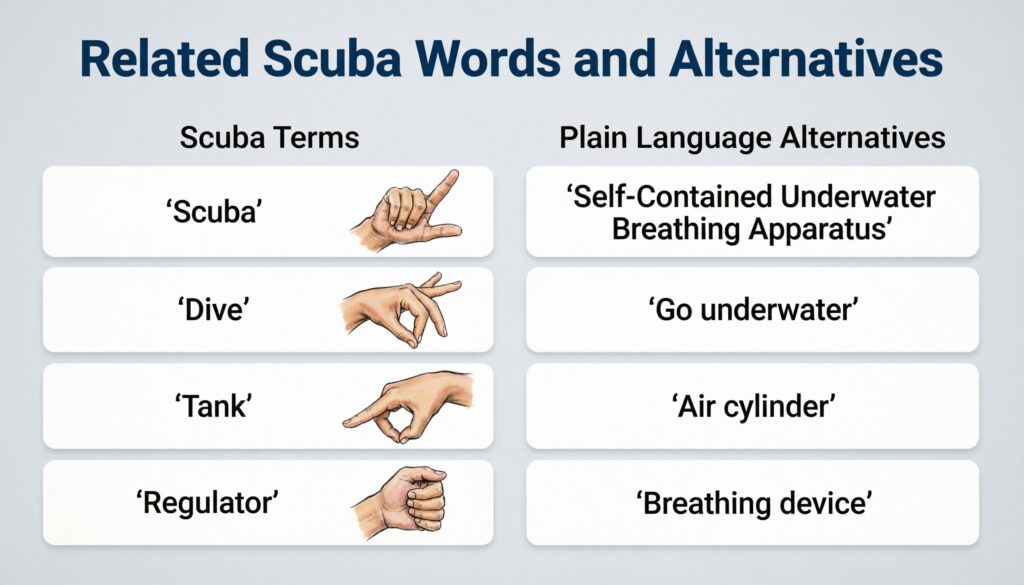
If you’re interested in scuba slang meaning, you may also encounter these related terms:
- Scuba diving
- Diving
- Diver
- Dive buddy
- Dive gear
- Dive shop
- Dive site
- Underwater diving
- Recreational diving
- Technical diving
- Open-water diving
- Freediving
- Snorkeling
- Surface interval
- Safety stop
- Buoyancy
- Regulator
- BCD
- Dive computer
These terms can help you understand conversations about the diving world more easily.
Scuba vs. Freediving
Freediving is another underwater activity, but it differs significantly from scuba diving.
A freediver generally dives while holding their breath rather than breathing from a scuba cylinder underwater.
Scuba diving, on the other hand, uses a breathing apparatus supplied from a carried cylinder.
Both activities involve underwater exploration, but they require different skills, equipment, and training.
How to Respond When Someone Says “Scuba”
If someone says:
“I’m going scuba this weekend.”
You could respond naturally with:
- “That sounds fun!”
- “Where are you diving?”
- “How long have you been scuba diving?”
- “Is this your first dive?”
- “Do you go diving often?”
- “What kind of marine life do you usually see?”
If you’re unsure what they mean, simply ask:
“Do you mean scuba diving?”
That’s perfectly natural.
Is Scuba a Good Word to Use in Casual English?
Yes, especially when the context is already about diving.
For example:
“I love scuba.”
This can sound natural among people familiar with diving.
However, for formal writing, it is often clearer to write:
“I enjoy scuba diving.”
Instead of:
“I enjoy scuba.”
The longer version is more precise and easier for everyone to understand.
Frequently Asked Questions About Scuba Slang Meaning
1. What does scuba mean in slang?
Scuba usually refers informally to scuba diving or scuba-related equipment. It is not generally considered traditional slang.
2. What does SCUBA stand for?
SCUBA stands for Self-Contained Underwater Breathing Apparatus.
3. Is scuba a slang word?
Not exactly. Scuba is an established term that originated as an acronym. People may use it informally as a shortened way of referring to scuba diving.
4. What does “going scuba” mean?
“Going scuba” is an informal expression that usually means going scuba diving.
5. Does scuba have a hidden dating meaning?
There is no widely recognized universal dating or sexual slang meaning for “scuba.” On a dating profile, it normally refers to an interest in scuba diving.
6. What is the difference between scuba and snorkeling?
Scuba diving uses a self-contained underwater breathing system, while snorkeling normally uses a snorkel for breathing at the surface.
7. What are some common scuba slang terms?
Common informal or specialized diving terms include dive buddy, dive gear, reg, tank, bottom time, safety stop, surface interval, BCD, and dive site.
Conclusion
Understanding scuba slang meaning is easier once you know that “scuba” is primarily a diving-related term rather than traditional internet slang. It comes from Self-Contained Underwater Breathing Apparatus and has become a normal part of everyday English.
In casual conversations, people may shorten “scuba diving” to simply “scuba.” For example, “I love scuba” generally means “I love scuba diving.” On social media, dating profiles, travel posts, and text messages, the meaning is usually connected to underwater exploration or diving as a hobby.
The most important thing is context. If “scuba” appears alongside words such as “dive,” “ocean,” “gear,” “tank,” or “underwater,” its meaning is almost certainly related to scuba diving.
So the next time you see someone write “I’m going scuba,” you don’t need to search for a complicated hidden definition—it most likely means they’re heading underwater for a dive.
Quick takeaway: Scuba is an acronym-turned-word associated with underwater breathing equipment, and its casual use often simply means scuba diving.
Discover More Articles:
- Whale Tail Slang Meaning: What Does “Whale Tail” Mean in Slang?
- Is Huckleberry Slang? Meaning, History, and Common Uses
- What Does DWS Mean in Chatting and Online Conversations?

Hi, I’m Ethan Walker, founder of GrammarNestz. Passionate about language, writing, and clear communication, I help learners and writers improve their grammar skills through practical tips, easy-to-understand guides, and engaging content.