
If you have come across the word dado and wondered what it means, you are not alone. The dado meaning can change depending on the context in which it is used. In everyday English, architecture, woodworking, furniture, and even games, “dado” can refer to different things. This makes the word interesting but sometimes confusing for English learners and casual readers.
In simple terms, dado commonly refers to the lower part of an interior wall, especially the section below a decorative line or molding. In woodworking, a dado is also a groove or channel cut into a piece of wood so another piece can fit into it. The word has been used for centuries and remains useful in modern design and construction. Understanding these meanings can help you recognize the word when you see it in conversations, books, DIY guides, or home-improvement content.
What Is the Dado Meaning?
The word dado has several meanings, but its most common meanings are related to architecture and woodworking.
Dado Meaning in Simple English
A dado can mean:
- The lower part of an interior wall, usually decorated differently from the upper part.
- A groove or rectangular channel cut into wood.
- In architecture, the lower section of a pedestal or column.
- A woodworking joint made by cutting a groove into one board so another board can fit inside it.
The exact meaning depends on the sentence.
Dado Definition
Dado is generally defined as the lower section of a wall or the rectangular groove cut into wood for joining pieces together.
For example:
“The designer used blue tiles on the dado of the bathroom wall.”
Here, dado refers to the lower part of the wall.
Another example is:
“Cut a dado into the board before installing the shelf.”
In this sentence, it means a groove cut into wood.
Dado Meaning in Architecture
One of the oldest uses of dado is found in architecture and interior design.
In a room, the lower section of a wall may be treated differently from the upper section. It might have:
- Decorative panels
- Tiles
- Wood
- Paint in a different color
- Stone
- Wallpaper
- Molding
This lower section can be called the dado.
Traditionally, a dado was often used to protect the lower part of a wall from dirt, furniture, and everyday wear.
Example of a Dado in a Room
Imagine a dining room with:
- White paint on the upper wall
- Dark wooden panels on the bottom three feet
- A decorative molding separating the two sections
The wooden lower section can be described as the dado.
This design is still seen in:
- Traditional homes
- Hotels
- Restaurants
- Historic buildings
- Offices
- Classic interior designs
Dado Meaning in Woodworking
Another important dado meaning is used in woodworking.
A dado is a groove or channel cut across the grain of a piece of wood. Another piece of wood can fit into this groove.
For example, a carpenter might cut a dado into the side of a cabinet and insert a shelf into it.
This creates a strong and neat connection.
Simple Woodworking Example
Suppose you are building a bookshelf.
You have a vertical wooden panel and want to attach a shelf securely.
Instead of simply placing the shelf against the side panel, you can cut a groove into the panel. The shelf then fits into that groove.
That groove is called a dado.
Why Are Dados Used?
Dados are useful because they can:
- Strengthen furniture joints
- Hold shelves securely
- Improve alignment
- Create a clean appearance
- Reduce movement between wooden pieces
- Make furniture more durable
Dado vs. Groove: What Is the Difference?
The terms dado and groove are sometimes used interchangeably, but traditional woodworking definitions distinguish them.
| Term | Meaning |
|---|---|
| Dado | A groove cut across the grain |
| Groove | A channel cut along the grain |
| Rabbet | A recess cut along an edge of a board |
| Mortise | A hole or recess designed to receive a tenon |
The distinction can vary slightly depending on woodworking traditions and regions.
For beginners, the easiest way to remember it is:
Dado = a channel cut across the board, commonly used for joining pieces.
Dado Meaning in Furniture
You may also encounter dado when reading about furniture construction.
Cabinets, bookshelves, drawers, and other wooden structures may use dado joints.
For example:
“The shelves were installed using dado joints.”
This means the shelves were fitted into grooves cut into the cabinet sides.
Why Dado Joints Are Popular
Dado joints are valued because they provide a combination of:
- Strength
- Stability
- Accurate positioning
- Clean construction
- Professional appearance
They are especially common in cabinetmaking and traditional woodworking.
Dado Meaning in Interior Design
In interior design, the word dado can describe a decorative treatment applied to the lower part of a wall.
A designer might create a dado using:
- Wooden wall panels
- Ceramic tiles
- Marble
- Decorative molding
- Paint
- Beadboard
- Wainscoting
Dado and Wainscoting
The terms dado and wainscoting are related, but they are not always exact synonyms.
Wainscoting generally refers to decorative wall paneling, traditionally covering part or all of the lower wall.
A dado refers more specifically to the lower section of a wall or architectural surface.
In modern interior design, these terms can overlap.
Dado Meaning in Construction
In construction and building discussions, dado often refers to the lower portion of a wall that receives a different material or finish.
For example, bathrooms and kitchens may have tiled lower walls.
A person might say:
“The bathroom dado should be tiled up to the required height.”
In this context, the dado helps protect the wall from:
- Water
- Dirt
- Scratches
- Furniture impact
- General wear
This is why dado treatments can be both decorative and practical.
Dado Height: How High Is a Dado?
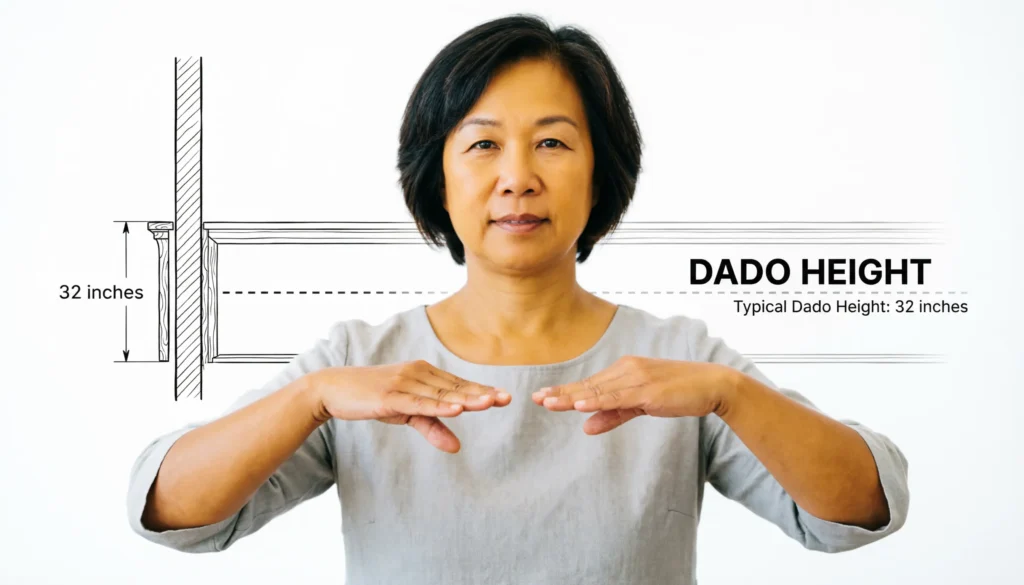
There is no single universal height for a dado.
The height depends on:
- Room design
- Building style
- Purpose
- Materials
- Interior designer preference
- Local construction practices
Historically, dados were often designed around furniture and human use. Modern interiors may use different heights depending on the desired visual effect.
For example, a designer might create a dado around one-third of the wall height, while another design may use a much shorter or taller treatment.
So, dado height is not a fixed measurement.
Historical Background of the Word Dado
The word dado has a long history in architecture.
It ultimately comes from an Italian word associated with the lower part or base of an architectural structure. The term became established in English architectural vocabulary over time.
Historically, architects used the word to describe the lower part of a pedestal. Later, its use expanded to describe the lower section of an interior wall.
This is why you may find dado in older architectural books, historic-house descriptions, and classical design discussions.
Dado Meaning in a Sentence
Seeing the word in sentences is one of the easiest ways to understand it.
Here are several examples:
Architecture
“The architect decorated the dado with marble panels.”
Interior Design
“The room has a wooden dado that gives it a traditional appearance.”
Construction
“The contractor installed ceramic tiles along the wall’s dado.”
Woodworking
“The carpenter cut a dado to hold the shelf.”
Furniture
“The cabinet uses dado joints for the shelves.”
DIY
“Use a router to create a clean dado in the wooden panel.”
These examples show why context is important when understanding the dado meaning.
What Is a Dado Joint?
A dado joint is a woodworking joint created when one piece of wood fits into a groove cut into another piece.
For example:
Side Panel
│        │
│  ──────│  ← Shelf fits into the dado
│        │
│        │
The groove provides a place for the shelf to sit.
Advantages of Dado Joints
Dado joints can offer:
- Strong support
- Good alignment
- A clean appearance
- Better load distribution
- Reliable shelf installation
They are especially useful in cabinet and furniture construction.
Types of Dado Joints
Depending on the design, woodworkers may use different variations.
1. Through Dado
A through dado extends completely across the width of the board.
The groove is visible from both edges.
2. Stopped Dado
A stopped dado does not extend all the way across the board.
The groove ends before reaching one or both edges, creating a cleaner appearance.
3. Rabbet and Dado Combination
In some furniture designs, a dado may be combined with a rabbet or another joint to create additional strength.
Each method has its own practical applications.
Dado vs. Rabbet
People who are new to woodworking sometimes confuse dado with rabbet.
A dado is typically a groove cut into the face of a board.
A rabbet is usually a recess cut along the edge of a board.
Easy Way to Remember
Think of it like this:
- Dado: groove in the middle or face of a board
- Rabbet: cut or step along an edge
Both can be used to connect wooden pieces, but they are made differently.
Common Misunderstandings About Dado
Because the word has multiple meanings, several misunderstandings are common.
Misunderstanding 1: Dado Always Means a Wall
Not necessarily.
In interior design, it often refers to the lower section of a wall. In woodworking, it commonly means a groove.
Misunderstanding 2: Dado Is the Same as Paint
No.
A dado describes a part of a wall or architectural treatment, not a particular type of paint.
The dado could be made from paint, wood, tiles, stone, or another material.
Misunderstanding 3: Every Groove Is a Dado
Not always.
Traditional woodworking terminology distinguishes a dado from a groove based primarily on its direction relative to the wood grain.
Misunderstanding 4: Dado Has Only One Meaning
This is probably the biggest misunderstanding.
The meaning depends heavily on context.
Related Words and Concepts
If you are learning vocabulary related to dado, these terms may also be useful:
- Wainscoting – decorative wall paneling, usually on the lower portion of a wall
- Molding – decorative strips used around walls, ceilings, doors, or other surfaces
- Baseboard – trim installed at the bottom of an interior wall
- Groove – a long narrow channel cut into a surface
- Rabbet – a recess cut along the edge of a board
- Mortise – a cavity made to receive another piece of wood
- Tenon – a projecting piece designed to fit into a mortise
- Paneling – material used to cover or decorate walls
- Joinery – the craft of connecting pieces of wood
Learning these related terms makes it much easier to understand woodworking and interior-design articles.
How to Use “Dado” Correctly

If you want to use dado in your English writing, first identify which meaning you need.
For Interior Design
Use it when talking about the lower section of a wall.
Example:
“The designer added decorative panels to the dado.”
For Woodworking
Use it when talking about a groove cut into wood.
Example:
“The shelf fits securely into the dado.”
For Architecture
Use it when describing the lower section of a pedestal or architectural feature.
Example:
“The statue stands on a pedestal with a decorated dado.”
Dado in Modern Interior Design
Although the word has historical roots, the concept remains relevant today.
Modern designers may use contrasting lower-wall finishes to create visual interest.
For example:
- Light wall + dark wood dado
- Plain wall + patterned tile dado
- Neutral paint + textured panels
- Marble dado + painted upper wall
A dado can also make a room feel more structured because it visually divides the wall into sections.
Practical Tips for Understanding “Dado”
When you encounter the word dado, ask yourself:
- Is the text discussing a wall?
- Is it talking about furniture?
- Is the topic woodworking?
- Is it describing architecture?
- Is a groove or joint being discussed?
If the answer is about a wall, dado probably means the lower wall section.
If the answer is about cutting wood, it probably means a groove or channel.
This simple context check can help you understand the word quickly.
Dado Meaning: Quick Summary Table
| Context | Meaning of Dado |
|---|---|
| Interior design | Lower section of an interior wall |
| Architecture | Lower part of a pedestal or architectural structure |
| Woodworking | Groove cut into a piece of wood |
| Furniture | Groove used to receive another wooden component |
| Construction | Lower wall treatment, often decorative or protective |
Frequently Asked Questions About Dado Meaning
1. What does dado mean in simple English?
In simple English, dado usually means either the lower part of an interior wall or a groove cut into wood. The correct meaning depends on the context.
2. What is a dado on a wall?
A dado on a wall is the lower section that is treated differently from the upper wall. It may be covered with tiles, wood, paint, stone, or decorative panels.
3. What is a dado in woodworking?
In woodworking, a dado is a groove or channel cut into a board, commonly used to hold another piece of wood, such as a shelf.
4. Is dado the same as wainscoting?
Not exactly. The terms are related, and they can overlap in modern interior-design language. However, dado refers more broadly to the lower section of a wall, while wainscoting usually refers to decorative wall paneling.
5. What is a dado joint?
A dado joint is a woodworking joint where one piece of wood fits into a groove cut into another piece. It is commonly used in cabinets, bookshelves, and furniture.
6. What is the difference between a dado and a groove?
Traditionally, a dado is a groove cut across the grain, while a groove is generally cut along the grain. Exact terminology can vary among woodworkers and regions.
7. Where does the word dado come from?
The English architectural term dado has Italian roots and was historically used for the lower part of a pedestal. Its meaning later expanded to include the lower part of an interior wall.
Conclusion:
The dado meaning becomes much easier to understand when you consider the context. In interior design and architecture, a dado usually refers to the lower part of a wall or architectural structure. In woodworking, it commonly means a groove cut into wood, often to create a strong joint for shelves or other components.
The word may look unfamiliar at first, but it is useful vocabulary if you are interested in architecture, home design, construction, furniture, or woodworking.
The easiest way to remember it is:
Dado = lower wall section in interior design OR a groove used in woodworking.
When you see the word in a sentence, look at the surrounding words. If the discussion involves walls, tiles, or decoration, it probably refers to a wall treatment. If it involves cutting boards, shelves, or furniture joints, it probably refers to a woodworking groove. Once you understand these two main meanings, recognizing and using dado becomes much simpler.
Discover More Articles:
- Hakuna Matata Meaning: What Does It Really Mean?
- IMY Meaning: What Does IMY Mean in Texting and Social Media?
- Overwhelmed Meaning and Synonyms You Should Know

Emily Thompson is an English language educator and grammar writer at grammarnestz.com. She specializes in grammar rules, vocabulary development, writing skills, and language-learning resources for students and professionals.