
If you have ever looked at the sidewall of a tire and wondered what numbers like 225/55R17 actually mean, you are not alone. Understanding tire size meaning can make buying replacement tires, checking compatibility, and maintaining your vehicle much easier. Those letters and numbers are not random—they provide important information about the tire’s width, aspect ratio, construction type, wheel diameter, and overall fit.
Knowing how to read a tire size can also help you avoid buying the wrong tires for your car. Whether you are replacing worn tires, upgrading your wheels, shopping online, or simply trying to understand your vehicle better, learning how tire sizes work is a useful skill.
In this guide, we will explain tire size meaning in simple English, break down each number and letter, provide real-world examples, discuss related tire measurements, and answer common questions drivers have about tire sizes.
What Does Tire Size Mean?
Tire size refers to a standardized set of numbers and letters printed on the sidewall of a tire. This information tells you the tire’s main physical dimensions and construction.
For example, consider this tire size:
225/55R17 97V
Each part provides specific information:
| Part | Meaning |
|---|---|
| 225 | Tire width in millimeters |
| 55 | Aspect ratio |
| R | Radial construction |
| 17 | Wheel diameter in inches |
| 97 | Load index |
| V | Speed rating |
The first four parts are usually what people mean when they talk about the basic tire size. The load index and speed rating provide additional information about the tire’s capabilities.
Understanding these markings helps you select a tire that fits your vehicle correctly.
How to Read a Tire Size
Let’s break down 225/55R17 step by step.
1. The First Number: Tire Width
The first number represents the tire’s width in millimeters, measured from one sidewall to the other.
For example:
225/55R17
The number 225 means the tire is approximately 225 millimeters wide.
Some common tire widths include:
- 185 mm
- 195 mm
- 205 mm
- 215 mm
- 225 mm
- 235 mm
- 245 mm
- 255 mm
- 275 mm
A wider tire can provide a larger contact area with the road, but wider does not automatically mean better. Vehicle design, driving conditions, wheel specifications, and tire type all matter.
2. The Second Number: Aspect Ratio
The second number is the tire’s aspect ratio.
In 225/55R17, the 55 means the sidewall height is approximately 55% of the tire’s width.
So, the sidewall height is calculated like this:
225 × 0.55 = 123.75 mm
That means the sidewall is approximately 123.75 millimeters high.
A lower aspect ratio generally means a shorter sidewall. For example:
- 225/65R17 → taller sidewall
- 225/55R17 → medium sidewall
- 225/45R17 → shorter sidewall
Lower-profile tires can provide a sportier appearance and handling characteristics, while tires with taller sidewalls can provide more cushioning over bumps.
3. The Letter R: Radial Construction
The R in a tire size stands for radial construction.
Radial tires use reinforcing cords arranged in a radial direction across the tire. This type of construction has become the standard for most modern passenger vehicles.
You may occasionally see other construction markings, although they are much less common on ordinary modern passenger cars.
4. The Last Number: Wheel Diameter
The number after the construction letter represents the wheel diameter in inches.
In 225/55R17, the number 17 means the tire is designed to fit a 17-inch wheel.
Examples:
- R15 = 15-inch wheel
- R16 = 16-inch wheel
- R17 = 17-inch wheel
- R18 = 18-inch wheel
- R20 = 20-inch wheel
It is important to understand that a 17-inch tire does not fit a 16-inch wheel simply because the width is similar. The tire’s bead must match the wheel diameter.
What Do the Numbers After the Tire Size Mean?
You may see something like:
225/55R17 97V
The 97V provides additional information.
Load Index
The number 97 is the tire’s load index.
The load index corresponds to a maximum load capacity according to standardized tire-rating tables.
A higher number generally represents a higher load capacity, but you should not simply choose the highest number available. Your vehicle manufacturer specifies appropriate load requirements.
Speed Rating
The letter V represents the tire’s speed rating.
Common speed-rating letters include:
- T
- H
- V
- W
- Y
Each rating corresponds to a standardized maximum speed capability under specified conditions.
Your vehicle’s recommended tire specification should always be considered when selecting a speed rating.
Tire Size Example Explained
Let’s take another common example:
205/60R16 92H
Here’s what it means:
- 205 = 205 mm tire width
- 60 = sidewall height is 60% of tire width
- R = radial construction
- 16 = designed for a 16-inch wheel
- 92 = load index
- H = speed rating
The basic size is therefore 205/60R16.
The additional 92H tells you about the tire’s load and speed rating.
Why Is Tire Size Important?
Choosing the correct tire size is important for several reasons.
Vehicle Safety
Your tires are the only parts of your vehicle that directly contact the road. Using an unsuitable tire can affect handling, braking, stability, and overall vehicle behavior.
Proper Fit
The tire needs to fit the wheel correctly and provide enough clearance around the vehicle’s suspension and body components.
Handling
Changing tire width or sidewall height can affect steering response and handling characteristics.
Fuel Economy
Tire size, construction, tread design, inflation pressure, and rolling resistance can all influence fuel consumption.
Speedometer Accuracy
Changing the overall tire diameter significantly can affect the relationship between actual vehicle speed and the speed shown on the speedometer.
Where Can You Find Your Tire Size?
The easiest place to find your current tire size is the sidewall of the tire.
You might see:
P 215/60R16 95H
You can also usually find the recommended tire size in:
- The vehicle owner’s manual
- The tire information label
- The driver’s door jamb
- The vehicle manufacturer’s documentation
The label inside the driver’s door area is particularly useful because it often provides recommended tire sizes and inflation pressures.
What Does the “P” Mean in Tire Size?
Sometimes a tire size begins with a letter.
For example:
P215/60R16
The P generally indicates a tire intended for passenger vehicles under the relevant tire classification system.
You may also encounter other prefixes depending on the vehicle and tire standard.
For example, light-truck applications can use markings such as LT.
The important thing is to understand that the prefix can provide information about the tire’s intended application.
What Does “LT” Mean on a Tire?
LT generally indicates a tire designed for light-truck applications.
For example:
LT265/70R17
The LT designation tells you that the tire belongs to a different tire classification than a standard passenger-car tire.
Light trucks, SUVs, vans, and work vehicles may have different load requirements, so choosing tires based solely on width and wheel diameter is not enough.
Tire Size and Overall Diameter
One of the most important measurements when comparing tire sizes is overall tire diameter.
A tire’s approximate overall diameter can be calculated using its width, aspect ratio, and wheel diameter.
For example, with:
225/55R17
The sidewall height is:
225 × 0.55 = 123.75 mm
There are two sidewalls, so:
123.75 × 2 = 247.5 mm
A 17-inch wheel has a diameter of approximately:
17 × 25.4 = 431.8 mm
Therefore, the approximate overall diameter is:
431.8 + 247.5 = 679.3 mm
This calculation is useful when comparing alternative tire sizes.
What Is a Tire Size Calculator?
A tire size calculator is a tool that compares two or more tire sizes.
It can help estimate differences in:
- Overall diameter
- Sidewall height
- Tire circumference
- Revolutions per mile
- Speedometer difference
For example, if you are considering changing from 225/55R17 to another size, a tire size calculator can show how the dimensions compare.
However, calculator results do not automatically mean a particular tire size is safe or approved for your vehicle. Physical clearance, wheel width, load requirements, manufacturer specifications, and other factors still matter.
Plus Sizing Explained
Plus sizing refers to changing to a larger wheel diameter while maintaining a similar overall tire diameter.
For example, a vehicle might use:
215/60R16
and an alternative setup could use a larger wheel with a lower-profile tire.
The goal is often to maintain a similar overall diameter while changing wheel and tire proportions.
Plus sizing can change:
- Appearance
- Steering response
- Ride comfort
- Handling characteristics
- Wheel protection
- Tire availability
It should be done according to vehicle and tire manufacturer recommendations.
Does a Bigger Tire Mean Better Performance?
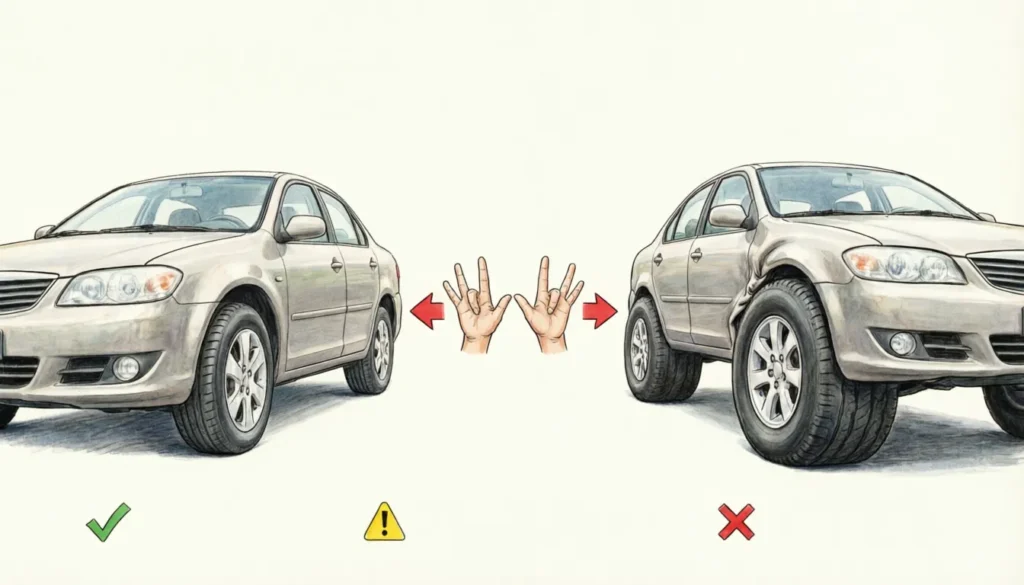
Not necessarily.
A larger or wider tire may change the vehicle’s handling, but several factors influence performance.
These include:
- Tire compound
- Tread pattern
- Tire construction
- Tire pressure
- Vehicle weight
- Suspension setup
- Wheel size
- Driving conditions
A premium tire in the correct factory size can perform better for a particular vehicle than a larger tire chosen simply because it looks more aggressive.
Wider Tires vs. Narrower Tires
Drivers sometimes wonder whether wider tires are better.
Potential characteristics of wider tires
Wider tires can potentially provide:
- A larger contact patch
- Different dry-road handling characteristics
- A sportier appearance
However, they can also affect:
- Steering effort
- Road noise
- Fuel consumption
- Hydroplaning behavior
- Ride comfort
Potential characteristics of narrower tires
Narrower tires may offer:
- Lower rolling resistance in some applications
- Different wet-weather characteristics
- Lighter steering feel
- Potentially better performance in certain snow conditions
There is no universal “best” width. The correct size depends on the vehicle and intended use.
Does Tire Size Affect Fuel Economy?
Yes, tire selection can influence fuel economy.
However, tire size is only one factor.
Other important factors include:
- Tire pressure
- Tire weight
- Rolling resistance
- Tread design
- Wheel weight
- Driving style
- Vehicle condition
- Road conditions
A wider tire or heavier wheel-and-tire combination may increase rolling resistance in some situations.
Maintaining the recommended tire pressure is one of the simplest things you can do to support proper tire performance and efficiency.
Does Tire Size Affect Ride Comfort?
Yes.
The aspect ratio is particularly relevant.
A tire with a taller sidewall generally has more sidewall material available to absorb road imperfections.
For example, compare:
225/65R17
with:
225/45R17
The 65-series tire has a taller sidewall than the 45-series tire.
A lower-profile tire may provide sharper steering response, while a taller sidewall can offer a more cushioned ride depending on the overall vehicle setup.
Common Tire Size Misconceptions
There are several misunderstandings about tire sizes.
Misconception 1: Bigger tires are always better
Bigger is not automatically better. The vehicle is designed around specific tire and wheel dimensions.
Misconception 2: Any tire with the same wheel diameter will fit
Not necessarily.
A 17-inch wheel diameter alone does not tell you whether the tire has the correct width, load capacity, construction, or clearance.
Misconception 3: The first number is the tire diameter
It is not.
In 225/55R17, the 225 refers to approximate tire width in millimeters.
Misconception 4: The second number is the sidewall height in millimeters
It is not.
The 55 represents a percentage of the tire’s width.
Misconception 5: All cars can use different tire sizes
Some vehicles have approved alternative sizes, while others have more limited options.
Always check the manufacturer’s recommendations before changing tire size.
How to Choose the Correct Tire Size
If you need replacement tires, follow these steps.
Step 1: Check your vehicle’s recommended size
Look at the owner’s manual or vehicle tire-information label.
Step 2: Check the current tire
Read the numbers printed on the sidewall.
Step 3: Compare the complete specification
Don’t look only at width.
Check:
- Tire width
- Aspect ratio
- Construction
- Wheel diameter
- Load index
- Speed rating
Step 4: Consider your driving conditions
Think about whether you mainly drive in:
- Cities
- Highways
- Rainy conditions
- Hot climates
- Snowy areas
- Off-road environments
Step 5: Confirm compatibility
Before purchasing a different size, confirm that it is approved for your specific vehicle and wheel setup.
Tire Size vs. Wheel Size
These terms are sometimes confused.
Wheel size generally refers to the wheel’s diameter, such as 17 inches.
Tire size describes a much broader set of dimensions.
For example:
225/55R17
contains information about:
- Width
- Aspect ratio
- Construction
- Wheel diameter
So, saying “I have 17-inch tires” does not provide enough information to identify the complete tire size.
How Tire Size Changes Can Affect Your Car
Changing tire size can influence several characteristics.
| Change | Possible Effect |
|---|---|
| Wider tire | Different handling and road contact |
| Taller sidewall | More sidewall cushioning |
| Lower profile | Sharper response but potentially firmer ride |
| Larger wheel | Different appearance and handling characteristics |
| Larger overall diameter | Can affect gearing and speedometer readings |
| Smaller overall diameter | Can also affect gearing and speedometer readings |
These are general effects. The actual result depends on the vehicle and tire combination.
Tire Size and Speedometer Accuracy
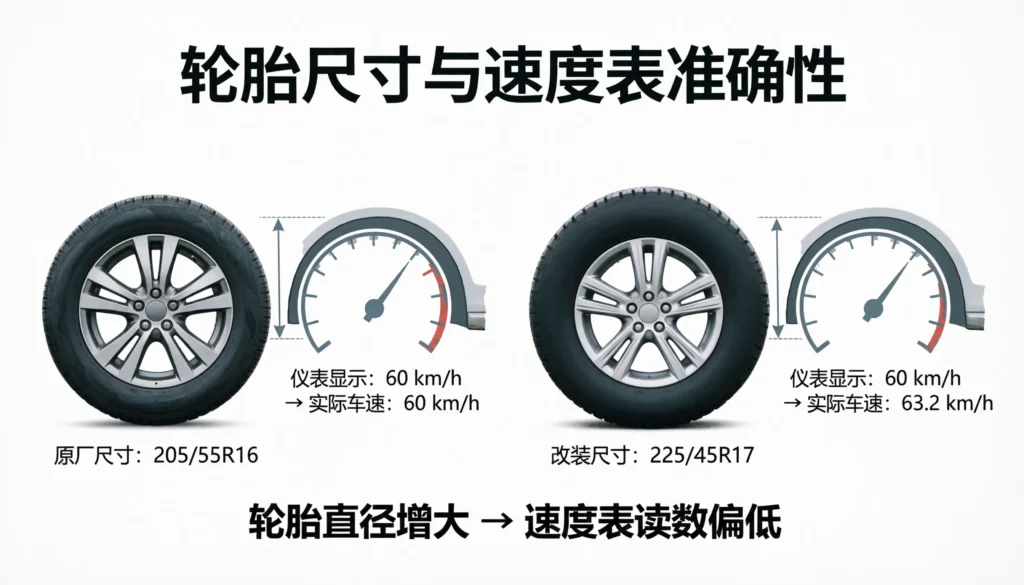
Your vehicle’s speedometer is calibrated around the expected tire circumference.
If you install a tire with a substantially different overall diameter, the tire completes a different number of revolutions over the same distance.
For this reason, changing tire size can affect speedometer readings.
This is one reason why maintaining a similar overall diameter is important when changing wheel and tire combinations.
Tire Pressure Matters Too
Knowing your tire size is useful, but tire pressure is equally important.
Do not use the maximum pressure printed on the tire sidewall as your normal target simply because it is listed there.
Instead, follow the vehicle manufacturer’s recommended cold tire pressure, normally found on the vehicle’s tire-information label or in the owner’s manual.
Correct inflation supports:
- Handling
- Tire wear
- Fuel efficiency
- Ride quality
- Safety
Check tire pressure regularly, especially before long trips.
Related Tire Terms You Should Know
If you are learning about tire sizes, these terms are worth knowing.
Tread
The tread is the part of the tire that contacts the road.
Sidewall
The sidewall is the area between the tread and the wheel.
Bead
The bead is the part of the tire that sits against the wheel rim.
Tread Width
This describes the width of the tread area rather than necessarily the tire’s overall section width.
Overall Diameter
This is the approximate height of the mounted tire from one side to the other.
Load Index
The load index indicates the tire’s standardized load-carrying capacity.
Speed Rating
The speed rating indicates the tire’s standardized speed capability under specified conditions.
A Quick Tire Size Cheat Sheet
Here’s a simple way to remember the basic pattern:
225 / 55 R 17
- 225 → Width
- 55 → Aspect ratio
- R → Radial
- 17 → Wheel diameter
And:
97V
- 97 → Load index
- V → Speed rating
Once you understand this pattern, reading most modern passenger-car tire sizes becomes much easier.
Frequently Asked Questions About Tire Size Meaning
1. What does tire size mean?
Tire size is a standardized combination of numbers and letters that describes important tire dimensions and specifications, including width, aspect ratio, construction, wheel diameter, load index, and speed rating.
2. What does 225/55R17 mean?
225/55R17 means the tire is approximately 225 mm wide, has a 55% aspect ratio, uses radial construction, and fits a 17-inch wheel.
3. Is a higher aspect ratio better?
Not necessarily. A higher aspect ratio means a taller sidewall, which can influence ride comfort and handling. The appropriate aspect ratio depends on the vehicle and manufacturer’s specifications.
4. Can I put a different tire size on my car?
Sometimes alternative tire sizes are approved for a vehicle, but you should verify compatibility before making a change. Wheel width, clearance, load rating, speed rating, and overall diameter all matter.
5. Does tire size affect fuel economy?
It can. Tire width, weight, rolling resistance, wheel size, tire pressure, and tread design can all influence fuel consumption.
6. Where can I find my car’s correct tire size?
You can usually find the recommended tire size in the owner’s manual, on the vehicle’s tire-information label, or sometimes on the driver’s door-area label.
7. What is the easiest way to understand tire numbers?
Read the size from left to right. In 225/55R17, the first number is width, the second is aspect ratio, R indicates radial construction, and the final number is wheel diameter.
Conclusion
Understanding tire size meaning does not have to be complicated. Once you know what each number and letter represents, a tire marking such as 225/55R17 97V becomes much easier to understand.
Remember the basic formula:
First number = width
Second number = aspect ratio
R = radial construction
Last number = wheel diameter
Then look at the additional load index and speed rating to understand more about the tire’s specifications.
Before buying replacement tires or changing sizes, always check your vehicle manufacturer’s recommendations. Don’t choose a tire simply because it looks bigger, wider, or more aggressive. The correct tire needs to match your vehicle’s requirements and your driving conditions.
A few minutes spent understanding your tire size can help you shop more confidently, avoid compatibility problems, and make better-informed decisions about your vehicle.
In short, tire numbers tell a story. Learn how to read them, and you will know much more about the tires underneath your car.
Discover More Articles:
- Plethora Meaning: Definition, Examples, Synonyms, and How to Use It
- Bogart Meaning: What Does Bogart Mean in Slang and Everyday Conversation?
- Kumbaya Meaning and Origin: From Song to Modern Expression

Emily Thompson is an English language educator and grammar writer at grammarnestz.com. She specializes in grammar rules, vocabulary development, writing skills, and language-learning resources for students and professionals.