
APRN meaning is most commonly Advanced Practice Registered Nurse. The term describes a registered nurse who has completed advanced education and clinical training to provide a higher level of nursing care. Depending on their specialty, an APRN may assess patients, diagnose certain health conditions, order or interpret tests, prescribe medications where permitted, and develop treatment plans.
If you have seen APRN on a medical website, prescription, hospital document, or a healthcare professional’s name, you may have wondered what these four letters actually mean. APRN is an important healthcare abbreviation, especially when discussing nurses who have responsibilities beyond those traditionally associated with registered nursing.
In this guide, we will explain the APRN meaning, what APRNs do, the different types of APRNs, how APRNs differ from registered nurses and doctors, and where you may encounter this term in everyday healthcare.
What Does APRN Mean?
APRN stands for Advanced Practice Registered Nurse.
An APRN is a registered nurse who has received additional education, specialized clinical training, and professional preparation to provide advanced patient care.
Unlike a standard registered nurse (RN), an APRN can often take on responsibilities that may include:
- Diagnosing certain illnesses and conditions
- Prescribing medications, depending on local laws
- Ordering diagnostic tests
- Interpreting laboratory and imaging results
- Creating treatment plans
- Managing chronic health conditions
- Providing specialized healthcare
- Educating patients and families
- Performing certain advanced procedures
The exact responsibilities of an APRN depend on the person’s specialty, education, certification, and the laws governing nursing practice where they work.
APRN Meaning in Simple English
In simple words, an APRN is a nurse with advanced training who can provide many types of healthcare services that go beyond traditional registered nursing duties.
For example, imagine that you visit a healthcare clinic because you have a persistent cough. An APRN may be able to:
- Ask about your symptoms and medical history.
- Perform a physical examination.
- Order appropriate tests.
- Determine what may be causing the problem.
- Recommend or prescribe treatment when legally authorized.
- Explain how to manage your symptoms.
- Arrange follow-up care if necessary.
This is why APRNs can play an important role in hospitals, clinics, medical offices, community health centers, and other healthcare settings.
What Is an APRN?
An Advanced Practice Registered Nurse is a licensed registered nurse who has completed advanced education and specialized clinical preparation.
The term is broader than a single job title. APRNs work in different specialties and can have very different responsibilities.
The four commonly recognized APRN roles are:
| APRN Type | Common Role |
|---|---|
| Nurse Practitioner (NP) | Provides diagnosis, treatment, and ongoing patient care |
| Certified Nurse-Midwife (CNM) | Provides maternity, reproductive, and women’s healthcare |
| Clinical Nurse Specialist (CNS) | Provides specialized nursing care and clinical expertise |
| Certified Registered Nurse Anesthetist (CRNA) | Provides anesthesia and related care |
Each role has a specific focus, although the exact scope of practice can vary by jurisdiction.
What Does an APRN Do?
The daily work of an APRN depends heavily on their specialty.
Some APRNs work directly with individual patients, while others focus on specialized clinical care, anesthesia, education, or healthcare improvement.
Common APRN responsibilities can include:
1. Patient Assessment
APRN professionals evaluate patients by asking questions about symptoms, medical history, medications, and lifestyle.
They may also perform physical examinations.
2. Diagnosis
Depending on their role and legal scope of practice, APRNs may diagnose illnesses or health conditions.
For instance, a nurse practitioner may evaluate symptoms and determine whether a patient may have an infection, asthma, hypertension, or another condition.
3. Treatment Planning
After evaluating a patient, an APRN may develop or contribute to a treatment plan.
The plan can involve:
- Medication
- Lifestyle changes
- Follow-up appointments
- Diagnostic testing
- Referrals
- Patient education
4. Medication Management
Some APRNs have legal authority to prescribe medications.
However, prescribing authority differs depending on the APRN’s role and the laws of the jurisdiction where they practice.
5. Patient Education
Education is another major part of advanced nursing practice.
An APRN may explain:
- How to take medication
- What symptoms to watch for
- How to manage a chronic condition
- When to seek additional medical attention
- How lifestyle choices can affect health
Types of APRNs
Understanding the different APRN categories can make the term much easier to understand.
Nurse Practitioner (NP)
A Nurse Practitioner is one of the most familiar types of APRN.
NPs can specialize in areas such as:
- Family healthcare
- Adult-gerontology care
- Pediatrics
- Women’s health
- Mental health
- Acute care
- Other specialized fields
Depending on local regulations, an NP may diagnose conditions, prescribe medication, order tests, and manage ongoing healthcare.
For example, a family nurse practitioner may provide routine healthcare to children and adults.
Certified Registered Nurse Anesthetist (CRNA)
A Certified Registered Nurse Anesthetist specializes in anesthesia care.
CRNAs may provide anesthesia for:
- Surgical procedures
- Medical procedures
- Diagnostic procedures
- Pain management in certain settings
Their work requires extensive specialized education and clinical preparation.
Certified Nurse-Midwife (CNM)
A Certified Nurse-Midwife specializes in reproductive and maternity care.
CNMs may provide services related to:
- Pregnancy
- Labor and delivery
- Postpartum care
- Reproductive health
- Family planning
- Routine women’s healthcare
Their exact responsibilities depend on their training, certification, and local regulations.
Clinical Nurse Specialist (CNS)
A Clinical Nurse Specialist is an APRN who focuses on specialized nursing practice.
A CNS may concentrate on a particular:
- Patient population
- Disease or health condition
- Healthcare setting
- Nursing specialty
Clinical nurse specialists can also contribute to patient care, education, research, quality improvement, and healthcare systems.
APRN vs. RN: What Is the Difference?
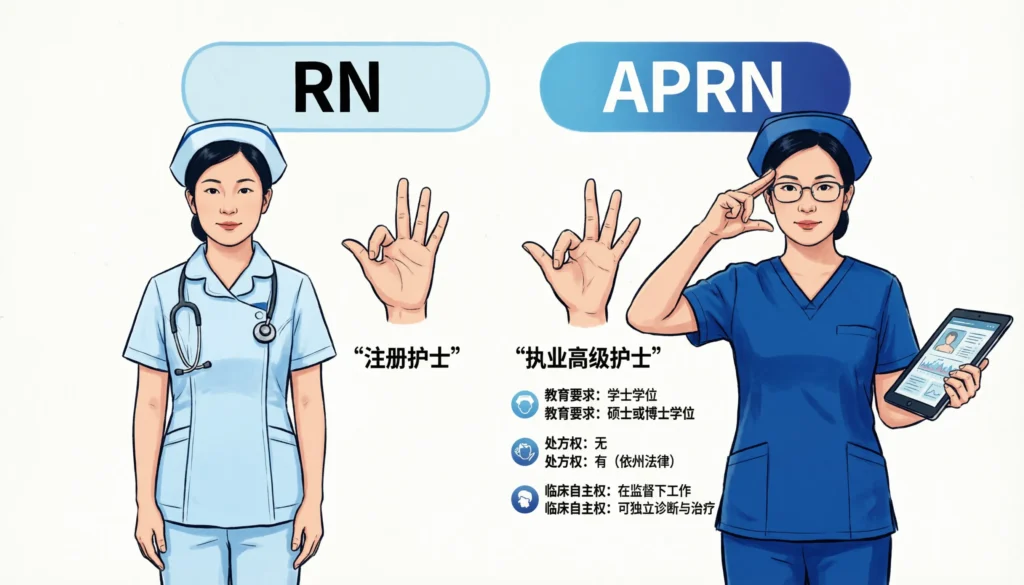
A common question is the difference between an APRN and an RN.
An RN is a registered nurse who has completed the required nursing education and licensing requirements.
An APRN is also a registered nurse, but has completed additional advanced education and specialized preparation.
Here is a simple comparison:
| Feature | RN | APRN |
|---|---|---|
| Registered nurse | Yes | Yes |
| Advanced nursing education | Not necessarily | Yes |
| Specialized advanced practice | Not usually | Yes |
| May diagnose | Usually not independently | Depending on role and law |
| May prescribe | Generally not | Depending on role and law |
| Advanced clinical responsibilities | Limited compared with APRNs | Often broader |
The important point is that an APRN does not represent a completely separate profession from nursing. An APRN builds upon registered nursing education and experience.
APRN vs. Doctor
Another common misunderstanding is that APRNs and physicians are exactly the same.
They are different healthcare professions, although there can be some overlap in the services they provide.
Physicians generally complete medical school followed by residency training and may pursue additional fellowship training.
APRN professionals begin as registered nurses and then complete advanced nursing education and clinical preparation.
Depending on their specialty and local laws, APRNs may provide many healthcare services independently or as part of a healthcare team.
The scope of practice is not identical everywhere. Therefore, you should not assume that every APRN has the same authority.
Where Do APRNs Work?
APRN professionals can work in many different healthcare environments.
Common workplaces include:
- Hospitals
- Primary care clinics
- Private medical practices
- Urgent care centers
- Community health centers
- Specialty clinics
- Women’s health centers
- Surgical settings
- Mental health facilities
- Long-term care facilities
- Academic institutions
- Public health organizations
Their work environment usually depends on their specialty.
For example, a CRNA may spend much of their professional time in surgical or procedural settings, while a family nurse practitioner may work in a primary care clinic.
APRN Meaning in Medical Documents
You may see APRN written after a healthcare professional’s name.
For example:
Jane Smith, APRN
This generally indicates that the professional is an advanced practice registered nurse.
You may also see additional credentials after a person’s name, such as:
Jane Smith, APRN, FNP-C
The additional letters provide more information about the professional’s specific role, certification, or credentials.
Because professional credentialing systems vary, the exact meaning of additional letters should be checked with the relevant licensing or certification organization.
Why Are APRNs Important?
APRN professionals can help expand access to healthcare and provide specialized services to patients.
They can be especially valuable in settings where healthcare resources are limited.
Some of the ways APRNs contribute to healthcare include:
- Providing primary care
- Managing chronic conditions
- Supporting preventive healthcare
- Educating patients
- Providing specialized services
- Helping coordinate care
- Supporting hospitals and healthcare teams
- Providing anesthesia services
- Caring for mothers and newborns
Their role can be particularly important when patients need ongoing care rather than a single medical appointment.
Common Examples of APRN Care
Understanding examples can make the APRN definition easier to remember.
Example 1: Family Healthcare
A patient visits a clinic for high blood pressure.
A nurse practitioner may:
- Review the patient’s medical history
- Check blood pressure
- Order laboratory tests
- Discuss lifestyle changes
- Develop a treatment plan
- Prescribe medication if authorized
- Schedule follow-up care
Example 2: Pregnancy Care
A pregnant patient receives care from a certified nurse-midwife.
The CNM may provide prenatal care, education, monitoring, and support during labor and after childbirth, depending on the setting and scope of practice.
Example 3: Surgery
A patient needs anesthesia for an operation.
A CRNA may be involved in providing anesthesia and monitoring the patient during the procedure.
These examples show why APRN is an umbrella term covering several advanced nursing roles.
Common Misunderstandings About APRN
There are several misconceptions about the term.
Misunderstanding 1: APRN Means Doctor
An APRN is not a physician.
APRN and physician are different professional paths, although certain healthcare responsibilities may overlap.
Misunderstanding 2: Every APRN Has the Same Responsibilities
This is not necessarily true.
A nurse practitioner, nurse-midwife, clinical nurse specialist, and nurse anesthetist have different areas of specialization.
Misunderstanding 3: APRNs Are Simply Experienced RNs
Experience is valuable, but APRN status involves additional education, clinical preparation, certification, and licensing requirements.
It is not simply a title given to an RN after working for a certain number of years.
Misunderstanding 4: Every APRN Can Prescribe Anything
Prescribing authority depends on the APRN’s role and applicable laws and regulations.
The rules can vary significantly between jurisdictions.
APRN Related Terms You Should Know
If you are researching APRN meaning, you may also encounter these terms:
RN
RN means Registered Nurse.
RNs provide direct nursing care and work in many healthcare settings.
NP
NP means Nurse Practitioner.
NPs are one of the major categories of APRNs.
CRNA
CRNA means Certified Registered Nurse Anesthetist.
CRNAs specialize in anesthesia care.
CNM
CNM means Certified Nurse-Midwife.
CNMs specialize in maternity and reproductive healthcare.
Means Clinical Nurse Specialist.
CNS professionals provide specialized nursing expertise and may work in direct patient care, education, research, or quality improvement.
APRN Credentials and Certifications

APRN professionals may have several letters after their names.
These credentials can identify:
- Their advanced practice role
- Their specialty
- Their professional certification
- Their education
- Their professional organization or certification body
For example, FNP-C can refer to a Family Nurse Practitioner certification.
However, credentials vary by country, state, province, organization, and professional specialty.
If you need to verify a healthcare professional’s qualifications, use the relevant official licensing or certification database rather than relying only on the letters after their name.
Is APRN a Job Title?
APRN can be used as a broad professional designation rather than describing one specific job.
For example, two people may both be APRNs while working in completely different areas.
One could be a nurse practitioner providing primary care, while another could be a nurse anesthetist working with surgical patients.
This is why understanding the specific APRN specialty is important.
How to Remember APRN Meaning
A simple way to remember the abbreviation is:
A = Advanced
P = Practice
R = Registered
N = Nurse
So:
APRN = Advanced Practice Registered Nurse
Think of it as a registered nurse who has completed additional advanced preparation for a specialized level of nursing practice.
Frequently Asked Questions About APRN Meaning
1. What does APRN stand for?
APRN stands for Advanced Practice Registered Nurse. It describes a registered nurse with advanced education, clinical preparation, and specialized practice responsibilities.
2. Is an APRN a nurse?
Yes. An APRN is a registered nurse who has completed additional advanced education and clinical preparation.
3. Is an APRN the same as a nurse practitioner?
Not exactly. A nurse practitioner is one type of APRN. Other APRN roles include certified nurse-midwives, clinical nurse specialists, and certified registered nurse anesthetists.
4. Can APRNs prescribe medication?
Some APRNs can prescribe medications, but prescribing authority depends on their professional role and the laws and regulations where they practice.
5. Is an APRN the same as a doctor?
No. APRNs and physicians are different healthcare professionals with different educational and professional pathways. However, some APRNs may provide healthcare services that overlap with services provided by physicians.
6. What is the difference between RN and APRN?
An RN is a registered nurse. An APRN is a registered nurse with additional advanced education and specialized clinical preparation. APRNs may have a broader scope of practice depending on their role and local regulations.
7. What are the four types of APRNs?
The commonly recognized APRN roles are Nurse Practitioner (NP), Certified Nurse-Midwife (CNM), Clinical Nurse Specialist (CNS), and Certified Registered Nurse Anesthetist (CRNA).
Conclusion
The APRN meaning is straightforward: Advanced Practice Registered Nurse. However, the role behind the abbreviation can involve a wide range of advanced healthcare responsibilities.
APRN professionals build on registered nursing education and receive additional preparation for specialized practice. Depending on their specialty, they may assess patients, diagnose conditions, manage treatments, prescribe medications where authorized, provide anesthesia, deliver maternity care, or provide advanced clinical expertise.
The easiest way to remember the term is:
APRN = Advanced Practice Registered Nurse.
If you encounter APRN on a medical document or next to a healthcare professional’s name, look at the additional credentials or specialty to understand exactly what type of advanced practice nurse they are.
Most importantly, remember that APRN responsibilities can differ depending on the professional’s specialty and local laws. When you need information about a particular healthcare professional, checking their official credentials and licensing information is the most reliable approach.
Discover More Articles:
- Copacetic Meaning: Definition, Origin, Examples, and How to Use It
- GMFU Meaning: What Does GMFU Mean in Text and Slang?
- Tire Size Meaning: How to Read and Understand Tire Numbers

Emily Thompson is an English language educator and grammar writer at grammarnestz.com. She specializes in grammar rules, vocabulary development, writing skills, and language-learning resources for students and professionals.