Francium meaning refers to the name and characteristics of one of the rarest naturally occurring elements on Earth. Francium is a chemical element with the symbol Fr and atomic number 87. It belongs to the alkali metal group and is known for being extremely radioactive and highly unstable.
If you have come across the word “francium” in chemistry, science articles, or the periodic table, you may wonder what it means, where it comes from, and why it is considered such a fascinating element. In this guide, we will explain francium meaning, its definition, history, properties, uses, and interesting facts in simple language.
What Is the Meaning of Francium?
The word francium is the name of a chemical element. Its chemical symbol is Fr, and its atomic number is 87.
Francium is classified as an alkali metal, which means it belongs to the same group of elements as lithium, sodium, potassium, rubidium, and cesium.
Simple definition of francium
Francium is a very rare, highly radioactive chemical element with the symbol Fr and atomic number 87.
It occurs naturally in extremely small amounts because its atoms are unstable and quickly undergo radioactive decay.
Francium meaning in simple English
In simple terms:
Francium is a rare radioactive metal found naturally in tiny amounts in uranium and other radioactive decay chains.
Because it is so unstable, scientists cannot collect or store a large amount of francium in the same way they can with ordinary metals.
Francium Meaning in the Periodic Table
Important position on the periodic table of elements.
| Property | Francium |
|---|---|
| Chemical symbol | Fr |
| Atomic number | 87 |
| Element group | 1 |
| Period | 7 |
| Category | Alkali metal |
| State at room temperature | Expected solid |
| Appearance | Not observed in large quantities |
| Radioactive | Yes |
| Natural occurrence | Extremely rare |
| Name origin | France |
| Electron configuration | [Rn] 7s¹ |
Francium is located below cesium in Group 1.
This location is important because elements in the same group generally have similar chemical behavior.
Why Is Francium So Rare?
One of the most interesting things about francium is its extreme rarity.
Francium is produced naturally through radioactive decay, particularly within the decay chains of heavier radioactive elements. However, francium atoms do not survive for very long.
The most stable naturally occurring isotope of francium is francium-223, which has a half-life of only about 22 minutes.
This means that after around 22 minutes, approximately half of a sample of francium-223 would have decayed into other elements.
Because francium disappears so quickly through radioactive decay, there is never a large natural supply of it.
Why can’t we simply collect francium?
There are several reasons:
- It is extremely rare.
- It is highly radioactive.
- Its isotopes have very short half-lives.
- It is continuously produced and destroyed through radioactive processes.
- A large visible sample cannot easily accumulate naturally.
Scientists therefore study francium mostly through tiny quantities produced or observed under controlled conditions.
Who Discovered Francium?
Francium was discovered by Marguerite Perey, a French physicist and chemist.
She discovered the element in 1939 while working at the Radium Institute in Paris.
Perey was studying actinium, a radioactive element. During her research, she identified evidence of a previously unknown radioactive element.
The new element was eventually named francium, after France, Perey’s home country.
The name Francium
The name francium comes from France.
This follows a common tradition in chemistry where elements are named after:
- Places
- Countries
- Scientists
- Mythological figures
- Minerals
- Properties of the element
Francium is one of the elements whose name directly honors a country.
Francium’s Chemical Symbol: Fr
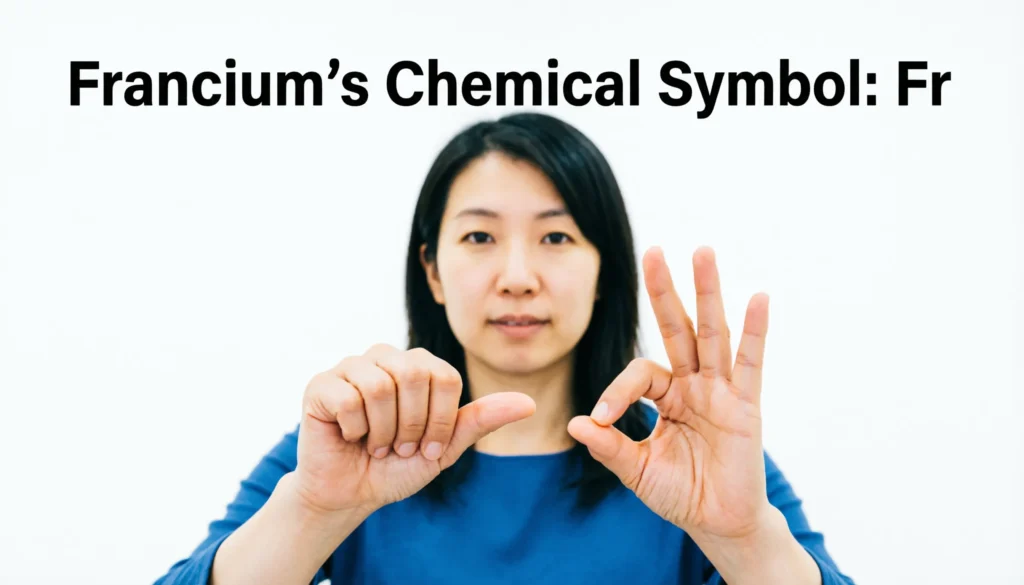
The chemical symbol for francium is Fr.
The first letter is capitalized, while the second letter is lowercase.
For example:
- Francium = Fr
- Sodium = Na
- Potassium = K
- Cesium = Cs
When reading a periodic table, Fr immediately identifies element number 87.
Francium and Radioactivity
Radioactivity is one of the defining characteristics of francium.
A radioactive element contains unstable atomic nuclei. These nuclei naturally change or decay, releasing radiation and often transforming into another element.
Francium is radioactive because all of its known isotopes are unstable.
What does radioactive mean?
In simple language, radioactive means that an atom’s nucleus is unstable and can release energy or particles as it changes into a more stable form.
Francium undergoes radioactive decay relatively quickly compared with many other elements.
This is one reason researchers handle it differently from stable metals such as iron or copper.
Francium’s Position Among Alkali Metals
Francium belongs to Group 1, also called the alkali metals.
The group includes:
- Lithium
- Sodium
- Potassium
- Rubidium
- Cesium
- Francium
These elements generally have one electron in their outermost electron shell.
As you move down the group, atoms generally become larger and their outer electron is held less strongly.
This makes francium particularly interesting to chemists.
Is Francium the Most Reactive Metal?
Francium is traditionally described as the most reactive alkali metal based on its position in the periodic table and predicted chemical behavior.
However, there is an important scientific detail.
Because francium is so rare and radioactive, scientists cannot perform ordinary large-scale chemical experiments with it. As a result, many of its expected properties are based on periodic trends and theoretical calculations rather than extensive direct observation.
Cesium, which is directly above francium, is therefore much more commonly used in actual chemical experiments.
Francium vs. Cesium
| Feature | Francium | Cesium |
|---|---|---|
| Symbol | Fr | Cs |
| Atomic number | 87 | 55 |
| Group | 1 | 1 |
| Radioactive | Yes | Naturally stable |
| Natural abundance | Extremely rare | More abundant |
| Reactivity | Predicted extremely high | Extremely high |
| Practical research | Very limited | Much more extensive |
This distinction is useful when reading claims about francium online.
Physical Properties of Francium
Scientists know some properties of francium from direct measurements, while others are estimated from periodic trends.
Francium is expected to be a soft metal under normal conditions.
Its predicted or known characteristics include:
- Very low natural abundance
- Strong radioactivity
- High chemical reactivity
- Metallic character
- One outer-shell electron
- Very short-lived isotopes
Because no large visible piece of francium exists naturally, descriptions such as its exact appearance should be treated carefully.
What Is Francium Used For?
You might expect an element with such an unusual name and position on the periodic table to have many applications.
In reality, francium has very few practical uses.
Its extreme rarity and radioactivity make it impractical for everyday products and industrial applications.
Scientific research
Francium is primarily important for scientific research.
Researchers can use francium atoms to investigate topics such as:
- Atomic structure
- Nuclear physics
- Fundamental physics
- Atomic spectroscopy
- Electroweak interactions
- Properties of heavy alkali atoms
Because francium has a very heavy nucleus, studying it can help scientists test theories about how atoms and fundamental forces behave.
Why Isn’t Francium Used in Everyday Products?
Francium is not found in common products such as:
- Batteries
- Phones
- Jewelry
- Cooking equipment
- Building materials
- Household chemicals
The main reason is its extreme instability.
A material needs to exist in useful quantities and remain available long enough to be practical. Francium fails both of these requirements.
Even if scientists could produce more of it, handling large quantities would present major radioactive safety challenges.
How Is Francium Produced?
Naturally occurring francium is produced through radioactive decay.
For example, one important pathway involves the decay of actinium-227.
Francium can also be produced artificially in specialized scientific facilities.
However, production creates extremely small quantities because the resulting francium isotopes decay rapidly.
This makes francium fundamentally different from common laboratory metals.
Francium Half-Life Explained
The concept of half-life is essential for understanding francium.
A half-life is the amount of time required for half the radioactive atoms in a sample to decay.
For francium-223, the half-life is roughly 22 minutes.
Imagine starting with 100 francium-223 atoms:
- After about 22 minutes → around 50 remain
- After another 22 minutes → around 25 remain
- After another 22 minutes → around 12–13 remain
The exact behavior of individual atoms is probabilistic, but the overall decay follows a predictable statistical pattern.
This short half-life explains why francium is so difficult to study and why it cannot accumulate naturally in large quantities.
Francium vs. Other Elements
Often compared with other Group 1 elements.
Lithium
Lithium is relatively light and has many practical applications, including rechargeable batteries.
Francium, in contrast, is extremely heavy, radioactive, and rare.
Francium vs. Sodium
Sodium is a common element found in nature and is essential in many chemical and biological processes.
Francium exists only in tiny quantities and has no comparable everyday role.
Francium vs. Potassium
Potassium is important for living organisms and is found in many foods.
Francium has no known essential biological function.
Francium vs. Cesium
Cesium is the closest naturally occurring stable counterpart to francium in Group 1. Cesium is highly reactive but can be studied and used in real-world technologies.
Interesting Facts About Francium
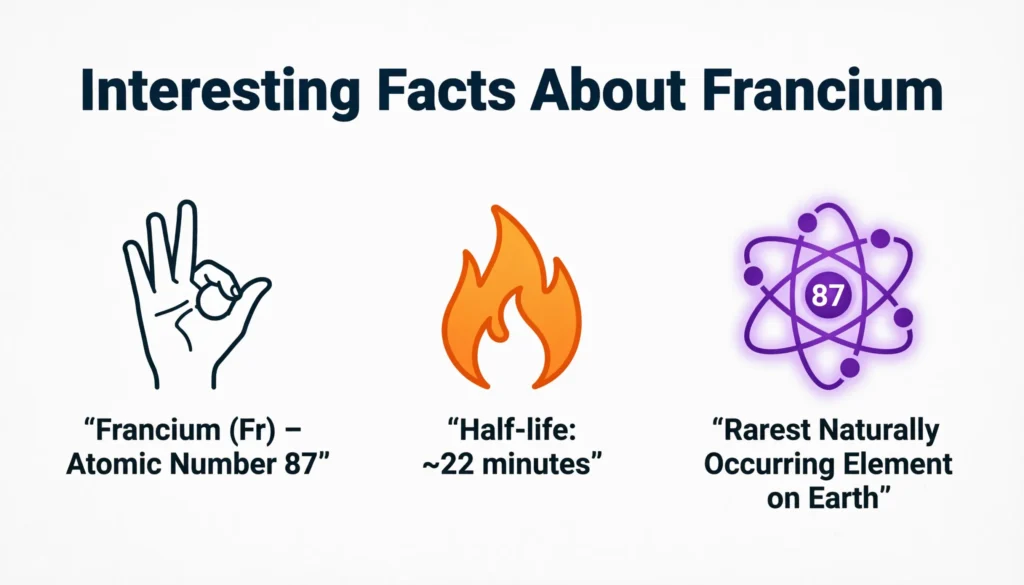
Here are some fascinating francium facts:
1. Francium is element number 87
Its atomic number is 87, meaning a neutral francium atom contains 87 protons.
2. It was named after France
The element’s name honors France.
3. It was discovered in 1939
Marguerite Perey identified francium while studying radioactive elements.
4. It is extremely rare
Only tiny amounts of francium exist naturally at any given time.
5. Francium is highly radioactive
Every known francium isotope is radioactive.
6. It belongs to Group 1
Francium is an alkali metal, like sodium and potassium.
7. Its isotopes are short-lived
The short half-lives of its isotopes prevent francium from accumulating.
8. It has limited practical applications
Its main importance is scientific rather than commercial.
9. It is difficult to observe directly
Scientists generally work with extremely small quantities or individual atoms.
10. It is one of the most fascinating elements on the periodic table
Its combination of rarity, radioactivity, and predicted chemical properties makes it particularly interesting to researchers and chemistry students.
Common Misconceptions About Francium
There are several myths and misunderstandings about francium.
Misconception 1: Francium can easily be collected
It cannot.
Francium occurs in incredibly small quantities and decays rapidly.
Misconception 2: Scientists have large pieces of francium
There is no practical supply of large visible samples comparable to ordinary metals.
Misconception 3: Francium is commonly used in nuclear power
Francium is not a standard fuel or major industrial material for nuclear power.
Misconception 4: Every property of francium has been directly measured
Not necessarily.
Because francium is so difficult to obtain, some properties are inferred from periodic trends, theoretical calculations, or limited experiments.
Misconception 5: Francium is valuable because it is rare
Rarity alone does not make an element commercially valuable.
Francium’s instability and radioactivity make it impractical for normal commercial use.
Francium Meaning in Simple Words
If you need a short answer for school, a quiz, or general understanding, you can remember this:
Francium is a rare and highly radioactive alkali metal with the chemical symbol Fr and atomic number 87. It was discovered by Marguerite Perey in 1939 and named after France.
This sentence captures the most important part of francium meaning.
Why Is Francium Important to Science?
Although francium has little everyday use, it remains scientifically important.
Its position in the periodic table makes it useful for understanding trends among heavy alkali metals.
Scientists can also study francium atoms to investigate fundamental physics.
For students, francium is a good example of how an element can be scientifically important even when it has almost no practical consumer applications.
It also demonstrates an important lesson in chemistry:
Not every element exists in quantities large enough for everyday use.
Related Terms You Should Know
If you are researching francium meaning, these related terms may also help:
- Atomic number – The number of protons in an atom’s nucleus.
- Isotope – A version of an element with a different number of neutrons.
- Radioactive decay – The process by which an unstable nucleus changes.
- Half-life – The time required for half of a radioactive sample to decay.
- Alkali metal – An element belonging to Group 1 of the periodic table.
- Periodic table – A chart organizing chemical elements according to their properties.
- Chemical symbol – A shortened notation used to represent an element.
- Actinium – A radioactive element involved in the natural decay process that produces francium.
Understanding these terms makes the chemistry of francium much easier to follow.
Frequently Asked Questions About Francium
1. What does francium mean?
Francium is the name of a chemical element with the symbol Fr and atomic number 87. It is an extremely rare and radioactive alkali metal.
2. Why is francium called francium?
Francium was named after France. The name was chosen by its discoverer, Marguerite Perey, to honor her country.
3. Who discovered francium?
Marguerite Perey discovered francium in 1939 while studying radioactive actinium at the Radium Institute in Paris.
4. Is francium radioactive?
Yes. All known isotopes of francium are radioactive, and they decay relatively quickly.
5. Is francium found naturally?
Yes, but only in extremely tiny amounts. It is naturally produced through radioactive decay chains.
6. What is francium used for?
Francium has very limited practical use. It is mainly valuable for scientific research involving atomic physics, nuclear physics, and fundamental interactions.
7. Is francium the rarest element?
Francium is often described as one of the rarest naturally occurring elements on Earth. Its extreme rarity is largely due to its short-lived radioactive isotopes.
Conclusion
The francium meaning is simple: francium is a rare, highly radioactive chemical element represented by Fr and identified by atomic number 87. It belongs to the alkali metals and sits at the bottom of Group 1 on the periodic table.
Francium was discovered by Marguerite Perey in 1939 and named after France. Its extreme rarity and short half-life make it very difficult to study in large quantities, which is why it has almost no everyday applications.
If you are learning chemistry, remember these key points:
- Francium = Fr
- Atomic number = 87
- Group = 1
- Type = Alkali metal
- Highly radioactive
- Extremely rare
- Discovered in 1939
- Named after France
- Main importance = scientific research
In short, francium may not be an element you encounter in everyday life, but its unusual properties make it one of the most intriguing elements on the periodic table.
Discover More Articles:
- FTE Meaning in Jobs: Full-Time Equivalent Explained
- TIL Meaning Explained for Beginners and Social Media Users
- Penultimate Meaning: Definition, Usage, Examples & FAQs

Emily Thompson is an English language educator and grammar writer at grammarnestz.com. She specializes in grammar rules, vocabulary development, writing skills, and language-learning resources for students and professionals.