If you have seen someone say “book it,” “I’m gonna book,” or “they booked him,” you may wonder what book slang meaning actually is. The word book has several meanings in modern English, and its slang meaning can change depending on the sentence, situation, and social context.
In everyday conversations, texting, social media, and casual speech, book can mean to leave quickly, make a reservation, or, in some contexts, be arrested or processed by police. You may also encounter expressions such as “book it,” “booked,” and “booking.”
This guide explains the different meanings of book in slang, where these expressions come from, how people use them, and how to understand the meaning from context. Whether you saw the word on TikTok, Instagram, Snapchat, in a text message, or in a conversation, this article will help you understand it clearly.
What Does “Book” Mean in Slang?
The slang meaning of book depends heavily on the phrase in which it appears.
One common informal use is “book it,” meaning to leave or move very quickly.
For example:
“We’re late. Book it!”
Here, book it means hurry up, run, or move quickly.
Another use is related to making a reservation or appointment. Although this meaning is not necessarily slang, it is extremely common in casual communication.
For example:
“I booked a table for tonight.”
In some situations, booked can also refer to someone being arrested or officially processed by police.
For example:
“He got booked after the incident.”
Therefore, there isn’t one single definition of book slang meaning. The surrounding words provide the clue.
Quick Meaning Guide
| Expression | Meaning |
|---|---|
| Book it | Leave or move quickly |
| I’m booking | I’m leaving quickly |
| Book a room | Reserve a room |
| Book a table | Reserve a table |
| Booked by police | Arrested and processed |
| Get booked | Be arrested or officially processed |
| Booking | Reservation or police processing, depending on context |
“Book It” Slang Meaning
One of the most recognizable slang expressions is “book it.”
When someone says “book it,” they usually mean go quickly, run, hurry, or leave fast.
For example:
- “The bus is coming—book it!”
- “We heard the alarm and booked it.”
- “Book it before they see us.”
- “I had five minutes to get there, so I booked it.”
In these examples, book it describes quick movement.
The expression is informal and often appears in conversations between friends. It can also be used humorously.
Example Conversation
Alex: “Are we going to miss the movie?”
Sam: “Probably. Book it!”
Alex: “Okay, let’s go!”
Here, Sam is telling Alex to hurry up.
What Does “I’m Booking” Mean?

When someone says “I’m booking,” the meaning is usually similar to “I’m leaving” or “I’m heading out.”
The exact meaning depends on regional speech and context.
For example:
“It’s getting late. I’m booking.”
This could mean:
“I’m leaving now.”
Another example:
“I’m booking home before the rain starts.”
This means the person is heading home quickly.
Because slang can differ between communities and countries, it is always useful to look at the surrounding conversation.
“Book” Meaning in Texting
In texting, book can be confusing because messages are often short and lack context.
If a friend texts:
“Gotta book.”
They probably mean:
“I have to leave.”
If they text:
“Book it!”
They are probably telling you:
“Hurry up!” or “Run!”
But if someone says:
“I booked the hotel.”
That is not slang. It simply means they reserved the hotel.
Texting Examples
Friend: “Where are you?”
You: “Still at work.”
Friend: “Book it, we’re waiting!”
Meaning: Hurry up and come.
Another example:
Friend: “I gotta book. Talk later.”
Meaning: I have to leave.
Book Slang Meaning on TikTok
On TikTok and other social media platforms, book can appear in different phrases. The meaning usually comes from the phrase rather than the word itself.
For example:
“Book it!”
usually means:
- Hurry
- Run
- Move quickly
- Leave quickly
A creator might use “book it” in a funny video where someone suddenly runs away.
However, social media slang changes quickly. A particular creator, community, or trend may give an ordinary word a temporary meaning. That’s why it is important not to assume that every use of book online has the same definition.
Book Slang Meaning on Instagram and Snapchat
On Instagram, Snapchat, and other messaging platforms, book is generally used in the same informal ways as everyday conversation.
For example:
“I’m gonna book ”
This may mean:
“I’m going to leave.”
Or:
“We better book it.”
This may mean:
“We better hurry.”
Emoji and surrounding words can also help you understand the intended tone.
For example:
“I’m booking ”
could jokingly mean that the person is leaving because the situation has become embarrassing, funny, awkward, or overwhelming.
“Book It” vs. “Book a Reservation”
One important thing to understand is that book does not always mean slang.
English speakers commonly use book as a regular verb when talking about reservations.
Examples
- “I booked a flight.”
- “She booked a hotel.”
- “We booked a restaurant.”
- “He booked an appointment.”
- “They booked tickets for the concert.”
Here, book means reserve or arrange something in advance.
This is standard English rather than internet slang.
Compare the Two
| Sentence | Meaning |
|---|---|
| “Book it!” | Hurry or run |
| “I’m booking.” | I’m leaving |
| “I booked a flight.” | I reserved a flight |
| “She booked a hotel.” | She reserved a hotel |
| “He got booked.” | He was arrested/processed |
The same word can therefore have completely different meanings.
“Booked” Slang Meaning: Arrested
Another important use of booked appears in American English and crime-related conversations.
When someone says:
“He got booked.”
it can mean that the person was arrested and formally processed by police.
Police booking can involve recording personal information, taking fingerprints, photographing the person, and documenting the arrest.
For example:
“The suspect was arrested and booked.”
In this context, booked has nothing to do with reading a book or making a hotel reservation.
Important Difference
Compare:
“I booked a hotel.”
→ I made a reservation.
“He was booked by police.”
→ He was formally processed following an arrest.
The surrounding words make the meaning clear.
Where Did “Book It” Come From?
The exact history of “book it” as slang for moving quickly is not completely straightforward. The expression has been used in informal English for many years, particularly in American speech.
One commonly discussed explanation connects the expression with the idea of moving as quickly as a book could be sent or delivered, while other theories connect it with older uses of book meaning to register, record, or move rapidly.
Because slang often develops through spoken language, expressions can spread without having one clearly documented moment of origin.
What matters for modern readers is that “book it” is widely understood in informal English as telling someone to hurry, run, or move quickly.
Common Phrases With “Book”
Learning common expressions is often easier than memorizing one dictionary definition.
1. Book It
Meaning: Hurry, run, or leave quickly.
Example:
“Book it! The store closes in five minutes.”
2. I’m Booking
Meaning: I’m leaving or heading somewhere quickly.
Example:
“I’m booking home. See you tomorrow.”
3. Booked It
Meaning: Left or moved quickly.
Example:
“As soon as the teacher entered, he booked it.”
4. Get Booked
Meaning: Be arrested and processed by police.
Example:
“He got booked after the police arrested him.”
5. Book a Room
Meaning: Reserve a room.
Example:
“We booked a room for the weekend.”
6. Book a Table
Meaning: Reserve a table at a restaurant.
Example:
“I booked a table for eight o’clock.”
Is “Book” a Bad Word?
No. Book is not inherently a bad or offensive word.
The expression “book it” is informal but generally harmless.
For example:
“Book it, we’re going to be late!”
There is nothing offensive about this sentence.
However, the meaning can become more serious when booked is used in a police or criminal context.
The important thing is to understand the situation rather than treating book as automatically slang or offensive.
Is “Book It” Formal English?
“Book it” is informal.
You would normally avoid it in formal writing, professional reports, academic essays, or official correspondence.
Instead of:
“Book it because we’re late.”
you could say:
“Please hurry because we are running late.”
Instead of:
“I’m booking.”
in a formal situation, you could say:
“I need to leave now.”
Informal vs. Formal
| Informal | More Formal |
|---|---|
| Book it! | Please hurry. |
| I’m booking. | I need to leave. |
| We booked it out of there. | We left the area quickly. |
| Book a room. | Reserve a room. |
Using slang with friends is perfectly normal, but formal situations usually require clearer standard English.
Book Slang Meaning in Different Situations
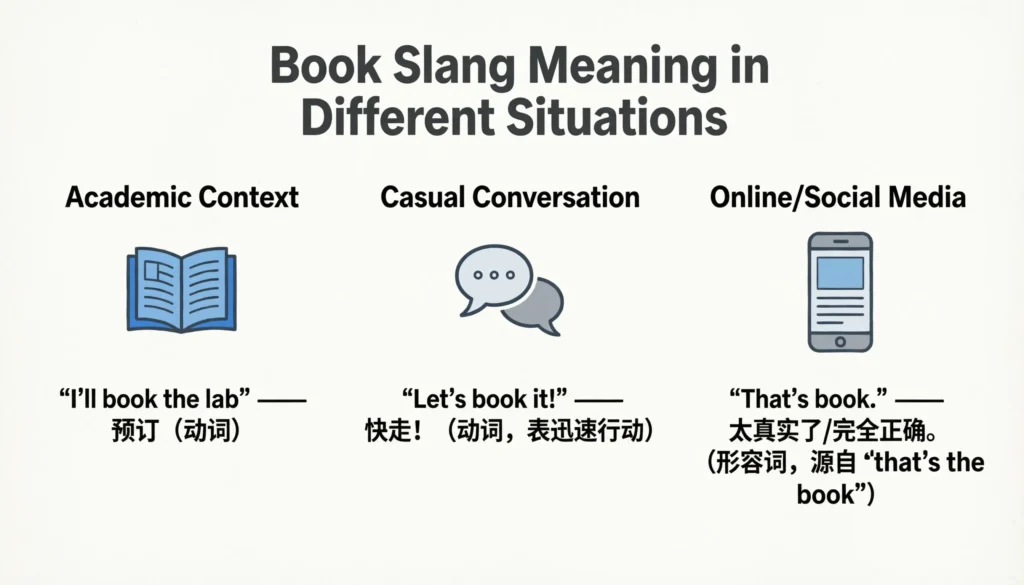
Context is the key to understanding slang.
In a Conversation
“We need to book it.”
Meaning: We need to hurry or leave quickly.
In a Text
“Gotta book.”
Meaning: I have to leave.
At a Hotel
“I booked two rooms.”
Meaning: I reserved two rooms.
At a Restaurant
“Did you book a table?”
Meaning: Did you make a reservation?
In a Crime Story
“The police booked him.”
Meaning: The police formally processed him after arrest.
The same word changes meaning depending on the situation.
Common Misunderstandings About “Book”
Because book has so many meanings, people sometimes misunderstand it.
Misunderstanding 1: “Book” Always Means a Reservation
Not necessarily.
If someone says:
“Book it!”
they are probably not talking about a reservation.
They may be telling you to run or hurry.
Misunderstanding 2: “Book It” Means Read a Book
Usually, no.
The sentence:
“Book it!”
doesn’t normally mean “read a book.”
The phrase is an informal expression meaning move quickly or leave quickly.
Misunderstanding 3: “Booked” Always Means Arrested
Not at all.
For example:
“I booked a flight.”
Here, booked means reserved.
Only context involving police or arrest suggests the criminal-justice meaning.
Misunderstanding 4: Every Online Use Is Gen Z Slang
Not necessarily.
Some uses of book and book it have existed in informal English for a long time. Seeing them on TikTok or Instagram doesn’t automatically mean they originated there.
Synonyms and Alternatives for “Book It”
If you’re trying to understand or replace book it, several expressions have similar meanings.
Depending on context, you could say:
- Hurry up
- Run
- Move quickly
- Get going
- Take off
- Get out of here
- Leave quickly
- Make a run for it
- Head out
- Get moving
Example
Original:
“Book it! We’re late.”
Alternative:
“Hurry up! We’re late.”
Another:
Original:
“I booked it home.”
Alternative:
“I rushed home.”
The best alternative depends on whether the speaker is emphasizing speed, leaving, or urgency.
Book vs. Dip vs. Bounce
People sometimes compare book with other slang words for leaving.
Book It
Usually emphasizes speed or urgency.
“Book it!”
Dip
Often means leave, especially casually.
“I’m gonna dip.”
Bounce
Also means leave, often in relaxed or informal speech.
“Let’s bounce.”
Take Off
Can mean leave quickly.
“We should take off.”
All four can relate to leaving, but their tone and context differ.
Examples of “Book” in Everyday Sentences
Here are several examples to make the meaning easier to recognize.
- “Book it! They’re closing the doors.”
→ Hurry up. - “I’m booking after dinner.”
→ I’m leaving after dinner. - “She booked it down the street.”
→ She moved or ran quickly down the street. - “We booked a hotel for Saturday.”
→ We reserved a hotel. - “Did you book the tickets?”
→ Did you reserve or purchase the tickets? - “He was booked after his arrest.”
→ He was formally processed by police. - “I gotta book, bro.”
→ I have to leave. - “Everyone started booking it when the rain came.”
→ Everyone started moving quickly.
How to Understand “Book” From Context
When you see book in a message, ask yourself three simple questions:
1. Is Someone Moving?
If yes, book probably means hurry, run, or leave quickly.
“Book it!”
2. Is Someone Making a Reservation?
If yes, book probably means reserve.
“I booked a flight.”
3. Are Police or an Arrest Mentioned?
If yes, booked probably means formally processed after an arrest.
“He got booked.”
This simple method can help you identify the correct book slang meaning without confusion.
Why Slang Meanings Matter
Understanding slang is useful because modern communication is increasingly informal.
People use slang in:
- Text messages
- TikTok comments
- Instagram captions
- Snapchat
- YouTube
- Online gaming
- Group chats
- Everyday conversations
A word can look confusing if you only know its traditional dictionary definition.
For example, someone learning English may know that a book is something you read. But when they see:
“Book it!”
they may wonder why someone is talking about reading.
Understanding context makes conversational English much easier.
Tips for Using “Book” Correctly
If you want to use this slang naturally, keep these tips in mind:
- Use “book it” when telling someone to hurry or move quickly.
- Use “I’m booking” only in casual conversations where the meaning is clear.
- Don’t use slang expressions in formal academic or professional writing unless you’re discussing the expression itself.
- Look at the surrounding words before deciding what booked means.
- Remember that book can mean reserve, leave quickly, or refer to police processing.
- When talking with international English learners, use clearer wording if the slang could cause confusion.
Frequently Asked Questions About Book Slang Meaning
1. What does “book” mean in slang?
In slang, book can mean to leave or move quickly, especially in expressions such as “book it.” However, its meaning depends on context.
2. What does “book it” mean?
“Book it” usually means hurry, run, or move quickly. For example, “Book it, we’re late!” means “Hurry up because we’re late.”
3. What does “I’m booking” mean?
In casual speech, “I’m booking” can mean “I’m leaving” or “I’m heading out,” sometimes with an implication of moving quickly.
4. What does “booked” mean in slang?
“Booked” can mean different things. In casual speech, it may refer to leaving quickly, while in a police context, being booked means being formally processed after an arrest.
5. Is “book it” Gen Z slang?
Not exactly. Although younger people may use “book it” on social media, the expression is older informal English and did not originate exclusively with Gen Z.
6. Is “book it” rude?
Generally, no. “Book it” is informal but not normally offensive. Its appropriateness depends on the situation and audience.
7. What are other words for “book it”?
Depending on the context, alternatives include hurry, run, rush, get moving, take off, leave, dip, bounce, and get going.
Conclusion
Understanding the book slang meaning becomes much easier once you pay attention to context. The expression “book it” commonly means to hurry, run, or move quickly, while “I’m booking” can mean that someone is leaving. At the same time, book has ordinary meanings, such as making a reservation, and “booked” can refer to being formally processed by police after an arrest.
The most important lesson is that book does not have one fixed slang definition. The words around it tell you what the speaker means.
“book it” in a casual conversation, think “hurry up” or “move quickly.” “book a hotel,” think “make a reservation.” You see “booked by police,” think “formally processed after arrest.”
Once you recognize these patterns, you’ll be able to understand book slang meaning in texts, conversations, TikTok posts, Instagram captions, and everyday English much more confidently.
Discover More Articles:
- Ultimate Gym Slang Dictionary: Fitness Words and Meanings
- SNM Meaning in a Conversation: When and How to Use It
- HR Slang Meaning: 5 Common Ways People Use “HR” Online

Emily Thompson is an English language educator and grammar writer at grammarnestz.com. She specializes in grammar rules, vocabulary development, writing skills, and language-learning resources for students and professionals.