If you have ever done something quickly without giving it much care, you may have used a slapdash approach without realizing it. The slapdash meaning describes something done in a careless, rushed, or poorly organized way. It is often used when a person finishes a task too quickly and does not pay enough attention to quality or detail.
In everyday English, slapdash can describe work, writing, cleaning, planning, repairs, or almost anything that looks hurried and careless. For example, if someone submits an assignment full of mistakes because they rushed through it, you could call the work slapdash.
Understanding this word can help you describe poor-quality work more naturally and make your English vocabulary more expressive.
What Is the Slapdash Meaning?
The word slapdash means done quickly and carelessly, without enough attention to detail or quality.
It is commonly used as an adjective to describe something that appears rushed, incomplete, or poorly done.
Simple definition of slapdash
Slapdash: Done in a hurried and careless way, often resulting in poor quality.
For example:
“The report looked slapdash because it contained several spelling mistakes.”
This means the report appeared to have been prepared too quickly and without proper care.
Slapdash meaning in simple English
In very simple English, slapdash means:
- Quick and careless
- Rushed
- Poorly done
- Lacking attention to detail
- Not carefully prepared
- Done without proper effort
The word usually has a negative meaning because it suggests that something could have been done much better.
Slapdash Meaning in Everyday Conversations
People often use slapdash when they want to criticize the quality of something without saying that it is completely useless.
Imagine that a friend quickly cleans a room before guests arrive. The room looks better, but several things are still messy and out of place.
You might say:
“You did a pretty slapdash job of cleaning the room.”
Here, slapdash suggests that the cleaning was rushed and lacked attention to detail.
Another example:
“His slapdash preparation caused problems during the presentation.”
This means he prepared too quickly and did not properly organize his presentation.
Slapdash Definition and Part of Speech
Slapdash is primarily used as an adjective.
| Word | Part of Speech | Meaning |
|---|---|---|
| Slapdash | Adjective | Careless, rushed, or poorly done |
| Slapdash work | Phrase | Work completed without enough care |
| Slapdash approach | Phrase | A careless or hurried method |
| Slapdash job | Phrase | A poorly or quickly completed task |
Examples:
- She gave the project a slapdash review.
- The repairs were slapdash.
- His slapdash approach created more problems.
- They produced a slapdash report.
What Does Slapdash Mean in a Sentence?
Here are several examples showing how slapdash works in real sentences:
- The contractor did a slapdash job on the kitchen.
- His slapdash writing was full of grammatical errors.
- Don’t submit a slapdash application if you want the position.
- The website looked slapdash and unfinished.
- She gave me a slapdash explanation instead of answering properly.
- The team was criticized for its slapdash preparation.
- I made a slapdash dinner because I was running late.
These examples show that slapdash can describe many different kinds of work and activities.
Slapdash Meaning in Work and Business
The word slapdash is especially useful when talking about professional work.
Suppose an employee is asked to prepare an important document. Instead of checking the information, formatting the document, and correcting mistakes, they quickly put something together.
A manager might describe it as:
“This is a slapdash report. Please review it carefully before sending it.”
The word does not necessarily mean the person intentionally did a bad job. It can simply suggest that the work was completed without sufficient care.
Common workplace examples
project:
A project that appears rushed or poorly organized.
presentation:
A presentation with weak preparation, errors, or poor organization.
report:
report containing mistakes or missing important information.
solution:
quick solution that does not properly address the problem.
Slapdash Meaning in Writing
Slapdash can also describe writing.
A piece of writing may be called slapdash when it contains:
- Frequent spelling mistakes
- Poor grammar
- Weak organization
- Repeated ideas
- Missing information
- Little proofreading
- Unclear sentences
For example:
“The article felt slapdash because it had not been properly edited.”
This does not necessarily mean the ideas were bad. It means the writing appeared rushed and insufficiently polished.
For students, writers, and content creators, this distinction is useful. A piece can have good ideas but still look slapdash if the final presentation is careless.
Slapdash Meaning in Social Media and Online Chat
Although slapdash is not exactly modern internet slang, it can easily be used when discussing online content.
For example:
“That post looks slapdash. They probably made it in a hurry.”
Or:
“The website redesign feels a little slapdash.”
Online, people may use words such as rushed, messy, low-effort, or poorly made instead of slapdash.
Still, slapdash is a useful word when you want a more traditional English expression.
Is Slapdash a Negative Word?
Yes, slapdash generally has a negative or critical tone.
Calling something slapdash suggests that it lacks care, attention, or quality.
Compare these sentences:
“She completed the project quickly.”
This is neutral. It simply says she worked quickly.
“She completed the project in a slapdash manner.”
This is negative. It suggests that she worked quickly and carelessly.
Therefore, slapdash is stronger than simply saying “fast” or “quick.”
Slapdash vs. Quick
These words are not exact synonyms.
Quick describes speed.
Slapdash describes speed combined with a lack of care.
For example:
“He quickly finished the assignment.”
This could be positive or negative.
Maybe he is highly skilled and finished it efficiently.
But:
“He finished the assignment in a slapdash way.”
This suggests that he rushed and failed to give the assignment enough attention.
Quick vs. slapdash
| Word | Main Idea | Usually Positive or Negative? |
|---|---|---|
| Quick | Fast | Neutral |
| Slapdash | Fast and careless | Negative |
| Efficient | Fast and effective | Positive |
| Rushed | Done with too little time | Often negative |
| Careful | Done with attention | Positive |
Slapdash vs. Careless
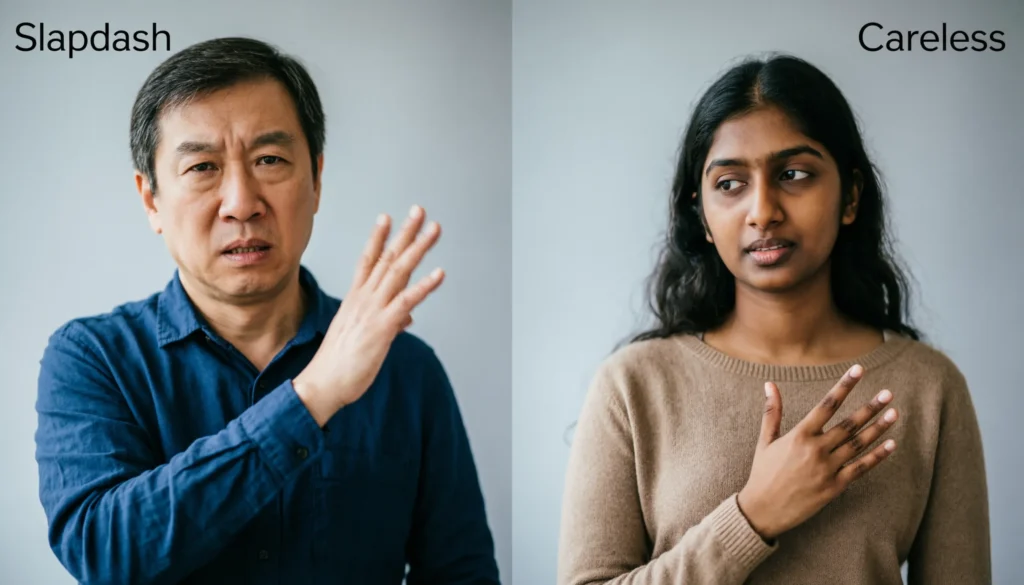
Careless and slapdash are closely related, but they are not always interchangeable.
Careless focuses on a lack of attention or caution.
Slapdash focuses more on something being rushed and poorly completed.
For example:
“He was careless with the equipment.”
This means he did not handle it carefully.
But:
“He did a slapdash job repairing the equipment.”
This means the repair itself was rushed and poorly done.
Slapdash Synonyms
If you are looking for words similar to slapdash, several options are available.
Common synonyms
- Careless
- Hasty
- Rushed
- Hurried
- Haphazard
- Messy
- Shoddy
- Negligent
- Unpolished
- Half-hearted
- Ill-prepared
- Inattentive
However, each synonym has a slightly different meaning.
Slapdash vs. haphazard
Haphazard means lacking a clear plan or organization.
“The books were arranged in a haphazard way.”
Slapdash suggests something was done quickly and carelessly.
“The books were cleaned and arranged in a slapdash manner.”
Slapdash vs. shoddy
Shoddy means poorly made or of low quality.
“The furniture was made with shoddy materials.”
Slapdash focuses more on the careless way something was completed.
“The furniture was assembled in a slapdash way.”
Opposite of Slapdash
The opposite of slapdash is something done carefully, thoroughly, and professionally.
Useful opposites include:
- Careful
- Thorough
- Detailed
- Meticulous
- Precise
- Diligent
- Well-prepared
- Professional
- Methodical
- Thoughtful
For example:
“Instead of taking a slapdash approach, she carefully reviewed every detail.”
This sentence clearly contrasts careless work with careful work.
How to Use Slapdash Correctly
Because slapdash is an adjective, it usually comes before a noun or after a linking verb.
Before a noun
“He submitted a slapdash report.”
“They created a slapdash website.”
“She gave a slapdash explanation.”
After a linking verb
“The work was slapdash.”
“His preparation seemed slapdash.”
“The final product looked slapdash.”
You can also use the phrase “in a slapdash manner.”
“The problem was solved in a slapdash manner.”
Common Collocations With Slapdash
Some combinations sound especially natural in English.
1. Slapdash job
“The mechanic did a slapdash job.”
2. Slapdash work
“The client was unhappy with the slapdash work.”
3. Slapdash approach
“A slapdash approach can create unnecessary problems.”
4. Slapdash effort
“His slapdash effort was obvious.”
5. Slapdash preparation
“The team’s slapdash preparation affected the presentation.”
6. Slapdash solution
“The company offered a slapdash solution to a complicated problem.”
7. Slapdash writing
“The article contained several signs of slapdash writing.”
Learning these combinations can make your English sound more natural.
Examples of Slapdash in Different Situations
School
“The student handed in a slapdash essay five minutes before class.”
Work
“The manager rejected the slapdash report and asked for a complete revision.”
Home
“I made a slapdash breakfast because I was late.”
In construction
“The repairs looked slapdash and needed to be redone.”
Design
“The logo looked slapdash and lacked consistency.”
Customer service
“The customer received a slapdash response that did not answer the question.”
Everyday life
“I gave the room a slapdash cleaning before my guests arrived.”
Why Do People Use the Word Slapdash?
The word is useful because it communicates more than just “bad.”
If you say something is bad, the reason is unclear.
But when you say something is slapdash, you communicate that it was likely:
- Done too quickly
- Not carefully planned
- Not properly checked
- Missing important details
- Below the expected standard
This makes slapdash a precise vocabulary choice when describing low-quality work caused by haste or carelessness.
Common Misunderstandings About Slapdash
Misunderstanding 1: Slapdash simply means fast
Not exactly.
Something can be fast and still be excellent.
Slapdash usually suggests that speed came at the expense of quality.
Misunderstanding 2: Slapdash always means completely useless
No.
Something described as slapdash may still work or contain useful information. The criticism is usually about the lack of care or quality.
Misunderstanding 3: Slapdash is internet slang
Not really.
It can appear in online conversations, but it is a standard English adjective rather than a modern social-media abbreviation.
Misunderstanding 4: Slapdash only describes physical work
No.
You can describe writing, planning, preparation, explanations, websites, reports, repairs, and many other things as slapdash.
The History and Origin of Slapdash
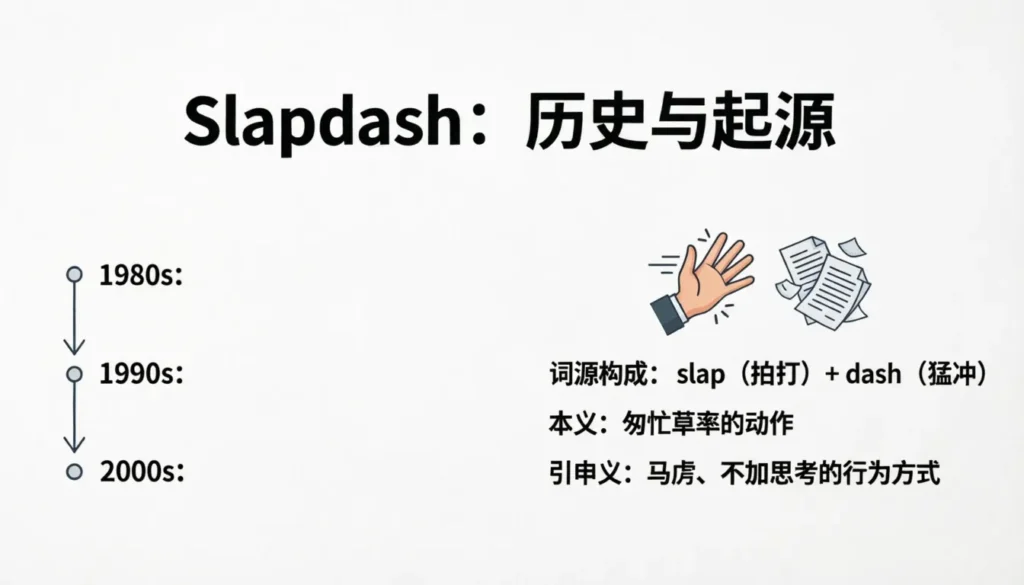
The word slapdash has been used in English for centuries. Its unusual sound comes from combining words associated with quick or careless action.
The expression developed into an adjective describing something done hurriedly and without sufficient care.
Today, it remains a recognizable English word, particularly in writing and speech where someone wants to criticize the quality of work.
Its colorful sound may be one reason it remains memorable for English learners.
Slapdash in Modern English
In modern English, slapdash is still useful, although people may choose simpler alternatives in casual conversation.
Depending on the situation, you might hear:
- “That was rushed.”
- “That looks careless.”
- “It feels low-effort.”
- “The work is messy.”
- “They didn’t put much effort into it.”
- “It looks poorly done.”
Slapdash provides a concise way to express the same general idea while sounding slightly more descriptive.
How to Remember the Meaning of Slapdash
A simple memory trick is:
Slapdash = rushed + careless + not enough attention
Think of someone who has only five minutes to finish a job. They quickly put everything together without checking their work.
That is a slapdash approach.
Remember:
Fast is not always slapdash, but slapdash work is usually too rushed or careless.
Slapdash Meaning: Quick Comparison
| Expression | Meaning |
|---|---|
| Slapdash | Rushed and careless |
| Careless | Lacking attention |
| Hasty | Done too quickly |
| Haphazard | Lacking order or planning |
| Shoddy | Poorly made |
| Rushed | Done with insufficient time |
| Thorough | Complete and careful |
| Meticulous | Extremely careful and detailed |
This comparison can help you choose the right word depending on what you want to express.
Frequently Asked Questions About Slapdash Meaning
1. What does slapdash mean?
Slapdash means done quickly and carelessly, without enough attention to detail or quality. It is generally used to criticize work that appears rushed or poorly prepared.
2. Is slapdash a positive or negative word?
Slapdash is generally negative. It suggests that something was completed without enough care, preparation, or attention to quality.
3. What is a simple synonym for slapdash?
Simple synonyms include careless, rushed, hasty, messy, haphazard, and poorly done. The best choice depends on the context.
4. Can slapdash describe a person?
Usually, slapdash describes a person’s work, method, approach, or behavior rather than the person directly. For example, “He took a slapdash approach to the project” sounds more natural than calling someone “a slapdash person.”
5. What is the opposite of slapdash?
Opposites include careful, thorough, meticulous, precise, diligent, professional, and well-prepared.
6. Is slapdash formal English?
Yes. Slapdash is a standard English word. It can be used in both conversation and writing, although some casual speakers may prefer simpler terms such as “rushed” or “careless.”
7. Can I use slapdash in a sentence?
Yes. For example:
“The company rejected the slapdash report because it contained too many errors.”
This means the report appeared rushed and insufficiently prepared.
Conclusion
The slapdash meaning is simple: something that is done quickly, carelessly, and without enough attention to detail. It is a useful English word for describing work, writing, preparation, repairs, projects, and other tasks that seem rushed or poorly completed.
Remember that slapdash does not simply mean fast. Speed alone is not necessarily negative. The important idea is that the lack of time, effort, planning, or attention has affected the quality of the result.
When you want to describe something that looks rushed and careless, slapdash can be a strong and precise vocabulary choice.
Quick tip: Think of slapdash as “too rushed to be properly careful.” Once you remember that idea, it becomes much easier to understand and use the word naturally.
Discover More Articles:
- Retcon Meaning: What Does Retcon Mean in Modern Slang?
- FYE Meaning in Text: Everything About This Online Slang
- Kudos Meaning in Modern Conversations and Messages

Hi, I’m James Richardson, the creator of GrammarNestz.com. My mission is to help students, writers, and language enthusiasts improve their English grammar skills through practical guides, easy lessons, and useful learning resources.