
Trucking slang meaning refers to the informal words, phrases, codes, and expressions commonly used by truck drivers, dispatchers, mechanics, and other people working in the trucking industry. If you have ever listened to truck drivers talking on a CB radio or watched trucking videos online, you may have heard words that sound confusing at first.
Trucking has its own unique language, developed over decades of life on the road. Drivers use slang to communicate quickly about traffic, weather, road conditions, vehicles, deliveries, police activity, and everyday experiences. Some expressions are practical, while others are funny, colorful, or deeply connected to trucking culture.
Understanding truck driver slang can make conversations easier to follow and give you a better appreciation of life behind the wheel. In this guide, we will explain popular trucking terms and slang, provide simple examples, discuss their meanings, and answer common questions about trucker language.
What Does Trucking Slang Mean?
Trucking slang is informal language used within the trucking community. Unlike official transportation terminology, slang is usually casual and may vary between regions, generations, companies, and individual drivers.
Truckers often spend long hours traveling across highways, so fast and familiar communication is valuable. Many slang terms became popular through CB radio communication, while others developed naturally from life on the road.
For example:
- Bear – A police officer or highway patrol officer.
- Four-wheeler – A passenger vehicle or car.
- Big rig – A large commercial truck, usually a tractor-trailer.
- Hammer down – Drive faster or maintain a high speed.
- Chicken coop – A weigh station.
- 10-4 – Message received or understood.
- Smokey – Police officer or highway patrol.
- Handle – A trucker’s nickname used over the radio.
These expressions help create a shared vocabulary among drivers.
Why Do Truck Drivers Use Slang?
Truck drivers use slang for several reasons. The most important is communication.
When someone is driving a heavy vehicle at highway speeds, they do not always have time for long conversations. A short, familiar phrase can communicate an idea quickly.
Trucking slang is also part of the industry’s culture. Drivers often spend many hours alone, and CB radio conversations can provide entertainment, information, and companionship.
Common reasons for using trucking slang include:
- Communicating quickly
- Sharing road information
- Warning other drivers
- Describing traffic or weather
- Talking about vehicles
- Creating a sense of community
- Adding humor to everyday conversations
- Keeping radio conversations informal
Over time, these expressions became an important part of trucker culture.
Popular Trucking Slang Terms and Their Meanings
There are hundreds of trucking expressions, but some are much more recognizable than others. Here are several common examples.
1. Bear
A bear usually means a police officer, especially a highway patrol officer.
Example:
“Watch your speed up ahead. There’s a bear near the exit.”
The term is often associated with police monitoring traffic.
2. Smokey
Smokey is another common term for a police officer or highway patrol officer.
Example:
“Smokey is sitting behind the bridge.”
Although the expression has been around for decades, its popularity can vary among drivers.
3. Four-Wheeler
A four-wheeler generally refers to a regular passenger vehicle, such as a car or SUV.
Truckers use the term because passenger vehicles have four wheels, while commercial trucks have many more.
Example:
“Watch that four-wheeler trying to merge.”
The expression is not necessarily insulting, although the tone can sometimes be negative.
4. Big Rig
A big rig means a large commercial truck, usually a tractor connected to a trailer.
Example:
“That big rig is carrying a heavy load.”
The term is common in everyday American English and is closely associated with long-haul trucking.
5. Hammer Down
Hammer down means to drive at a relatively fast pace or maintain speed.
Example:
“We’re running late, so it’s time to hammer down.”
Drivers should, of course, always follow posted speed limits and traffic laws.
6. Chicken Coop
A chicken coop is trucking slang for a weigh station.
Commercial trucks may be required to enter weigh stations so authorities can check vehicle weight and compliance.
Example:
“There’s a chicken coop coming up in a few miles.”
7. Handle
A handle is a nickname used by a trucker, particularly when communicating over a CB radio.
Example:
“My handle is Road Runner.”
Truckers historically used handles to identify themselves without giving their full names over the radio.
8. Deadhead
Deadhead refers to a truck traveling without a paying load.
Example:
“I have to deadhead 200 miles to pick up my next load.”
Deadheading can be an important part of freight logistics because a driver may need to travel empty to reach the next pickup location.
9. Bobtail
A truck is bobtailing when the tractor is being driven without a trailer attached.
Example:
“I’m bobtailing back to the terminal.”
This is different from deadheading because deadheading generally involves a tractor and empty trailer, while bobtailing means the tractor has no trailer.
10. Yard
The yard is an area where trucks, trailers, and freight may be parked or organized.
Example:
“Take the trailer to the yard after unloading.”
Depending on the company, it may be called a truck yard, terminal yard, or simply the yard.
Trucking Slang Used on the CB Radio
CB radio played a major role in developing trucking slang. Before modern communication technologies became widespread, truck drivers commonly used CB radios to communicate with one another.
Certain expressions became especially recognizable through CB communication.
10-4
10-4 means “message received” or “understood.”
Example:
“Take the next exit.”
“10-4.”
The phrase became famous far beyond trucking and is now widely understood in popular culture.
What’s Your 20?
What’s your 20? means “What is your location?”
Example:
“What’s your 20?”
“I’m just outside the city.”
The expression comes from the CB radio code “10-20.”
Breaker, Breaker
Breaker, breaker is a traditional CB radio phrase used when someone wants to get another person’s attention or start communicating.
Example:
“Breaker, breaker, anyone got a traffic update?”
It is strongly associated with classic trucking and CB culture.
Come Back
Come back can mean asking someone to repeat what they said or continue speaking.
Example:
“I didn’t catch that. Come back?”
This kind of expression makes radio communication easier when there is noise or a weak signal.
Trucking Slang for Roads and Traffic
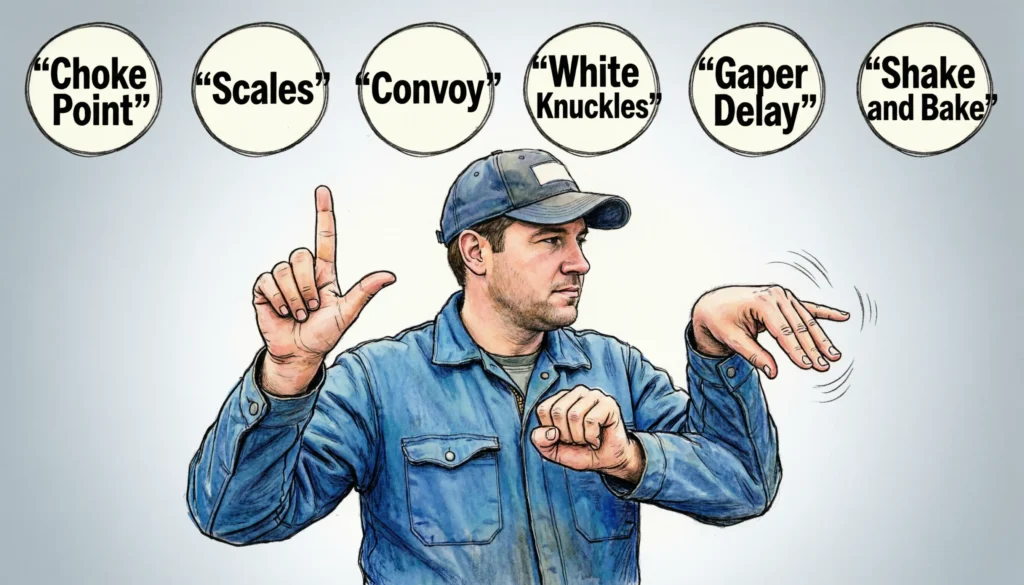
Truck drivers spend much of their working lives on highways, so many slang expressions describe road conditions and traffic.
Gridlock
Gridlock means extremely heavy traffic where vehicles can barely move.
Example:
“We’re stuck in gridlock downtown.”
Hammer Lane
The hammer lane usually refers to the left lane on a multi-lane highway, particularly when discussing faster-moving traffic.
Example:
“I’m moving into the hammer lane to pass.”
The exact use can vary depending on region and context.
Parking Lot
Truckers may jokingly describe a highway as a parking lot when traffic is completely stopped.
Example:
“The interstate is a parking lot after the accident.”
Four-Wheeler Trouble
This phrase can describe situations where passenger vehicles make driving difficult for commercial trucks.
For example, a car might suddenly merge in front of a truck without leaving enough stopping distance.
Trucking Slang for Loads and Freight
The trucking industry has its own vocabulary for freight and deliveries.
Hot Load
A hot load is a shipment that needs to move quickly because it has an urgent delivery schedule.
Example:
“This is a hot load, so we need to get moving.”
High Value
High value generally refers to freight that has significant monetary value and may require additional security or special handling.
Short Load
A short load can refer to a shipment that is smaller than a typical full truckload, depending on context.
Full Load
A full load generally means the truck is carrying enough freight to utilize most or all of its available capacity.
Backhaul
A backhaul is freight carried on a return trip, often after completing the original delivery.
Example:
“I found a backhaul heading west, so I won’t be running empty.”
Backhauls can help trucking companies reduce empty miles.
Trucking Slang for Trucks and Equipment
Truckers also use informal terms for different types of trucks and equipment.
| Trucking Term | Meaning |
|---|---|
| Big rig | Large commercial truck |
| Semi | Tractor-trailer combination |
| Rig | Truck, often referring to a tractor-trailer |
| Bobtail | Tractor without a trailer |
| Reefer | Refrigerated trailer |
| Flatbed | Trailer with an open, flat platform |
| Sleeper | Tractor with a sleeping compartment |
| Cab | Driver’s compartment |
| Trailer | Unit pulled behind the tractor |
| Fifth wheel | Coupling device connecting tractor and trailer |
Reefer
A reefer is a refrigerated trailer used to transport temperature-sensitive goods.
Example:
“I’ve got a reefer load of frozen food.”
Sleeper
A sleeper is a truck equipped with a sleeping compartment for drivers who spend nights on the road.
Long-haul drivers frequently use sleeper trucks during multi-day trips.
Funny and Informal Truck Driver Slang
Not all trucking slang is technical. Some expressions are simply humorous.
Truckers often create colorful descriptions for everyday situations.
For example:
- Rolling office – A truck that serves as a driver’s mobile workplace.
- Road warrior – A driver who spends extensive time traveling.
- Four-wheeler – Passenger vehicle.
- Shiny side up – A humorous reminder to stay safe and avoid a rollover.
- Seat cover – Sometimes jokingly used for someone sitting in a truck.
- Gravy load – An easy or desirable load.
- Alligator – A piece of tire tread lying on the road.
The exact meaning of some expressions can vary from one trucking community to another.
What Does “Alligator” Mean in Trucking?
One of the more interesting examples of trucking slang is alligator.
An alligator is a large piece of tire tread that has separated from a truck tire and is lying on the highway.
Drivers may warn one another about these pieces because hitting them can damage tires, vehicles, or other equipment.
Example:
“Watch out for an alligator in the right lane.”
The term is especially common in conversations about highway hazards.
Trucking Slang vs. Official Trucking Terms
It is important to understand that slang and official terminology are not always the same.
For example:
| Slang | More Formal Term |
|---|---|
| Bear | Police officer |
| Four-wheeler | Passenger vehicle |
| Chicken coop | Weigh station |
| Big rig | Tractor-trailer |
| Reefer | Refrigerated trailer |
| Deadhead | Empty repositioning trip |
| Bobtail | Tractor without trailer |
| Yard | Terminal or truck yard |
| Alligator | Detached tire tread |
| Handle | Radio nickname |
Learning both types of language can help beginners understand conversations while still using professional terminology when appropriate.
Trucking Slang in Text Messages and Social Media
Today, trucking slang is no longer limited to CB radios. Drivers use trucking terminology on Facebook groups, TikTok, YouTube, Instagram, Reddit, text messages, and trucking forums.
You might see phrases such as:
- “Rolling out.”
- “Deadheading home.”
- “At the shipper.”
- “Waiting on dispatch.”
- “Got a hot load.”
- “Another long-haul run.”
- “Parked for the night.”
- “Running westbound.”
- “Made it to the yard.”
Social media has helped introduce truck driver slang to people who have never worked in the trucking industry.
This is one reason trucking expressions continue to appear in online conversations and viral videos.
Common Misunderstandings About Trucking Slang
Is all trucking slang offensive?
No. Most trucking slang is simply informal language. However, some expressions can be disrespectful depending on how they are used.
Does every trucker use the same slang?
Not necessarily. Slang differs by region, age, company, experience, and personal preference.
Is trucking slang still used today?
Yes. While communication technology has changed, many traditional expressions remain familiar, especially among experienced drivers.
Is CB radio still important?
CB radio is less dominant than it once was, but it remains part of trucking culture and is still used by some drivers.
Does slang replace professional terminology?
No. Slang is generally informal. Professional trucking operations still rely on standardized terminology, regulations, documentation, and communication procedures.
Related Trucking Terms You Should Know
If you’re learning trucking slang meaning, it is helpful to understand a few related concepts.
Dispatcher
A dispatcher coordinates loads, routes, schedules, and communication between drivers and trucking operations.
Shipper
The shipper is generally the party that sends or provides the freight.
Receiver
The receiver is the location or party receiving the shipment.
Carrier
A carrier is a company or transportation provider responsible for moving freight.
CDL
CDL stands for Commercial Driver’s License, which is required for operating certain commercial motor vehicles.
Logbook
A logbook records a driver’s working and driving time. Modern trucking operations commonly use electronic logging systems.
Detention
Detention generally refers to time a driver spends waiting at a shipper or receiver beyond the expected loading or unloading period.
Layover
A layover occurs when a driver must remain in an area or wait before continuing to the next part of a trip.
Understanding these terms makes trucking conversations much easier to follow.
Examples of Trucking Slang in Conversations

Here are a few simple examples of how these expressions might appear naturally.
Example 1:
Driver A: “What’s your 20?”
Driver B: “I’m about 10 miles east of the terminal.”
Here, “What’s your 20?” means “Where are you?”
Example 2:
Driver A: “How’s traffic ahead?”
Driver B: “It’s a parking lot near the city.”
Here, “parking lot” means traffic is moving extremely slowly or not at all.
Example 3:
Driver A: “Are you loaded?”
Driver B: “No, I’m deadheading to the next pickup.”
Here, “deadheading” means traveling without a paying freight load.
Example 4:
Driver A: “Watch out for that alligator.”
Driver B: “10-4.”
Here, the driver is warning about a piece of tire tread on the highway.
How to Learn Trucking Slang Easily
If you’re new to trucking language, don’t try to memorize hundreds of terms at once.
Start with the most common expressions:
- Learn basic CB radio phrases.
- Understand common truck and trailer terms.
- Learn slang for police and road conditions.
- Practice reading trucking conversations.
- Watch trucking videos and interviews.
- Pay attention to context.
- Compare slang with formal trucking terminology.
Context is especially important because some words can have different meanings depending on how they are used.
Why Trucking Slang Matters
Trucking slang is more than a collection of funny words. It reflects the history, lifestyle, and culture of people who spend their working lives transporting goods across highways.
For experienced drivers, these terms can feel natural. For beginners, they may initially sound like a completely different language.
Learning the vocabulary can help:
- New truck drivers communicate more confidently.
- Trucking students understand experienced drivers.
- Families understand what truckers are talking about.
- Viewers understand trucking videos.
- Readers understand trucking-related social media posts.
- Non-truckers appreciate the culture of the industry.
In other words, understanding trucking slang helps bridge the communication gap between people inside and outside the trucking world.
Frequently Asked Questions About Trucking Slang
1. What does trucking slang mean?
Trucking slang refers to informal words and expressions used by truck drivers and other people in the trucking industry. These terms often describe vehicles, roads, freight, police, traffic, and everyday driving situations.
2. What does “10-4” mean in trucking?
“10-4” traditionally means that a message has been received and understood. It became widely known through CB radio communication and popular culture.
3. What does “bear” mean in trucking slang?
A “bear” commonly refers to a police officer or highway patrol officer. Truckers may use the term when warning other drivers about police activity.
4. What is a “four-wheeler” in trucking?
A “four-wheeler” generally means a passenger vehicle such as a car or SUV. Truck drivers use the term because ordinary passenger vehicles typically have four wheels.
5. What does “deadhead” mean in trucking?
“Deadhead” means traveling without a paying freight load. A driver may deadhead to another location to pick up the next shipment.
6. What does “bobtail” mean?
“Bobtail” means operating a tractor without a trailer attached. It is different from deadheading, where a tractor may be pulling an empty trailer.
7. Why do truckers use slang?
Truckers use slang because it provides quick, informal communication and is an important part of trucking culture. Many terms developed through CB radio conversations and years of life on the road.
Conclusion
Understanding trucking slang meaning gives you a useful look into the unique language and culture of the trucking industry. From “bear” and “four-wheeler” to “deadhead,” “bobtail,” “reefer,” “alligator,” and “10-4,” these expressions make communication between drivers faster, easier, and more familiar.
The best way to learn trucker slang is to focus on context rather than trying to memorize every term. Start with common CB expressions, vehicle terminology, road-related phrases, and freight vocabulary. As you hear these words used in real conversations, their meanings will become much easier to remember.
Whether you’re a new driver, a trucking enthusiast, a student, or simply someone curious about truck driver slang, learning these expressions can help you understand conversations on the road and online. Trucking language continues to evolve, but its basic purpose remains the same: communicate clearly, quickly, and safely while life keeps moving down the highway.
Discover More Articles:
- Red Wings Slang Meaning: Where Did the Phrase Come From?
- What Does CT Mean in a Text? Common Meanings Explained
- Kid Slang Meaning: What Does “Kid” Mean in Slang?

Emily Thompson is an English language educator and grammar writer at grammarnestz.com. She specializes in grammar rules, vocabulary development, writing skills, and language-learning resources for students and professionals.