Woke Slang Meaning is a topic many people search for after seeing the word “woke” on social media, in online discussions, or even in everyday conversations. If you have come across this term on TikTok, Instagram, X, or YouTube and wondered what it really means, you’re not alone.
The word has become increasingly popular and is often used in different contexts, making its meaning confusing for some people. In this article, we’ll break down the woke slang meaning in simple terms, explore where it came from, how people use it today, and share real-life examples so you can understand and use the term with confidence.
What Does Woke Mean in Slang?
The term woke in slang means being aware of important social, cultural, or political issues. It is commonly used to describe someone who recognizes problems like racism, inequality, discrimination, and injustice instead of ignoring them.
Originally, “woke” simply meant “awake.” Over time, especially in African American communities, it developed into slang meaning socially aware or conscious of unfair treatment. Today, the word is widely used on social media, in conversations, and in online communities.
Depending on the context, woke can be used positively to praise someone’s awareness or negatively by people who think someone is being overly political or sensitive.
What Is Woke Slang For?
If you’re wondering what woke slang is for, it usually refers to a person who pays attention to social justice, equality, and current cultural issues. Someone described as “woke” is expected to recognize unfair treatment and support positive social change.
In casual conversations, however, the meaning can vary. Some people use it sincerely to compliment awareness, while others use it sarcastically to criticize someone they believe is trying too hard to appear morally superior.
Stay Woke Meaning on TikTok
On TikTok, the phrase “stay woke” often means stay alert, stay informed, and don’t be easily fooled. Users may use it when discussing trending news, celebrity drama, internet scams, relationships, or social issues.
Examples include:
- “Stay woke—they’re trying to trick everyone.”
- “Stay woke before believing every viral video.”
- “You need to stay woke online.”
Although the phrase originally referred to social awareness, TikTok users now apply it to many everyday situations where being observant is important.
Woke Meaning in TikTok Slang
In TikTok slang, woke doesn’t always refer to politics. It can simply describe someone who understands hidden meanings, notices red flags, or thinks critically before accepting information.
For example, a creator might comment:
- “She’s finally woke.”
- “The comments are more woke than the video.”
- “Once you’re woke, you can’t unsee it.”
The meaning depends on the video’s topic, but it generally suggests greater awareness or understanding.
Woke Culture Meaning
Woke culture refers to a mindset or movement that encourages people to be aware of social inequality, discrimination, diversity, and inclusion. Supporters believe it promotes fairness and equal opportunities for everyone.
However, critics argue that woke culture can sometimes go too far, leading to excessive political correctness or limiting open discussion. Because of these different opinions, the phrase is often debated in media and politics.
Woke Person Meaning
A woke person is someone who is informed about social issues and actively supports fairness, equality, and justice. They may speak out against discrimination, support marginalized communities, or encourage respectful treatment of others.
Examples include:
- “She’s very woke about environmental issues.”
- “He’s considered a woke person because he supports equal rights.”
- “Many young people describe themselves as socially woke.”
What Is the Meaning of Woke in Politics?
In politics, woke refers to awareness of political and social issues such as racism, gender equality, LGBTQ+ rights, climate change, and economic inequality.
Supporters use the word to describe progressive values and social responsibility. Opponents may use it as criticism, suggesting that certain political ideas are overly ideological or politically correct.
Because of these different viewpoints, the political meaning of woke often depends on who is using the term.
What Does Anti-Woke Mean?
Anti-woke describes people, organizations, or movements that oppose what they see as excessive “woke” ideas or activism. They may disagree with certain diversity initiatives, political correctness, or social policies associated with woke culture.
Like the term woke, anti-woke is highly context-dependent and can have different meanings depending on political or cultural perspectives.
Woke Women Meaning
A woke woman is a woman who is socially aware and supports equality, fairness, and human rights. She may advocate for women’s rights, racial equality, education, or other social causes.
The phrase is generally descriptive, but in some conversations it may be used sarcastically depending on the speaker’s opinion.
Woke Vibes Meaning
Woke vibes refers to the impression that someone, a video, a song, or a conversation promotes awareness, inclusivity, or progressive values.
For example:
- “That documentary gives woke vibes.”
- “Her content has positive woke vibes.”
- “People said the campaign had woke vibes.”
The expression is informal and is commonly seen on social media platforms.
Woke Examples
Here are a few examples showing how woke is used in everyday conversations:
- “She’s become more woke after learning about social issues.”
- “Stay woke and always verify information before sharing it.”
- “Many TikTok users use ‘woke’ to describe people who notice hidden truths.”
- “Some people support woke culture, while others criticize it.”
- “He was called woke for speaking out against discrimination.”
These examples show that the meaning of woke changes depending on the conversation and context.
What Does “Woke” Stand For?
The word woke does not stand for an acronym. It is simply the past tense of the verb wake, which evolved into slang meaning aware, informed, or socially conscious.
Today, the term is widely used in online conversations, news, politics, and social media, where its meaning may be positive, neutral, or critical depending on the speaker and situation.
Woke Slang Meaning and Definition
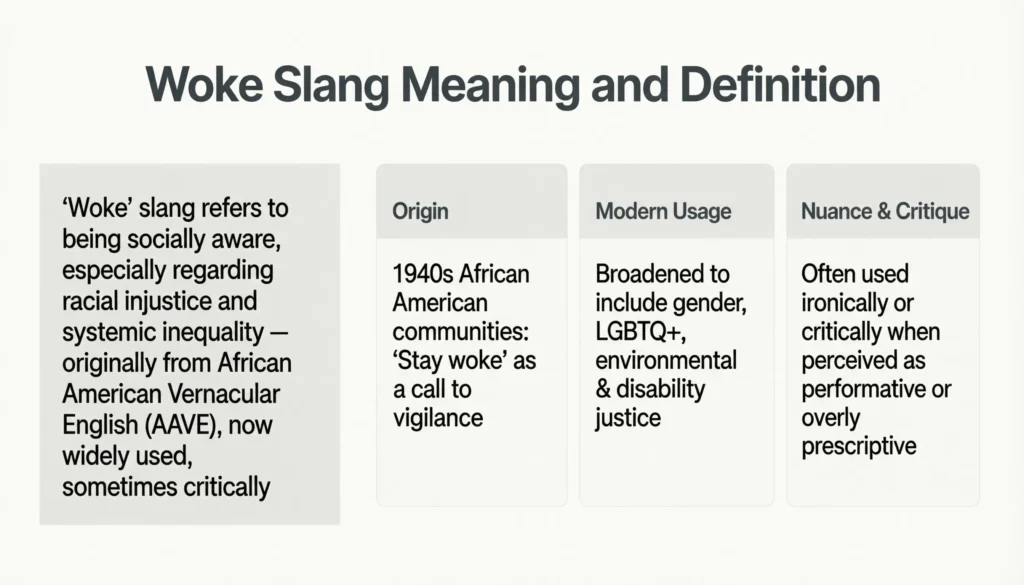
The most common woke slang meaning refers to being aware, informed, and conscious of social, cultural, or political issues. A person described as “woke” is often considered knowledgeable about topics such as equality, discrimination, social justice, and human rights.
Originally, the phrase “stay woke” meant staying alert to unfair treatment or injustice. Over time, the word evolved and became widely used beyond its original communities. Today, it can carry different meanings depending on who is using it and why.
For example:
- “She’s very woke about environmental issues.”
- “Stay woke and pay attention to what’s happening.”
- “That company is trying to appear woke.”
The term can be positive, neutral, or negative.
Positive Usage
When used positively, “woke” describes someone who is informed, compassionate, and aware of social problems.
Example:
- “He is woke and supports equal opportunities for everyone.”
Negative Usage
Some people use the term sarcastically to criticize ideas they consider overly political or extreme.
Example:
- “That’s just another woke policy.”
Neutral Usage
Others simply use the word to describe awareness without expressing approval or criticism.
Example:
- “Many young people discuss woke topics online.”
Because of these different interpretations, understanding the speaker’s tone is important when determining the intended meaning.
Background and Origin of the Term
The history of “woke” goes back many decades. The word originated within African American communities in the United States. It was initially used as a reminder to remain aware of social injustices and discrimination.
The expression “stay woke” gained wider recognition through music, literature, and cultural discussions. During the 2010s, social media platforms helped spread the term globally. As conversations about race, equality, and social justice became more visible online, the word became increasingly popular.
Soon, journalists, activists, celebrities, and politicians began using it. As its popularity grew, the meaning also expanded. People started applying it to various issues such as:
- Environmental concerns
- Gender equality
- Economic fairness
- Human rights
- Political awareness
Over time, opponents and critics also adopted the word, often using it sarcastically. This created a situation where the same term could be interpreted differently by different groups.
Today, “woke” remains a powerful and sometimes controversial expression. Its meaning often depends on cultural background, political perspective, and the context in which it appears.
Usage in Different Contexts
The word “woke” can have different meanings depending on where it is used.
Everyday Conversations
In casual speech, people may use it to describe awareness of important social issues.
Example:
- “My friend became more woke after learning about climate change.”
Social Media
On social media, the term often appears in discussions about current events, politics, and cultural topics.
Example:
- “Stay woke and check the facts before sharing news.”
Business and Professional Fields
Companies sometimes promote diversity, sustainability, or social responsibility initiatives. Supporters may call these efforts woke, while critics may use the same word negatively.
Example:
- “The company launched a woke advertising campaign.”
Political Discussions
Political debates frequently include the term. Supporters may see it as social awareness, while opponents may view it as excessive activism.
Because the word can be interpreted differently, context is always important.
Woke Meaning in Chat, WhatsApp, Instagram, and TikTok
Online platforms have given the word new life and expanded its usage.
In chats, friends may use it casually.
Example:
- “Stay woke, don’t believe every rumor.”
Instagram users often use the word in captions, comments, and stories discussing social topics.
Example:
- “Being woke means educating yourself.”
TikTok
TikTok creators use the term in videos related to social awareness, trends, or political commentary.
Example:
- “This video will wake you up stay woke.”
Online Chat
In gaming communities and forums, the word may appear humorously or sarcastically.
Example:
- “Look at him acting woke again.”
On digital platforms, tone and context are especially important because the same word can express support, criticism, or humor.
Meaning in Physics, Medical, and Aircraft Terminology
Interestingly, the word “woke” has little to no specialized meaning in physics, medicine, or aviation terminology.
Physics
In physics, “woke” is not a recognized technical term. People generally use it only in its social or cultural sense.
Medical Context
In medicine, professionals typically use “awake” rather than “woke.” However, “woke” may simply refer to someone who has awakened from sleep or anesthesia.
Example:
- “The patient woke after surgery.”
Aircraft Terminology
In aviation, the term itself is not commonly used. However, there is a related concept called “wake turbulence,” which refers to air disturbances left behind by an aircraft. Despite the similar spelling, this is unrelated to the slang term “woke.”
Therefore, in technical fields, the slang meaning rarely applies.
Common Misconceptions About Woke
Many misunderstandings surround the word.
Misconception 1: It Always Means Political
Not necessarily. Some people use it simply to describe awareness or education.
Misconception 2: It Is Always Positive
The word can be positive, neutral, or negative depending on context.
Misconception 3: Everyone Uses It the Same Way
Different communities interpret the term differently.
Misconception 4: It Is a New Word
Although it became popular recently, its origins go back many decades.
Understanding these misconceptions helps prevent confusion during conversations.
Similar Terms and Alternatives
Several words and phrases share similarities with “woke.”
Common alternatives include:
- Aware
- Conscious
- Informed
- Educated
- Alert
- Socially aware
- Mindful
- Knowledgeable
Examples:
- “She is socially aware.”
- “He is informed about current events.”
- “They are conscious of environmental issues.”
These alternatives are often less controversial and easier to understand in formal communication.
How to Respond to Woke
Your response depends on how the word is being used.
If Used Positively
You can engage respectfully.
Example:
- “That’s an interesting perspective.”
If Used Critically
Ask for clarification.
Example:
- “What do you mean by woke in this situation?”
If Used as a Joke
Respond according to the tone of the conversation.
Example:
- “I see what you mean.”
When uncertain, asking questions is usually the best approach because the term can mean different things to different people.
Differences From Similar Words
Although “woke” is related to words like aware, informed, and conscious, there are important differences.
| Word | Meaning |
| Woke | Social or political awareness |
| Aware | General understanding of something |
| Informed | Possessing accurate information |
| Conscious | Mentally aware or alert |
| Mindful | Thoughtful and attentive |
“Woke” is generally associated with social and cultural issues, whereas the other terms have broader applications.
Relevance in Online Conversations and Dating Apps
The term has become increasingly common on dating apps and online communities.
Some users include “woke” in their profiles to signal their values and beliefs. Others may use it to indicate support for social causes or political awareness.
Examples:
- “Looking for someone who is woke.”
- “Not interested in woke politics.”
Because the word can carry strong opinions, it may influence compatibility and conversations between users.
In online discussions, understanding its meaning helps people communicate more effectively and avoid unnecessary misunderstandings. Whether used seriously, humorously, or critically, the term remains a significant part of modern internet culture.
Conclusion
Conclusion
Understanding the woke slang meaning helps you better follow today’s online conversations, social media trends, and cultural discussions. While the word originally meant being aware of social injustice and inequality, its meaning has expanded over time and can vary depending on the context.
Today, you may see it used sincerely to describe someone who is socially aware or sarcastically in political debates and internet memes. Because its meaning changes with the situation, it’s always important to consider the tone and context before using or interpreting it. By learning how “woke” is used in everyday conversations, you’ll be better prepared to understand modern slang and communicate more confidently online.
Discover More Articles:
- Thirsty Slang Meaning Explained with Real Chat Examples (2026 )
- Vanilla Slang Meaning 2026: Latest Internet Definition & Examples
- Simp Slang Meaning with Real-Life Chat Examples
Hi, I’m Ethan Walker, founder of GrammarNestz. Passionate about language, writing, and clear communication, I help learners and writers improve their grammar skills through practical tips, easy-to-understand guides, and engaging content.