If you have ever seen the word deprecated in a software message, technical guide, or everyday conversation, you may have wondered what it actually means. The deprecated meaning is generally connected to something that is no longer recommended, supported, or considered the best choice, especially when a newer option is available.
In technology, you may see a warning such as “This feature is deprecated,” which means it may still work for now but could be removed later. However, deprecated is not limited to programming or computers. Understanding this word can help you read technical documentation, follow instructions, and communicate more clearly. In this guide, we will explain the deprecated definition, meaning, synonyms, examples, pronunciation, and common uses in simple English.
What Does Deprecated Mean?
The word deprecated means that something is no longer recommended for use because it has been replaced by something newer, better, or more appropriate.
The exact meaning can depend on the context.
In simple words:
Deprecated means no longer recommended, especially because a newer alternative is available.
For example:
- “This software feature is deprecated.”
- “The old method has been deprecated.”
- “Developers should avoid using this deprecated function.”
In each example, the thing may still exist or work, but people are being encouraged to use another option instead.
Deprecated Meaning in Simple English
Here is an easy definition:
Deprecated = no longer recommended or preferred for use.
It does not always mean completely removed.
This distinction is particularly important in technology.
A deprecated feature may continue working for months or even years, while developers are given time to move to a replacement.
Deprecated Definition
According to common English usage, deprecated can mean strongly disapproved of or regarded as outdated.
In modern technology, however, the word has a more specific meaning:
Deprecated describes a feature, function, method, product, or technology that is still available but is no longer recommended because a better alternative may exist.
Quick Definition
| Term | Meaning |
|---|---|
| Deprecated | No longer recommended |
| Outdated | Old or no longer modern |
| Obsolete | No longer useful or in use |
| Removed | No longer available |
| Replaced | Superseded by another option |
These words are related, but they are not always interchangeable.
What Does Deprecated Mean in Technology?
The word deprecated is extremely common in software development and technology.
When developers say that an API, function, command, or feature is deprecated, they usually mean:
- It still exists.
- It may still work.
- Developers should stop using it for new projects.
- A newer replacement may be available.
- It could eventually be removed.
For example, imagine a programming language has a function called oldFunction().
A developer might receive a warning:
“oldFunction() is deprecated. Use newFunction() instead.”
This does not necessarily mean oldFunction() has stopped working.
Instead, it tells the developer that newFunction() is now the preferred choice.
Why Do Developers Deprecate Features?
There are several reasons why software companies deprecate features.
1. A Better Alternative Exists
Technology constantly changes. A new method may be faster, safer, or easier to maintain.
2. Security Improvements
An older function might create security risks. Developers may encourage users to move to a safer replacement.
3. Better Performance
A newer API or function might perform more efficiently.
4. Simplifying Software
Maintaining too many old features can make software complicated.
5. Compatibility
Old methods may not work well with newer systems or technologies.
Deprecated vs. Removed: What Is the Difference?
One of the most common misunderstandings is thinking that deprecated means deleted.
It usually does not.
Deprecated
A deprecated feature is generally:
- Still available
- Still potentially functional
- No longer recommended
- Likely to be replaced or removed eventually
Removed
A removed feature is:
- No longer available
- No longer functional
- Not supported by the current version
For example:
“This API is deprecated.”
means you should start moving away from it.
But:
“This API was removed.”
means you can no longer use it in that version.
This difference is especially important when updating software or maintaining an older application.
Examples of Deprecated in Sentences
Learning through examples is one of the easiest ways to understand the word.
Technology Examples
Example 1:
“The developer received a warning that the function was deprecated.”
Meaning: The function still exists, but it is no longer recommended.
Example 2:
“This API has been deprecated and will eventually be removed.”
Meaning: Developers should move to the newer API.
Example 3:
“The old command is deprecated in the latest version.”
Meaning: The command is still available but is no longer the preferred method.
Everyday Examples
Example 4:
“The company deprecated its old paper-based system.”
Meaning: The company stopped recommending the old system in favor of a newer one.
Example 5:
“That approach is now considered deprecated.”
Meaning: The approach is no longer viewed as the preferred option.
Formal Example
Example 6:
“The committee deprecated the outdated procedure.”
Here, deprecated has a more traditional sense of expressing disapproval or criticism.
Deprecated Meaning in Programming
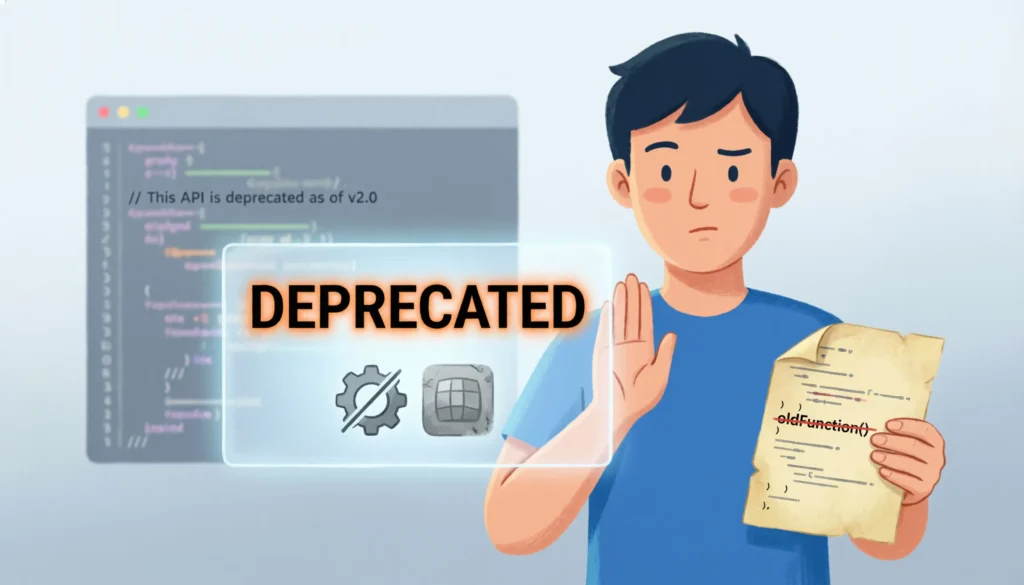
If you work with programming languages, APIs, websites, or software development, you will probably encounter deprecated frequently.
A programming language or framework may mark an old feature as deprecated.
For example:
Warning: This method is deprecated.
Use the updated method instead.
This warning is useful because it gives developers an opportunity to update their code before the old feature disappears.
What Should You Do When You See a Deprecated Warning?
Don’t panic.
A deprecated warning usually means:
“This still works, but you should start using something else.”
A good approach is to:
- Read the warning carefully.
- Check the official documentation.
- Find the recommended replacement.
- Test the replacement.
- Update your code when practical.
- Check whether the old feature has a planned removal date.
This can prevent future compatibility problems.
Deprecated Meaning in APIs
An API, or Application Programming Interface, allows different software components to communicate.
API developers sometimes deprecate an endpoint, parameter, method, or entire API version.
For example:
GET /api/v1/usersmight eventually be deprecated in favor of:
GET /api/v2/usersThe old version may continue working temporarily so users have time to migrate.
Why Is API Deprecation Important?
API deprecation can affect:
- Websites
- Mobile applications
- Software integrations
- Automated systems
- Developer tools
- Third-party services
If you ignore a deprecation notice for too long, an application may eventually stop working when the old feature is removed.
Deprecated Meaning in Software
In software, deprecated is usually a warning about the future.
Suppose you use an application with an old feature. The company announces that the feature is deprecated.
You might still be able to use it today.
However, the company is essentially saying:
“We recommend that you stop depending on this feature.”
This gives users and developers time to adjust.
A Simple Timeline
Think of it like this:
Available → Deprecated → Eventually Removed
Not every deprecated feature follows this exact timeline, but this is a useful way to understand the general concept.
Deprecated vs. Obsolete
The words deprecated and obsolete are closely related, but they have different meanings.
Deprecated
Something is deprecated when it is no longer recommended, often because a newer alternative exists.
Obsolete
Something is obsolete when it is outdated and generally no longer useful or relevant.
For example:
“This programming method is deprecated.”
means it may still work.
But:
“This technology is obsolete.”
suggests that it has largely fallen out of practical use.
Quick Comparison
| Word | Basic Meaning |
|---|---|
| Deprecated | No longer recommended |
| Obsolete | Outdated and generally no longer useful |
| Outdated | Old compared with current options |
| Discontinued | No longer produced or provided |
| Removed | Taken away or deleted |
Deprecated vs. Discontinued
Deprecated and discontinued are also different.
A product can be discontinued when a company stops producing or selling it.
For example:
“The manufacturer discontinued the old model.”
This means the company stopped making or offering it.
But if a software feature is deprecated, it may still be available.
So:
Deprecated = don’t rely on it going forward.
Discontinued = no longer being produced or offered.
Deprecated Synonyms
There are several words that can sometimes be used as synonyms for deprecated, depending on context.
Common Synonyms
- Outdated
- Discouraged
- Disapproved
- Superseded
- Old-fashioned
- Obsolete
- Replaced
- No longer recommended
- No longer preferred
- Phased out
However, these words do not have exactly the same meaning.
For technical writing, “no longer recommended” is often the clearest replacement.
Example
Original:
“This function is deprecated.”
Alternative:
“This function is no longer recommended.”
Both communicate the main idea clearly.
How to Pronounce Deprecated
The word deprecated is commonly pronounced:
DEE-pruh-kay-tid
It can be broken down roughly as:
de-pre-ca-ted
The pronunciation may vary slightly depending on accent, but “DEE-pruh-kay-tid” is a common pronunciation in American English.
What Is the Opposite of Deprecated?
There is no single perfect opposite in every situation.
Depending on the context, possible opposites include:
- Recommended
- Supported
- Current
- Preferred
- Modern
- Approved
- Active
For example:
“This method is deprecated.”
The opposite could be:
“This method is recommended.”
In software documentation, supported or recommended may be the most appropriate opposite.
Traditional Meaning of Deprecated
Although modern technology has made the word extremely common, deprecated has an older meaning.
Traditionally, deprecate could mean to express strong disapproval of something or to ask that something be avoided.
For example:
“The speaker deprecated the use of violence.”
Here, the meaning is closer to criticized, disapproved of, or strongly discouraged.
The technical meaning developed from this idea of discouraging something.
So, the modern programming meaning is not completely unrelated to the traditional English meaning.
How the Meaning Changed Over Time
The word comes from the Latin deprecari, associated with asking to avert or ward off something.
Over time, English usage developed around ideas such as:
- Expressing disapproval
- Discouraging something
- Advising against something
In modern software terminology, this became a practical way to tell developers:
“You can use this for now, but we recommend moving away from it.”
That is why the word is now so common in technical documentation.
Common Misunderstandings About Deprecated
The word can cause confusion, especially for people new to technology.
Misunderstanding 1: Deprecated Means Broken
Not necessarily.
A deprecated feature may continue working perfectly.
Misunderstanding 2: Deprecated Means Immediately Deleted
Usually not.
Deprecation often happens before removal.
Misunderstanding 3: Deprecated Means Dangerous
Not always.
Some deprecated features are perfectly safe but are simply less efficient, less convenient, or no longer maintained as the preferred option.
Misunderstanding 4: You Must Stop Using It Immediately
Not necessarily.
For an existing project, you may be able to keep using it temporarily. However, you should check the documentation and migration guidance, especially if removal is planned.
Misunderstanding 5: Every Old Thing Is Deprecated
No.
Something can be old without officially being deprecated.
Deprecation is often an explicit decision by a software developer, organization, or standards body.
Why Deprecation Matters to Users
You might think deprecation is only important for programmers, but it can affect ordinary users too.
For example, an app may depend on an old operating-system feature.
If that feature becomes deprecated and is eventually removed, the app may need an update.
Deprecation can therefore affect:
- Mobile apps
- Websites
- Browsers
- Operating systems
- Online services
- Plugins
- Software integrations
- Developer tools
Understanding the term helps you know why an update or migration may be necessary.
Practical Example: A Website Developer
Imagine Sarah owns a website that uses an old software library.
One day, she sees:
“Version 1 is deprecated. Upgrade to Version 2.”
Sarah can still use Version 1 today.
But if she ignores the warning indefinitely, future updates might cause compatibility problems.
A smart approach would be:
- Read the migration guide.
- Identify differences between versions.
- Back up the project.
- Test the newer version.
- Fix compatibility issues.
- Deploy the update.
This is a simple example of why understanding deprecated meaning matters in real life.
When Should You Use the Word Deprecated?
Use deprecated when you want to explain that something is no longer recommended, especially when it remains available.
It works particularly well in:
- Technical documentation
- Programming
- Software development
- API documentation
- IT discussions
- Product documentation
- Formal writing
Example Sentences
- “The old API is deprecated.”
- “This feature has been deprecated.”
- “Developers should avoid deprecated methods.”
- “The company announced that the service would be deprecated.”
- “This command is deprecated in the latest release.”
For casual conversation, simpler phrases such as “no longer recommended” may be easier to understand.
Related Words You Should Know
Understanding related terms can make technical documentation much easier to read.
Legacy
A legacy system is an older system that is still being used.
Migration
Migration means moving from an old system, platform, or technology to a newer one.
Replacement
A replacement is the newer option intended to take the place of the old one.
Backward Compatibility
Backward compatibility means newer software can continue working with older systems or formats.
End of Life
End of life, often shortened to EOL, generally means a product or software version has reached the point where support is ending or has ended.
These concepts often appear together with deprecation notices.
Tips for Understanding a Deprecation Notice
When you encounter a warning, don’t simply ignore it.
Ask yourself:
- What exactly is deprecated?
- Why was it deprecated?
- Is there a recommended replacement?
- When might it be removed?
- Do I need to update my existing code?
- Will the replacement require other changes?
Reading the official documentation is usually the best way to find the answers.
FAQs About Deprecated Meaning
1. What does deprecated mean in simple words?
Deprecated means no longer recommended for use. Something may still work, but a newer or better alternative is usually preferred.
2. Does deprecated mean removed?
No. Deprecated does not normally mean removed. A deprecated feature can continue to work until it is eventually replaced or removed.
3. What is the meaning of deprecated in programming?
In programming, deprecated means that a function, method, API, command, or feature is still available but is no longer recommended. Developers are usually encouraged to use a newer alternative.
4. What is a synonym for deprecated?
Depending on the context, synonyms include outdated, discouraged, obsolete, superseded, replaced, and no longer recommended. In technical writing, “no longer recommended” is often the clearest choice.
5. What is the opposite of deprecated?
Possible opposites include recommended, supported, current, preferred, and active. The best opposite depends on the sentence.
6. Is deprecated the same as obsolete?
No. Deprecated usually means something is no longer recommended, while obsolete suggests that something is outdated and generally no longer useful or relevant.
7. Why do software developers deprecate features?
Developers may deprecate features because they have better replacements, security improvements, performance benefits, compatibility concerns, or maintenance issues. Deprecation gives users time to transition.
Conclusion
Understanding the deprecated meaning is especially useful if you read software documentation, use modern technology, or work with programming and websites. In simple terms, deprecated means something is no longer recommended, even though it may still be available or functional.
The most important distinction to remember is:
Deprecated does not automatically mean deleted or broken.
When you see a deprecated warning, treat it as a signal to look for the recommended replacement and plan an update when appropriate. Knowing the difference between deprecated, obsolete, discontinued, outdated, and removed can also help you understand technical messages much more easily.
Whether you are a beginner learning programming or simply trying to understand a software warning, remembering one simple definition is enough:
Deprecated = still available for now, but no longer recommended for future use.
Discover More Articles:
- ASF Meaning Decoded: What People Mean When They Type It
- Pepsinogen Definition: Meaning, Function, and Health Connection
- Catatonia Meaning: Symptoms, Causes, Types, Treatment, and More

Hi, I’m Ethan Walker, founder of GrammarNestz. Passionate about language, writing, and clear communication, I help learners and writers improve their grammar skills through practical tips, easy-to-understand guides, and engaging content.