
If you have come across the word tom slang meaning while watching a British show, reading an online conversation, or scrolling through social media, you may be wondering what it actually means. The interesting thing is that “tom” does not have just one slang meaning. Its meaning can change depending on the country, context, and sentence in which it appears.
everyday English, tom commonly refers to a male cat, while in British slang it can be a dated and offensive term for a female . American English, Tom can also appear as a shortened form of “Uncle Tom,” a derogatory expression connected with racial history. texting, some people use TOM as an abbreviation for “time of month,” usually referring discreetly to menstruation.
Because these meanings are so different, context is extremely important. This guide explains the tom slang meaning, its history, examples, related expressions, texting uses, and common misunderstandings.
What Does “Tom” Mean in Slang?
The meaning of tom depends heavily on context.
Here are the most important meanings you may encounter:
| Meaning | Context | Tone |
|---|---|---|
| Male cat | Everyday English | Neutral |
| Male turkey or other male animal | Animal-related | Neutral |
| Female | Older British slang | Offensive/dated |
| “Uncle Tom” or someone behaving like one | U.S. slang | Offensive |
| “Time of month” | Texting/social shorthand | Informal |
| Tomato | Some British regional usage | Informal |
| Ordinary man/person | Older expressions | Informal |
The standard dictionary meaning is usually a male cat, or the male of certain other animals such as a turkey. Cambridge and Merriam-Webster both list this as the primary meaning.
However, if you see tom in a crime drama, historical text, or certain British slang discussions, it may have a completely different meaning.
“Tom” Meaning a Male Cat
The most common meaning of tom is actually not slang at all.
A tom or tomcat is a male cat. For example:
- “There is a large tom living behind the house.”
- “Our tom is very friendly.”
- “That orange tom keeps visiting our garden.”
Cambridge Dictionary defines tom as a male cat and also notes that male turkeys can be called toms.
Tom vs. Tomcat
The words are closely related:
- Tom = male cat
- Tomcat = male cat
- Queen = female cat, particularly in breeding terminology
So if someone says, “I saw a tom in the garden,” they are probably talking about a male cat rather than using internet slang.
“Tom” as a Male Animal
The word can also refer to the male of certain animals.
For example:
- Tom turkey = male turkey
- Tomcat = male cat
You may hear phrases such as:
“The tom turkey was displaying its feathers.”
This usage is completely normal and does not carry a slang meaning.
Merriam-Webster defines tom as the male of various animals, especially a tomcat or male turkey.
British Slang: “Tom” Meaning a Female

One of the more unusual meanings behind tom slang meaning comes from older British slang.
In historical or dated British usage, tom could refer to a female . Wiktionary records this as a UK slang meaning and labels it as dated.
This meaning may appear in:
- Older British crime dramas
- Historical novels
- Old slang dictionaries
- Discussions about British street language
- Period television shows
For example, a fictional historical character might say:
“The police were questioning the toms around the area.”
In this context, toms would not mean male cats. It would refer to women involved in prostitution.
Is This Meaning Common Today?
Not really.
This use is dated and potentially offensive, so it should not be treated as normal modern vocabulary. If you encounter it in an old movie or book, understanding the historical context is more useful than trying to copy the expression in everyday conversation.
A discussion from World Wide Words also explains the historical British use of tom for a female and explores its possible connection with older expressions such as “tom-tart.”
“Tom” and the Meaning of “Uncle Tom”
Another important meaning appears in American English.
Uncle Tom is a historically loaded expression. When shortened to Tom, it can be used as a derogatory term referring to a Black person perceived as being excessively submissive toward white authority.
Collins Dictionary explicitly labels this American usage as informal and derogatory.
Because of its racial history, this meaning is sensitive and should not be casually used.
What Does “Tomming” Mean?
The verb tom or tomming can also refer to behaving in the manner associated with an “Uncle Tom.” Dictionary sources identify this usage as derogatory.
For example, you might encounter the word in historical commentary discussing racial politics or social behavior.
Important: This is not harmless Gen Z slang. It has a specific historical and racial context and can be deeply offensive.
“TOM” in Texting: “Time of Month”
Another meaning sometimes found online is TOM, meaning “time of month.”
In this usage, someone is indirectly referring to menstruation or a menstrual period.
For example:
“I’m feeling terrible. TOM is here.”
Or:
“She’s staying home because TOM has been difficult this week.”
This abbreviation is more of a private shorthand than a major modern slang trend. Some people use it in texts, group chats, or private conversations because they want to discuss periods discreetly.
However, this meaning is not universal. If someone sends you “TOM,” you should not automatically assume they mean menstruation. Context matters.
“Tom” as a Short Form of Thomas
Sometimes Tom is simply a name.
Tom is a common short form of Thomas.
For example:
“Tom will meet us at 7.”
There is no slang involved here.
This is one reason searching for tom slang meaning can become confusing. Search engines and social media posts may mix ordinary names, slang, abbreviations, and dictionary definitions.
Oxford lists Tom as a first name for boys and a short form of Thomas.
“Tom” in “Tom, Dick, and Harry”
You may also have seen Tom in the expression:
“Tom, Dick, and Harry.”
This phrase means ordinary or unspecified people.
For example:
“You can’t let every Tom, Dick, and Harry into the building.”
It basically means:
“You can’t let just anybody into the building.”
Oxford describes the expression as referring to any ordinary person, often with a slightly disapproving tone.
So in this expression, Tom is not necessarily slang by itself. It is part of a traditional English idiom.
“Tom” as a Tomato
In some British regional or informal usage, tom can be a shortened form of tomato.
For example:
“Can you get some toms from the shop?”
This is especially associated with informal British usage and may be heard in casual speech.
It is not a universal abbreviation, though. American English speakers may be less familiar with it.
“Tom” in Cockney Rhyming Slang
There is another interesting historical use of tom in Cockney rhyming slang.
Wiktionary records tom as an abbreviation derived from tomfoolery, with jewellery as the associated meaning.
Cockney rhyming slang often works by replacing a word with a phrase that rhymes with it and then shortening the phrase.
This is one reason British slang can be difficult for learners: a single short word may have several historical meanings depending on the region and period.
Is “Tom” a Gen Z Slang Word?
Not generally.
Unlike popular internet expressions such as rizz, sus, ate, no cap, or mid, the word tom is not widely recognized as a major Gen Z slang term.
Some websites may list modern meanings or abbreviations for TOM, but that does not mean every English speaker uses them.
The meaning of tom is much more dependent on:
- Geography
- Age
- Social group
- Historical period
- Conversation topic
- Capitalization
- Surrounding words
Therefore, it is better to describe tom as a word with multiple slang and informal meanings rather than a single trendy slang expression.
“Tom” Meaning on Social Media
On social media, TOM may appear as an abbreviation rather than traditional slang.
Possible interpretations include:
- Time of month
- Tomorrow, in some informal shorthand
- A person’s name
- A reference to an animal
- A historical slang expression
For example:
“TOM I’ll send it.”
In some conversations, someone may intend TOM to mean “tomorrow,” although this abbreviation is not universal.
Another person might write:
“TOM is here again ”
Here, the meaning could be “time of month.”
The surrounding conversation tells you which interpretation makes sense.
“Tom” Meaning in Text Messages
When someone sends tom or TOM in a text, don’t immediately assume that it has a slang definition.
Consider the sentence.
Example 1
“Tom is coming over tonight.”
Here, Tom is almost certainly a person’s name.
Example 2
“I saw a tom near the house.”
Here, tom probably means a male cat.
Example 3
“TOM has arrived .”
This could mean “time of month” if the conversation is about menstruation.
Example 4
“I’ll finish it TOM.”
This may be shorthand for “tomorrow,” depending on the person’s texting habits.
This demonstrates why context is essential when interpreting slang.
Examples of “Tom” in Different Contexts
Here are some simple examples to make the differences clearer.
Animal Context
“That tomcat is sitting on the wall.”
Meaning: Male cat.
British Historical Slang
“The old novel used ‘tom’ as a term .”
Meaning: A dated British slang term.
Texting Context
“TOM is making me feel awful today.”
Possible meaning: Time of month/menstrual period.
Name Context
“Tom called me yesterday.”
Meaning: A person’s name.
Idiom Context
“They don’t want every Tom, Dick, and Harry joining.”
Meaning: Any ordinary person.
Racially Sensitive Context
“The article discusses the historical use of ‘Uncle Tom.’”
Meaning: A historically derogatory racial expression.
Common Misunderstandings About “Tom”
Because the word has so many meanings, several misconceptions are common.
Misconception 1: Every “tom” is slang
False.
The ordinary dictionary meaning can simply be a male cat.
Misconception 2: “Tom” always means
False.
That is a dated British slang meaning, not the normal meaning of the word today.
Misconception 3: TOM always means “time of month”
False.
Some people use it this way, but it is not universal.
Misconception 4: “Tom” is always offensive
False.
“Tom” can be a completely ordinary name or a neutral word for a male animal.
However, particular slang uses can be offensive or sensitive.
Misconception 5: “Tom” is a new Gen Z word
Not really.
Many meanings of tom have existed for decades or centuries. Its modern appearance online does not necessarily mean the word itself is new.
Tom vs. Tomcat
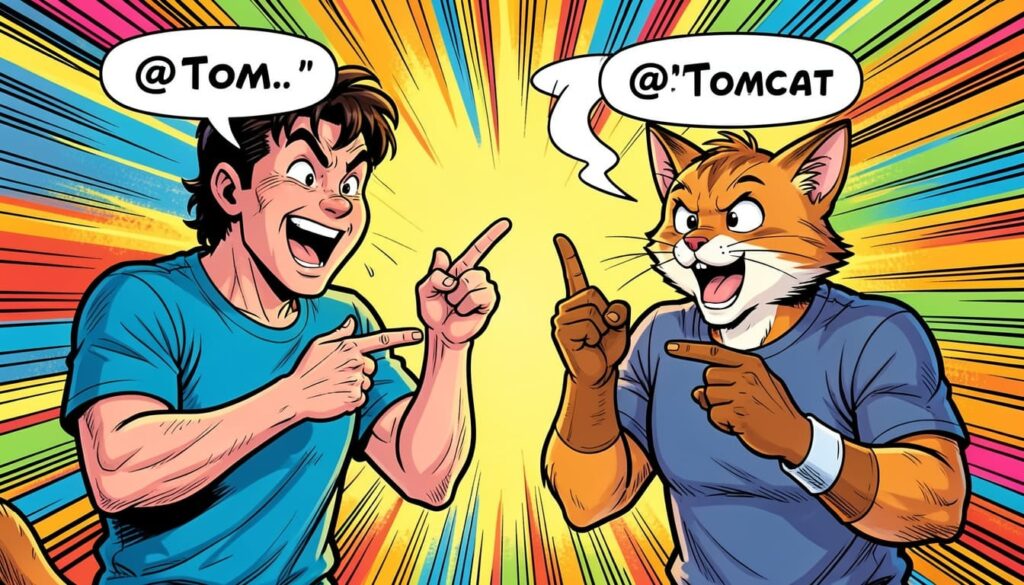
These words are closely connected, but their usage can differ.
| Word | Main Meaning |
|---|---|
| Tom | Male cat |
| Tomcat | Male cat |
| Tom turkey | Male turkey |
| Queen | Female cat |
| Kitten | Young cat |
Tomcat is often clearer when you specifically want to identify a male cat.
For example:
“A tomcat was sleeping under the car.”
The word immediately signals that the cat is male.
Related Slang and Expressions
If you are researching tom slang meaning, you may also encounter these related terms:
Tomcat
A male cat. It can also have an older slang meaning referring to a man who pursues multiple women.
Uncle Tom
A historically derogatory expression referring to a Black person perceived as excessively submissive toward white people.
Tom, Dick, and Harry
An expression meaning ordinary or unspecified people.
Peeping Tom
A person who secretly watches others, particularly in situations where privacy is expected.
Tomfoolery
Playful or foolish behavior.
These expressions show how the name Tom has developed into several English words and idioms over time.
How to Understand “Tom” Correctly
If you encounter tom online and don’t know what it means, use these steps.
Step 1: Look at the surrounding sentence
The words around tom usually provide the strongest clue.
Step 2: Check capitalization
person’s name.
common noun.
an abbreviation.
This isn’t a strict rule, but capitalization can provide useful information.
Step 3: Consider the platform
A dictionary, British television show, TikTok comment, and private text message may use the word differently.
Step 4: Consider the speaker’s location
British slang and American slang can differ significantly.
Step 5: Don’t repeat unfamiliar slang immediately
If a term may be offensive or outdated, understand its meaning before using it.
Is “Tom” Offensive?
The answer depends on which meaning is intended.
Usually neutral
- Tom as a person’s name
- tom as a male cat
- tom turkey
- Tom, Dick, and Harry
Potentially outdated or offensive
- tom meaning a female
- Tom as a shortened form of “Uncle Tom”
The second group should be handled carefully because the expressions carry historical and social baggage.
If you encounter one of these terms in a book, movie, or online discussion, understanding it does not mean you need to use it yourself.
Why Context Matters So Much
Imagine receiving this message:
“I saw a tom outside.”
You might think the person is talking about a male cat.
Now imagine:
“TOM is here again.”
The person might be referring to “time of month.”
Or:
“Tom will be there at eight.”
Now it is clearly someone’s name.
The exact same letters can represent completely different ideas.
This is especially common with short words and abbreviations because texting removes much of the context normally provided by full sentences.
Quick Guide to the “Tom Slang Meaning”
If you need a quick answer, remember this:
Tom can mean:
- A male cat.
- A male turkey or certain other male animals.
- A dated British slang term for a female .
- A derogatory abbreviation connected with “Uncle Tom.”
- “Time of month” in some informal texting contexts.
- A shortened form of Thomas.
- A component of expressions such as “Tom, Dick, and Harry.”
- An informal British shortening of “tomato” in some contexts.
- A historical Cockney rhyming slang term.
The most common everyday meaning is a male cat, while several slang meanings are much more context-specific.
Frequently Asked Questions About Tom Slang Meaning
1. What does “tom” mean in slang?
Tom has several slang meanings. In older British slang, it can mean a female , while in American usage “Tom” can refer to “Uncle Tom” in a derogatory sense. In other contexts, it simply means a male cat or may be an abbreviation.
2. Does “tom” mean a male cat?
Yes. This is the standard dictionary meaning of tom. A tom is a male cat, and tomcat is another common term for one.
3. What does TOM mean in texting?
In some private or informal conversations, TOM can mean “time of month,” referring to menstruation. Some people may also use TOM as shorthand for “tomorrow,” so context is important.
4. Is “tom” a British slang word?
It can be. A dated British slang meaning of tom refers to a female. However, this is not the normal modern meaning of the word and may be considered offensive or outdated.
5. Is “Tom” an offensive word?
Not by itself. Tom is a common first name and tom is a neutral term for a male cat. Certain historical slang meanings, particularly those associated with prostitution or “Uncle Tom,” can be offensive depending on context.
6. What does “Uncle Tom” mean?
“Uncle Tom” is a historically derogatory expression associated with a Black person perceived as excessively submissive toward white authority. Because of its racial history, it should be used with care.
7. Is “tom” popular Gen Z slang?
Not particularly. Unlike highly recognizable Gen Z expressions such as “rizz” or “no cap,” tom is not generally considered a major current Gen Z slang term. Its meaning is usually determined by context, region, or the specific abbreviation being used.
Conclusion
Understanding tom slang meaning can be surprisingly complicated because the word has several completely different meanings. In everyday English, tom most commonly means a male cat, and it can also describe the male of certain other animals.
However, the word has also developed several historical and slang meanings. Older British usage includes tom as a term for a female , while American English has the sensitive expression “Uncle Tom.” In informal texting, TOM may sometimes mean “time of month.”
The best way to understand the word is to look at the context before deciding what it means. Pay attention to capitalization, surrounding words, the speaker’s location, and the platform where you encountered it.
Most importantly, don’t assume that every slang definition you find online represents modern everyday English. Some meanings are regional, dated, or offensive. When in doubt, choose a neutral alternative and use the word according to its intended context.
SEO Meta Description:
Learn the tom slang meaning, including its British, American, texting, historical uses, examples, related terms, and common misconceptions.
Discover More Articles:
- Kitchen Slang Meaning in Text, Chat, TikTok & Social Media
- Furry Slang Meaning: Everything About This Popular Internet Term
- Gig Slang Meaning: What Does “Gig” Mean in Slang?

Hi, I’m Ethan Walker, founder of GrammarNestz. Passionate about language, writing, and clear communication, I help learners and writers improve their grammar skills through practical tips, easy-to-understand guides, and engaging content.