UK slang meaning is something many people search for when they come across unfamiliar words in British movies, TV shows, social media, or everyday conversations. I’ve noticed that some UK slang terms can sound confusing at first because their meanings often differ from standard English.
That’s exactly why I created this guide to make everything simple and easy to understand. Whether you’re chatting with British friends, traveling to the UK, or just curious about popular expressions, knowing these slang words can help you avoid misunderstandings and communicate more naturally. In this article, I’ll explain the meaning of UK slang, where it comes from, and how people use it in real-life conversations with clear examples.
British Slang Insults: Common Words and What They Mean
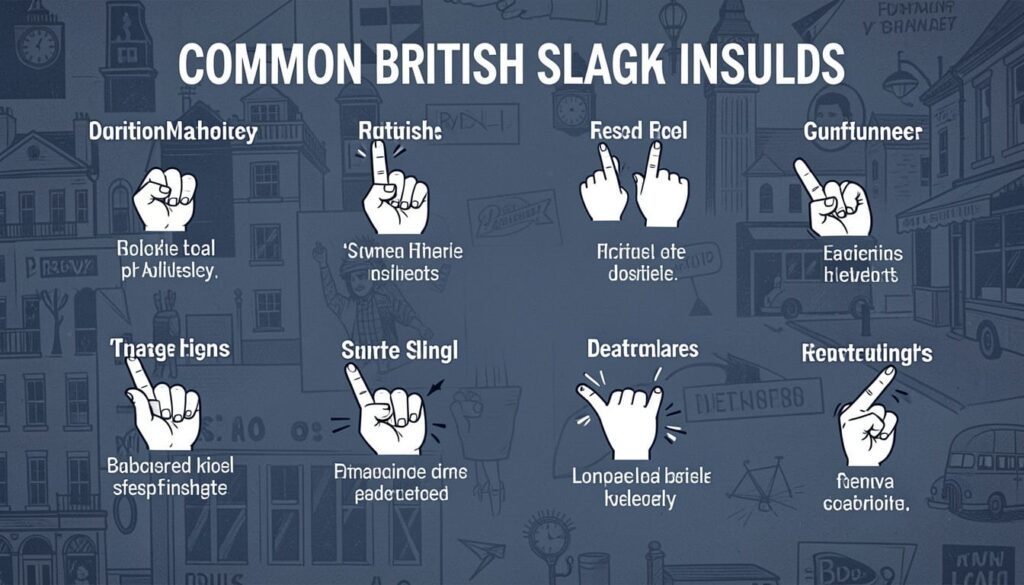
British slang insults are informal words or phrases used to tease, joke with, or sometimes offend someone. Unlike serious insults, many British expressions are used playfully among friends. For example, calling someone a “muppet” means they are acting foolish, while “wally” describes someone who made a silly mistake. Other common insults include “git,” “twit,” “numpty,” and “plonker.”
Understanding these expressions helps you avoid misunderstandings when watching British TV shows, chatting online, or visiting the UK. Always remember that the tone and situation matter. Some slang insults are friendly jokes, while others may be offensive if used with strangers. Learning their meanings makes it easier to recognize when someone is joking or being rude.
UK Slang Words Roadman: Popular Terms You Should Know
Roadman slang is a style of British street slang that became popular in London before spreading across the UK through music, social media, and everyday conversations. Many people search for UK slang meaning in English because roadman vocabulary can sound confusing to non-native speakers.
Some popular roadman slang words include:
- Mandem – A group of male friends.
- Leng – Someone or something very attractive.
- Peng – Extremely good-looking or excellent.
- Bruv – Brother or close friend.
- Safe – Thanks, okay, or goodbye.
- Bare – A lot or very.
- Peak – Unfortunate or disappointing.
- Allow it – Stop doing that or leave it alone.
These expressions are especially common in rap music, TikTok videos, YouTube content, and everyday conversations among young people in the UK.
UK Slang Meaning in English
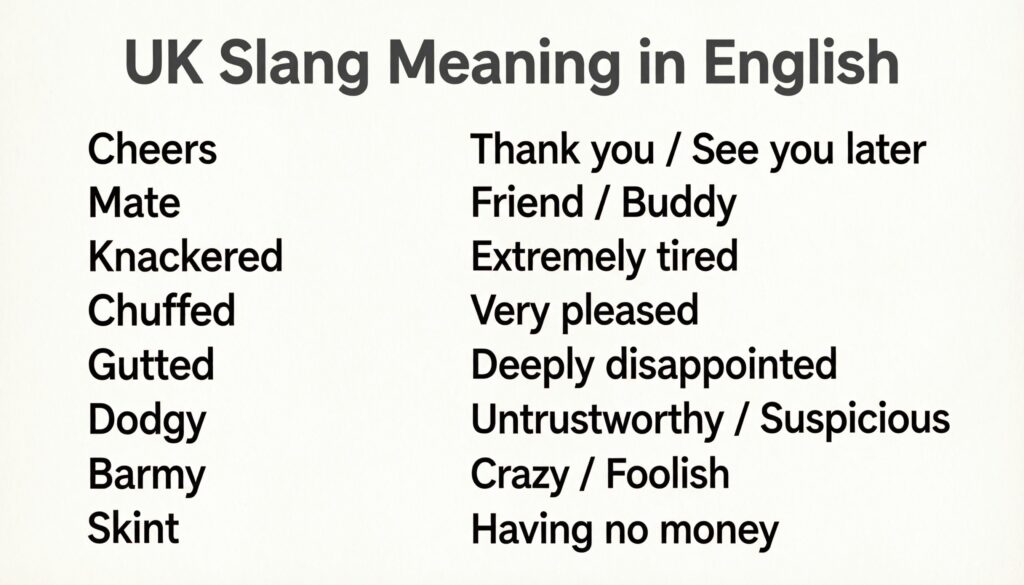
Many UK slang words have meanings that differ from standard English. For example, cheers often means “thank you” instead of simply celebrating with a drink, while knackered means extremely tired. Learning UK slang meaning in English helps you understand conversations, social media posts, movies, and British television more easily.
Although websites like Urban Dictionary may include slang definitions, keep in mind that user-submitted meanings can sometimes be exaggerated or inaccurate. It’s always helpful to compare them with real-life usage and reliable language resources to understand the correct meaning and context.
UK Slang for Girl: Popular British Expressions
British English has several slang words used to refer to a girl or young woman. The meaning often depends on the region and context.
Some common examples include:
- Bird – An informal word for a woman (older slang).
- Lass – Common in Northern England and Scotland.
- Missus – Often refers to someone’s wife or girlfriend.
- Love – A friendly way to address a woman in some parts of England.
- Girlie – A casual and playful term for a girl.
Some expressions may sound outdated or inappropriate in certain situations, so it’s best to understand the context before using them.
British Slang Insults Sentences with Examples
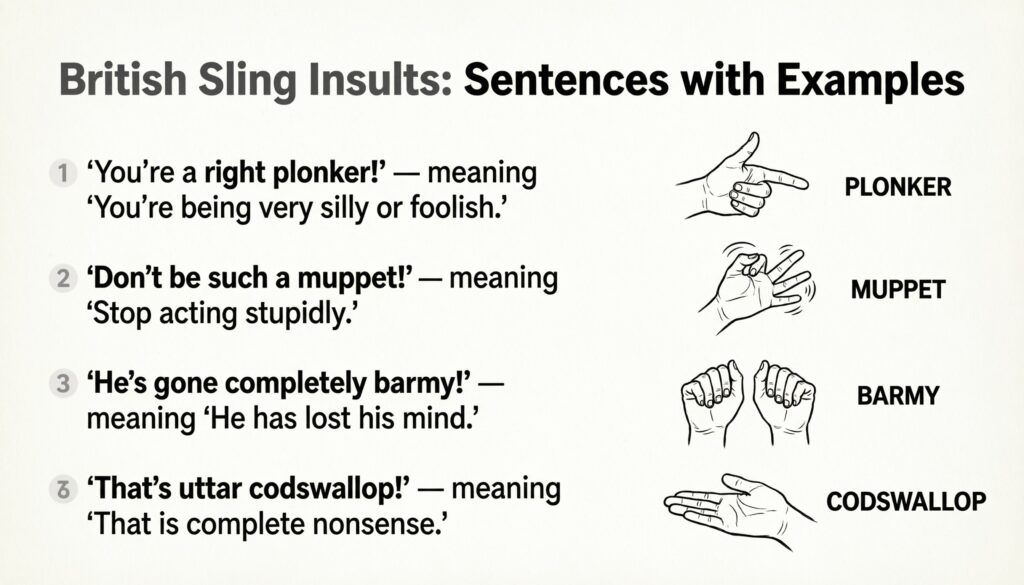
Seeing slang in real conversations makes it much easier to understand.
Examples:
- “Don’t be such a muppet—you forgot your keys again!”
- “You absolute numpty, that’s the wrong train.”
- “Stop acting like a plonker.”
- “He’s a bit of a git, but he’s actually friendly.”
- “Only a twit would do that.”
These example sentences show how British slang insults are commonly used in everyday conversations.
Meaning & Definition Background

The phrase UK slang refers to informal words, expressions, and phrases commonly used by people in the United Kingdom. These terms are not usually found in formal writing but are widely spoken in everyday conversations.
Unlike standard English, slang is casual, creative, and often reflects local culture. British slang includes words that may have entirely different meanings from American English or other English-speaking countries.
For example:
- Mate – Friend
- Cheers – Thank you or goodbye
- Knackered – Extremely tired
- Gobsmacked – Very surprised
- Brilliant – Excellent
- Chuffed – Very pleased
- Dodgy – Suspicious or unreliable
- Bloke – Man
- Lad – Young man
- Fancy – Like or be attracted to
People often search for UK slang meaning after hearing unfamiliar expressions in British television shows, YouTube videos, football interviews, podcasts, or online discussions.
It’s important to remember that not every British person uses the same slang. Expressions vary depending on region, age, and social group.
Background
British slang has evolved over hundreds of years. Many expressions originated from London’s streets, regional dialects, working-class communities, military language, and immigrant cultures.
Modern UK slang has been influenced by:
- Cockney rhyming slang
- Scottish and Irish expressions
- Caribbean English
- South Asian communities
- African communities
- Internet culture
- Music genres like grime and UK rap
As social media grew, British slang spread worldwide. Platforms such as TikTok, Instagram, Snapchat, and YouTube introduced millions of users to expressions they had never heard before.
Popular creators, footballers, musicians, and streamers have helped many UK slang words become globally recognized.
Because language constantly evolves, new slang appears every year while older expressions gradually disappear.
Usage in Different Contexts
The meaning of UK slang depends heavily on the situation.
Everyday Conversation
Friends commonly use informal expressions to sound relaxed and natural.
Example:
“You alright, mate?”
Here, the speaker is simply greeting someone.
Online Gaming
Gamers often combine UK slang with gaming terminology.
Example:
“That match was proper mental.”
This means the game was extremely exciting or chaotic.
Schools and Universities
Students frequently use modern slang among classmates but avoid it in academic writing.
Example:
“That exam was brutal.”
Workplace
Most professional environments prefer formal English.
Instead of saying:
“That’s dodgy.”
People might say:
“That seems questionable.”
However, casual conversations between coworkers may still include common British slang.
Meaning in Chat, WhatsApp, Instagram, and TikTok
Social media has dramatically increased the popularity of UK slang.
On messaging platforms, people often shorten sentences using informal language.
Examples include:
- “Safe” = Thanks or okay
- “Peak” = Unfortunate
- “Peng” = Attractive
- “Leng” = Very attractive
- “Bare” = A lot of
- “Bruv” = Brother or close friend
Example WhatsApp message:
“Cheers mate.”
Meaning:
Thanks, friend.
On Instagram captions:
“Proper buzzing.”
Meaning:
Very excited.
On TikTok:
Creators often use British slang to make videos feel authentic and humorous.
International audiences frequently search for these expressions after seeing them in viral videos.
Meaning in Physics, Medical, and Aircraft Terminology
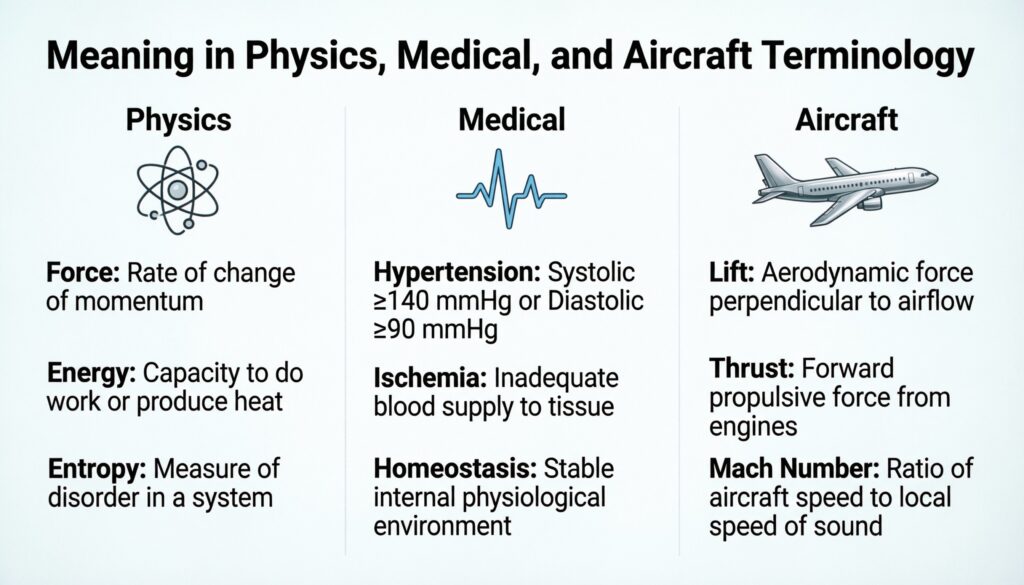
If most people search for UK slang meaning in relation to British English, the abbreviation UK can also appear in technical fields.
Physics
In physics, “UK” usually refers to the United Kingdom when discussing research institutions, universities, scientific publications, or laboratories. It is not a scientific unit or formula.
Medical
In healthcare, UK commonly identifies:
- United Kingdom healthcare guidelines
- UK clinical studies
- UK medical organizations
- UK health regulations
It is not considered a standard medical abbreviation for a disease or treatment.
Aircraft
Within aviation, UK generally represents:
- United Kingdom registration
- UK aviation authority references
- UK airports
- UK airspace regulations
Its meaning depends entirely on the surrounding context.
Common Misconceptions
Several misunderstandings exist about UK slang.
Misconception 1
All British people speak the same way.
Reality:
Slang differs across England, Scotland, Wales, and Northern Ireland.
Misconception 2
British slang is always rude.
Reality:
Most expressions are friendly and harmless.
Misconception 3
Every UK slang word is understood worldwide.
Reality:
Many expressions confuse even native English speakers from other countries.
Misconception 4
Slang belongs in professional writing.
Reality:
Formal communication generally avoids slang unless appropriate for the audience.
Similar Terms & Alternatives
Depending on context, people may use:
- British slang
- British expressions
- UK expressions
- British idioms
- Informal British English
- Colloquial British English
- Regional British phrases
- British street language
Although these phrases overlap, they are not always identical.
For example, idioms usually have fixed meanings, while slang changes frequently.
How to Respond to It
If someone uses UK slang that you don’t understand, don’t worry.
You can politely respond by asking:
- “What does that mean?”
- “I’m not familiar with that expression.”
- “Could you explain that?”
- “Is that British slang?”
If you recognize the meaning, simply reply naturally.
Example:
Person:
“Cheers!”
Response:
“You’re welcome!”
Or:
“No problem!”
Learning slang gradually through conversations, movies, and social media is one of the easiest ways to become comfortable with it.
Differences from Similar Words
| Term | Meaning |
| UK Slang | Informal expressions used in the United Kingdom |
| British English | Standard English spoken in Britain |
| Idiom | Fixed phrase with a figurative meaning |
| Colloquial English | Casual spoken language |
| Dialect | Regional variation of a language |
| Accent | Pronunciation style rather than vocabulary |
Understanding these differences helps avoid confusing slang with grammar or pronunciation.
Relevance in Online Conversations & Dating Apps
UK slang has become increasingly common on dating apps and social platforms.
Someone may say:
- “Fancy grabbing coffee?”
- “You’re lovely.”
- “You seem sound.”
- “You’re proper funny.”
These expressions often make conversations sound warmer and more natural.
However, if you’re speaking with people from other countries, remember that not everyone understands British slang. Using simple language is usually the safest approach when communicating internationally.
As online communities continue to connect people worldwide, familiarity with UK slang can improve conversations, reduce misunderstandings, and help users better understand British culture.
FAQ
- What does UK slang mean?
UK slang refers to informal words and expressions commonly used in the United Kingdom during everyday conversations. - Is UK slang different from American slang?
Yes. Many British slang words have different meanings or are not used in American English. - Where is UK slang most commonly used?
It is widely used in conversations, social media, television, music, gaming, and messaging apps like WhatsApp. - Can UK slang be used in professional writing?
Generally, no. Formal documents usually use standard English instead of slang. - Why do people search for UK slang meaning?
Many people encounter unfamiliar British expressions in movies, online videos, social media, or chats and want to understand their meanings.
Conclusion
Understanding UK slang meaning makes it easier to communicate with British speakers and enjoy online content without confusion. British slang is an important part of everyday life in the United Kingdom, reflecting the country’s culture, humor, and regional diversity. While many expressions are casual and friendly, their meanings often depend on context, making it helpful to learn them gradually.
Whether you encounter UK slang in WhatsApp messages, TikTok videos, Instagram captions, television shows, or face-to-face conversations, recognizing these expressions can improve your language skills and confidence. Remember that slang constantly evolves, so staying curious and paying attention to context is the best way to keep learning. With a basic understanding of common British expressions, you’ll be better prepared to interpret conversations naturally and communicate more effectively with English speakers from the UK.
Discover More Articles:
- Everything About Paisa Slang Meaning in One Simple Guide
- Kiwi Slang Meaning Guide: Definition, Examples & FAQs
- Greek Slang Meaning : Save This Before Your Greece Trip (2026)

Emily Thompson is an English language educator and grammar writer at grammarnestz.com. She specializes in grammar rules, vocabulary development, writing skills, and language-learning resources for students and professionals.